
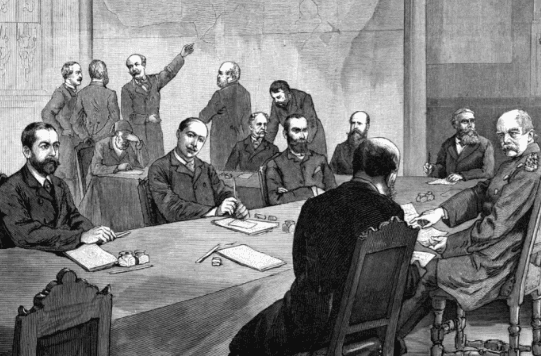
Berlin Conference of 1884–85: Key Provisions, Causes and Impact on Africa
Context: November 15, 2026 marks the 142nd anniversary of the Berlin West Africa Conference (1884–85), convened by German Chancellor Otto von Bismarck to regulate European colonial competition in Africa.

About Berlin Conference of 1884–85: Key Provisions, Causes and Impact on Africa
What It Was?
- A multilateral diplomatic summit held in Berlin from November 15, 1884, to February 26, 1885, culminating in the General Act of Berlin, which institutionalized the legal and diplomatic framework for European imperialism in Africa.
Participating Powers: Attended by 14 Western nations—including Great Britain, France, Germany, Portugal, Belgium, Spain, the Netherlands, Italy, Russia, Austria-Hungary, Denmark, Sweden-Norway, the Ottoman Empire (Turkey), and the United States (which signed but did not ratify the Act)—with zero African participation.
Why European Powers Convened the Conference?
- Countering British Informal Hegemony: German Chancellor Otto von Bismarck and French Foreign Minister Jules Ferry sought diplomatic alignment to check British imperial dominance following Britain’s occupation of Egypt (1882) and obstruction of German claims in Cameroon and Southwest Africa (Angra Pequena).
- Blocking the Anglo-Portuguese Treaty (1883): Rival European powers objected to an Anglo-Portuguese agreement recognizing Portuguese sovereignty over the mouth of the Congo River, which threatened to shut other commercial powers out of Central Africa’s interior.
- Regulating King Leopold II’s Congo Ambitions: Belgian King Leopold II’s Association Internationale du Congo (AIC) had aggressively acquired treaties across Central Africa, prompting demands for international recognition and neutral trade rules.
- Preventing Intra-European Armed Conflict: With France ratifying the Brazza-Makoko treaty (1882) and Germany proclaiming protectorates over Togoland and Cameroon in July 1884, European powers sought codified rules to avoid direct wars over African territories.
Key Provisions of the General Act of Berlin:
- Principle of “Effective Occupation”: Required any European power claiming coastal African territory to formally notify other signatories and establish actual administrative, military, and judicial authority on the ground rather than relying on nominal claims.
- Free Trade in the Conventional Basin of the Congo: Declared a vast region of Central Africa—spanning the Congo River basin and extending to the Indian Ocean—a free-trade zone open to merchants of all nations without discriminatory tariffs.
- Free Navigation on Major Rivers: Applied the Congress of Vienna (1814–15) principles of international river navigation to both the Congo and Niger rivers, ensuring unobstructed commercial transit.
- Neutrality of the Congo Basin: Obligated signatory powers to respect the neutrality of the Congo basin during European wars, treating it as a non-belligerent territory.
- Suppression of the Overland Slave Trade: Committed colonial powers to curbing slavery and the slave trade across interior territories while nominally pledging to protect indigenous populations.
Historical Debate: Did Berlin Conference Partition Africa?
- No Formal Map-Drawing at Berlin: The General Act did not explicitly carve up the African map or assign specific colonies to individual powers (aside from recognizing Leopold II’s claims over the Congo Free State), nor did the Act formally survive beyond 1919.
- Catalyst for the Scramble for Africa: By codifying the “Effective Occupation” rule, the conference triggered a frantic race among European powers to sign treaties with local rulers and deploy troops inland to validate claims.
- Dramatic Territorial Transformation: Before 1884, European control was largely confined to coastal enclaves (such as Algeria, Senegal, Gold Coast, Angola, Mozambique, and Cape Colony); by 1913, European states had colonized nearly all of Africa’s 12 million square miles, leaving only Ethiopia and Liberia independent.
Long-Term Legacy & Impact on Africa:
- Arbitrary Borders Dividing Communities: Subsequent bilateral boundary treaties drew straight geometric borders across longitudes and latitudes, splitting cohesive ethnic, linguistic, and cultural groups across rival colonial jurisdictions.
- Extractive Resource Economies: Institutionalized infrastructure (railways and ports) oriented solely toward extracting raw minerals and cash crops from the interior to European markets rather than fostering intra-African trade.
- Brutal Colonial Exploitation: Enabled systemic abuses—most notoriously under King Leopold II’s personal rule in the Congo Free State—under the guise of humanitarianism and free commerce.
- Post-Independence Geopolitical Fragility: Left newly independent African states in the mid-20th century with contested borders, secessionist movements, and structural governance challenges that persist today.
Conclusion:
While the Berlin Conference of 1884–85 did not physically draw the borders of modern Africa at the negotiating table, it legitimized colonial conquest by turning “effective occupation” into international law. By prioritizing European diplomatic stability and free-trade access over African sovereignty, the General Act accelerated the wholesale partition of the continent within three decades. Its enduring legacy of arbitrary borders and extractive institutions continues to shape Africa’s political and economic landscape today.
The Scramble for Africa was less about civilization and more about exploitation.’ Discuss the motives behind European colonisation of Africa and its long-term impacts.



