

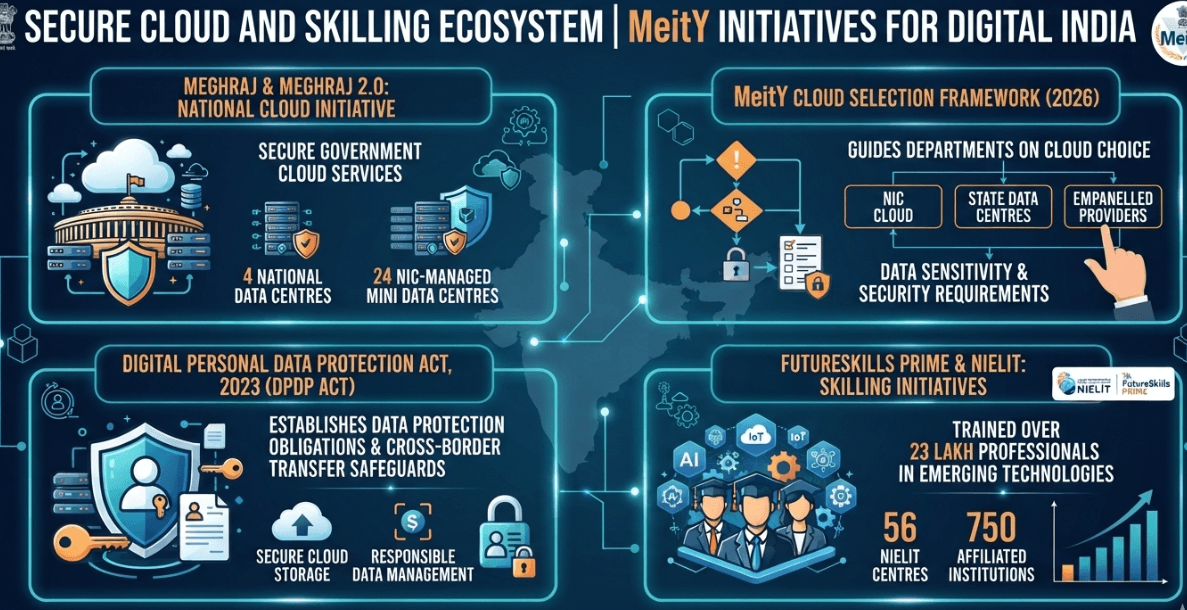
Cloud Ecosystem in India
Context: The Ministry of Electronics and Information Technology (MeitY) highlighted the expansion of India’s domestic cloud ecosystem, driven by national data sovereignty imperatives and rising data consumption.
About Cloud Ecosystem in India:
What It Is?
- Cloud computing is the on-demand delivery of computing resources—including data storage, servers, databases, networking, and software—over the internet on a pay-as-you-go basis. Instead of investing in and managing physical on-premises servers, organizations rent infrastructure and software capabilities dynamically.
Core Service Delivery Models (The Cloud Stack):
- Infrastructure as a Service (IaaS): On-demand provisioning of fundamental compute power, storage, and networking resources (e.g., virtual machines and block storage).
- Platform as a Service (PaaS): Cloud-hosted development environments, operating systems, and database tools that enable developers to build, test, and deploy applications without managing underlying hardware.
- Software as a Service (SaaS): Ready-to-use software applications hosted centrally and delivered over the web.
- Serverless Computing: Event-driven execution where the cloud vendor automatically manages machine resource allocation and scaling, freeing developers to write code without maintaining persistent server instances.
Deployment Architectures:
- Public Cloud: Multi-tenant infrastructure managed by commercial third-party providers and shared across multiple customer organizations.
- Private Cloud: Dedicated computing infrastructure provisioned for exclusive use by a single organization to maximize security and access control.
- Hybrid Cloud: An integrated deployment combining public and private cloud environments, allowing data and applications to be shared across them based on sensitivity, performance, and cost requirements.
Key Data & Stats on India’s Cloud Ecosystem:
- Surging Internet and Data Usage: India reached 1,092.79 million internet subscribers by March 2026, with monthly usage averaging 25.51 GB and annual wireless traffic reaching 285,376 petabytes.
- Data Centre Capacity Expansion: India’s operational capacity reached 1.57 GW in August 2026, projected to grow to nearly 8 GW by 2030 across major technology hubs.
- Massive Capital Investments: The data centre sector has attracted approximately $70 billion in ongoing investments, alongside $90 billion in announced infrastructure projects.
- Empanelled Cloud Service Providers: MeitY has empanelled 30 CSPs, including Jio, TCS, BSNL, AWS, Google Cloud and Microsoft, strengthening India’s cloud ecosystem.
- Skilled Developer Ecosystem: India has approximately 2.25 million cloud-native developers, with 44% adopting hybrid cloud architectures, according to CNCF 2026.
- National AI Computing Infrastructure: Under the ₹10,371.92 crore IndiaAI Mission, over 45,000 GPUs are being onboarded to expand affordable AI computing access.
Strategic Importance of a Domestic Cloud Ecosystem:
- Data Sovereignty and Jurisdictional Control: Keeps sensitive national datasets, intellectual property, and citizen information within Indian territory, insulating critical public functions from extraterritorial surveillance and foreign legal interventions.
- Elasticity and Scalability for Public Service Delivery: Allows digital public portals to dynamically absorb massive spikes in user traffic during nationwide registrations without service disruptions.
- Optimizing Public ICT Capital Expenditure: Replaces costly, fragmented state procurement of localized physical server rooms with centralized, multi-tenant government cloud hosting.
- Business Continuity and Disaster Recovery: Automates geo-redundant backups across distributed data centers, ensuring quick failover during operational blackouts, cyberattacks, or extreme weather events.

Challenges Associated with Cloud Adoption:
- Vendor Lock-in and Proprietary Systems: Dependence on vendor-specific APIs and databases restricts cloud portability, increasing migration costs, technical complexity and reliance on dominant providers.
E.g., Government agencies shifting between AWS, Azure or Google Cloud may face substantial data transfer charges, application redesign costs and operational disruptions.
- Energy Consumption and Grid Pressures: Rapid expansion of hyperscale data centres increases electricity and cooling demands, straining local power grids, freshwater resources and environmental sustainability.
E.g., Data centre clusters in Mumbai and Chennai require high-capacity electrical substations and continuous cooling infrastructure, intensifying urban resource pressures.
- Third-Party Cybersecurity Vulnerabilities: Dependence on external cloud vendors and contractors increases risks of credential theft, software misconfigurations and supply-chain attacks, threatening sensitive government information.
E.g., Compromised credentials of third-party IT contractors could expose confidential government databases, critical infrastructure records and sensitive operational information.
- Geographical Concentration of Data Centres: Concentration in Mumbai, Chennai and Delhi-NCR creates regional infrastructure imbalances, increasing network latency and vulnerability to localised service disruptions.
E.g., Inland regions rely on long-distance fibre networks connecting coastal data hubs, increasing dependence on limited connectivity routes and infrastructure resilience.
Way Ahead:
- Accelerate Edge Data Center Deployment: Incentivize the development of Tier-II and Tier-III mini and edge data centers across central and north-eastern states to balance regional loads and cut latency for real-time services.
- Mandate Open Cloud Interoperability Standards: Enforce open API protocols and containerized application architectures (such as Kubernetes-based deployments) across all government cloud contracts to eliminate vendor lock-in.
- Integrate Data Centers with Renewable Micro-Grids: Pair hyperscale data center parks with dedicated solar, wind, and pumped storage hydropower installations under green open-access rules to maintain carbon-neutral computing.
- Implement Strict Zero-Trust Cloud Architecture: Mandate zero-trust identity verification, granular micro-segmentation, and end-to-end data encryption across both data-at-rest and data-in-transit for all empanelled CSPs.
- Deepen Domestic Semiconductor and Server Hardware Manufacturing: Expand the India Semiconductor Mission and hardware PLI schemes to manufacture indigenous enterprise server boards, storage drives, and AI accelerator chips locally.
Conclusion:
While initiatives like MeghRaj 2.0 and the rapid expansion of domestic data centers have bolstered data sovereignty and service delivery, long-term resilience requires addressing vendor lock-in, infrastructure concentration, and high energy demands. By pairing zero-trust security architectures with green, distributed edge data centers, India can establish the digital foundation necessary to achieve the goals of Viksit Bharat 2047.



