

Disinvestment as an Economic Strategy
Context: The Union Government’s approval of the strategic stake sale in IDBI Bank, has positioned the Centre to exceed its full-year disinvestment and asset monetisation target of ₹80,000 crore.

About Disinvestment as an Economic Strategy:
What is Disinvestment?
- Disinvestment refers to the dilution or sale of the government’s equity stake in Public Sector Enterprises (PSEs) and state-owned financial institutions to mobilize non-debt capital receipts, optimize asset utilization, and improve corporate governance through market discipline.
Types of Disinvestments:
- Minority Disinvestment: The government retains majority ownership ( greater than 51%) and operational control while selling a portion of its equity via methods such as Initial Public Offerings (IPOs) or Offers for Sale (OFS).
- Majority Disinvestment: The government sells a controlling stake while retaining a minority shareholding, stepping down from active daily administration.
- Strategic Disinvestment / Privatisation: The sale of 50% or more of state shareholding along with the definitive transfer of management control to a strategic private buyer.
- Asset Monetisation: Unlocking the value of operational public assets through structured long-term leasing, concession frameworks, or trusts (InvITs/REITs) without an outright sale of primary state ownership.
Data / Stats on Disinvestment in India:
- H1 FY27 Revenue Mobilisation: The Centre raised ₹62,124 crore through disinvestment and asset monetisation during April–September 2026, including ₹55,757 crore from equity disinvestment.
- Progress Towards Budget Target: Disinvestment proceeds reached 78% of the ₹80,000 crore FY27 target even before IDBI Bank receipts, indicating potential target overachievement.
- Fiscal Pressures and Capital Expenditure: Despite modest tax (3.4%) and non-tax revenue (3.2%) growth, capital expenditure rose over 18%, with the fiscal deficit reaching 42% of Budget Estimates.
- National Monetisation Pipeline 2.0: Targets ₹16.72 lakh crore during FY26–FY30, building on the 90% achievement of NMP Phase 1 targets to unlock infrastructure asset value.
Disinvestment as a Key Economic Strategy:
- Fiscal Consolidation Without Debt: Provides vital non-debt capital receipts to finance public capital expenditure, preventing fiscal slippage and avoiding crowded-out private debt markets.
E.g., Channeling proceeds from the IDBI Bank sale directly into modern transport logistics and energy infrastructure while keeping borrowing spreads anchored.
- Enhancing Operational Efficiency & Corporate Governance: Exposing state firms to private managerial expertise, autonomous boards, and public market accountability improves productivity and profitability.
E.g., Modernization and fleet expansion of Air India under Tata Group management following its 2022 strategic sale.
- Operationalizing the 2021 PSE Policy: Aligns state activity with the New PSE Policy doctrine of a bare minimum presence of state-owned firms in strategic sectors, with exit or consolidation elsewhere.
E.g., Reducing public footprint in the financial services sector through the strategic disinvestment of IDBI Bank to institutional investors.
- Democratizing Retail Equity Ownership: Broadens capital market participation by issuing public listings that distribute corporate ownership among retail citizens and policyholders.
E.g., The 2022 Life Insurance Corporation (LIC) IPO drawing millions of first-time retail demat account holders into India’s capital markets.
- Unlocking Dormant Public Capital via Monetisation: Re-invests capital from mature roads, transmission lines, and pipelines into new greenfield projects via the National Monetisation Pipeline.
E.g., National Highways Infra Trust (NHAI InvIT) monetizing operational highway toll stretches to fund ongoing Bharatmala expressways.
Challenges to Disinvestment in India:
- Complex Valuation & Price Discovery in Volatile Markets: Fluctuations in market conditions complicate equity valuations, increasing the risk of political scrutiny over alleged asset undervaluation.
E.g., Protracted delays in timing large-scale secondary offerings for state-run oil marketing companies and public insurers due to commodity swings.
- Employee Union Resistance & Social Security Fears: Trade unions frequently oppose privatization due to concerns regarding job security, pension benefits, and affirmative action/reservation quotas.
E.g., Banking and insurance employee unions staging nationwide strikes and wearing black badges in protest against the IDBI Bank stake sale.
- Strict Fit-and-Proper Regulatory Filters: Stringent multi-agency security clearances and central banking regulations can narrow the field of prospective global buyers.
E.g., The lengthy multi-year RBI fit-and-proper due-diligence scrutiny required before clearing bids for strategic banking acquisitions.
- Legacy Liabilities and Asset Separation Hurdles: Disentangling non-core real estate, historical tax claims, and bad loan portfolios from public entities delays transaction timelines.
E.g., The creation of special purpose vehicles (SPVs) to park non-core real estate debt for Air India (AIAHL) before closing its sale.
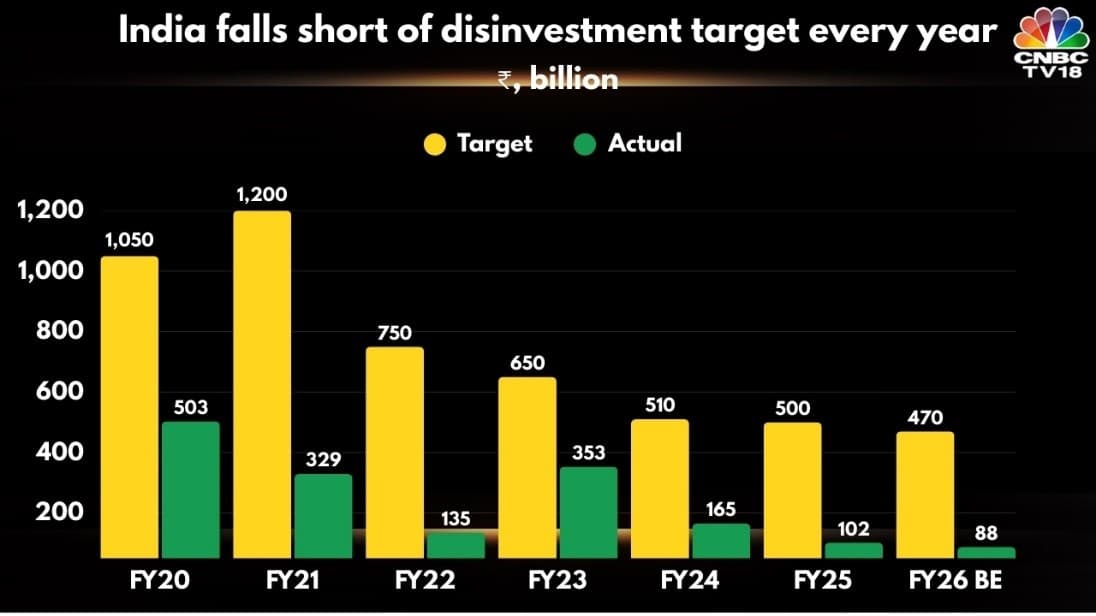
- Over-Reliance on Single Big-Ticket Transactions: Fiscal targets often depend disproportionately on single mega-deals rather than a regular, predictable stream of transactions.
E.g., Disinvestment receipts falling short in FY23 (₹30,184 crore against ₹65,000 crore) and FY24 (₹15,220 crore) when major planned sales stalled.
Way Ahead:
- Transition to a Demand-Based Investor Approach: Move away from purely government-driven schedules to a market-responsive model that prioritizes enterprises drawing strong private equity and institutional bids.
- Implement a Rolling Three-Year Disinvestment Pipeline: Establish a rolling 3-year divestment calendar to give prospective investors sufficient time for due diligence, improving price discovery and bidding participation.
- Execute Calibrated Stake Reductions to 51%: Bring state holdings down to 51% across listed Central Public Sector Enterprises (CPSEs) as an interim step, unlocking roughly ₹9 lakh crore while retaining public ownership control.
- Establish an Autonomous Strategic Asset Board: Set up a dedicated, empowered body comprising ministerial boards and industry experts to expedite legal clearances and manage bidding timelines.
- Safeguard Labor Transition and Social Contracts: Introduce clear social security frameworks, voluntary retirement packages, and transitional skilling programs to build consensus among workforce unions.
Conclusion:
The strategic sale of IDBI Bank and the mobilization of over ₹62,000 crore demonstrate that disinvestment is evolving beyond a routine fiscal gap-filler into an engine of structural reform. Shifting to a demand-driven, calibrated disinvestment model will be crucial to unlocking dormant capital while preserving fiscal consolidation. By pairing transparent price discovery with regulatory predictability, India can boost private investment and sustainably fund long-term infrastructure.
Examine why disinvestment is necessary? Analyze whether there is a need to relook at the policy of disinvestment?(250 words)



