
Forest Rights Act (FRA), 2006: Key Provisions and Analysis
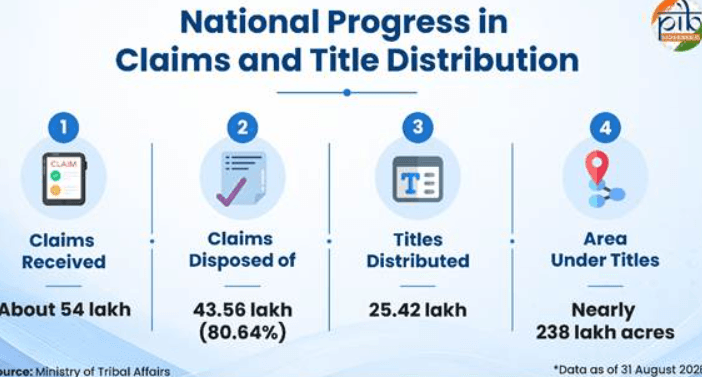
Context: The Ministry of Tribal Affairs launched the National FRA Digital Platform during Janjatiya Gaurav Pakhwada 2026 to digitise Forest Rights Act claims and title issuance. As of August 2026, 25.42 lakh titles covering 238 lakh acres had been distributed nationwide.
About Forest Rights Act (FRA), 2006: Key Provisions and Analysis
What It Is?
- Officially titled the Scheduled Tribes and Other Traditional Forest Dwellers (Recognition of Forest Rights) Act, 2006 (enacted in December 2006, enforced on December 31, 2007), it is a landmark legislation designed to undo historical injustices by legally recognizing the ancestral land tenure, livelihood, and conservation rights of forest-dwelling communities.
Nodal: The Ministry of Tribal Affairs (MoTA) serves as the nodal agency.
Eligible Beneficiaries:
- Forest-Dwelling Scheduled Tribes (FDST): ST members primarily residing in and depending on forests for bona fide livelihood needs prior to December 13, 2005.
- Other Traditional Forest Dwellers (OTFD): Communities primarily residing in and depending on forest land for at least three generations (75 years) prior to December 13, 2005.
Key Provisions & Types of Rights under FRA:
- Individual Forest Rights (IFR): Grants inheritable land titles for self-cultivation and habitation up to 4 hectares per family, registered jointly in the names of both spouses.
- Community Forest Rights (CFR): Recognizes collective village rights over common grazing grounds, water bodies, fishing areas, and ownership/collection/disposal of Minor Forest Produce (MFP) such as bamboo, honey, and medicinal plants.
- Community Forest Resource (CFRr) Rights: Empowers the Gram Sabha to protect, regenerate, conserve, and sustainably manage traditional forest ecosystems within its customary boundary.
- Habitat Rights for PVTGs: Protects the customary habitat and socio-cultural territory of Particularly Vulnerable Tribal Groups (PVTGs) even inside reserved/protected forests—so far granted to 11 PVTGs across Odisha, Chhattisgarh, and Madhya Pradesh.
- Diversion for Public Utility Facilities: Permits diversion of up to 1 hectare of forest land per project for basic village amenities upon Gram Sabha recommendation.
Three-Tier Claims Verification Process:
- Gram Sabha (Initiating Authority): Elects a 10–15 member Forest Rights Committee (minimum two-thirds ST and one-third women) to receive, verify, and map claims before passing a resolution.
- Sub-Divisional Level Committee (SDLC): Examines Gram Sabha resolutions, hears appeals within 60 days, and prepares the draft Record of Forest Rights.
- District Level Committee (DLC): Chaired by the District Collector with Revenue, Forest, Tribal Affairs, and Panchayati Raj representatives; issues the final, binding decision and digitally/jointly signed title
Progress & Key Recent Initiatives:
- Title Distribution (August 2026): Of 54 lakh FRA claims, 43.56 lakh were disposed of, with 25.42 lakh titles covering 238 lakh acres, led by Chhattisgarh, Odisha and Madhya Pradesh.
- National FRA Digital Platform (2026): Enables end-to-end digitisation of Gram Sabha claims, GIS-based boundary mapping, committee monitoring and digitally signed forest rights titles.
- Dharti Aaba Janjatiya Gram Utkarsh Abhiyan (DA-JGUA): Supports State and district FRA cells, provides ₹25 lakh per State for forest mapping and ₹15 lakh per Gram Sabha for community forest management plans.
- Revenue Record Integration & Welfare Convergence:
-
- Maharashtra: Introduced Village Forms 7E and 12E to link forest rights titles with crop loans, Kisan Credit Cards and PM-KISAN benefits.
- Andhra Pradesh & Telangana: Integrated Giribhumi and BhuBharathi FRA portals with revenue and banking databases to improve land records and financial access.

Challenges in Implementation:
- Unjustified Claim Rejections: Many FRA claims face arbitrary rejection without reasoned orders, denying claimants transparency and effective appeal opportunities.
E.g., OTFDs face rejection due to stringent demands for 75-year documentary residence proof.
- Delayed Revenue Record Updates: Failure to promptly update land and forest records after title distribution restricts access to institutional credit and agricultural welfare schemes.
E.g., IFR holders struggle to obtain Kisan Credit Cards and crop insurance without proper revenue entries.
- Underutilisation of Community Forest Rights: Community titles constitute less than 5% of distributed titles, reflecting inadequate recognition of Gram Sabha-led Forest governance.
E.g., Conflicts arise between Gram Sabha Forest management committees and Forest Department working plans.
- Protected Area Conflicts: Unresolved Forest rights within Tiger Reserves and National Parks expose communities to relocation pressures despite safeguards under Section 4(5).
Way Ahead:
- Enforce Mandatory Review of Rejected Claims: Mandate time-bound suo motu review of all rejected claims by SDLCs and DLCs, ensuring every rejection is accompanied by a written, reasoned order delivered to the claimant.
- Universalize Automated Revenue Record Mutation: Replicate the Maharashtra and Andhra Pradesh (Giribhumi) models nationwide via the National FRA Digital Platform so title issuance automatically updates land records.
- Accelerate Community Forest Resource (CFRr) & PVTG Habitat Campaigns: Deploy DA-JGUA funds and State FRA cells in mission mode to map customary village boundaries and recognize collective CFRr and PVTG habitat rights.
- Strengthen Gram Sabha Capacity & Inter-Ministerial Synergy: Scale up legal literacy camps, iGOT Karmayogi training for field officials, and joint MoTA–MoEFCC monitoring to align village conservation plans with ecological restoration goals.
Conclusion:
The Forest Rights Act has enabled distribution of 25.42 lakh titles covering nearly 238 lakh acres. Strengthening community rights, transparent claim processing and welfare convergence remains essential for tribal empowerment and sustainable forest conservation.
Evaluate the implementation of the Forest Rights Act (FRA), 2006 in India. Examine the legal and administrative hurdles faced in its enforcement. Suggest institutional reforms to strengthen the recognition of Community Forest Resource (CFR) rights.



