Today, we are breaking down the Right to Equality (Articles 14-18) and the Right to Freedom (Article 19). Let's look at the exact constitutional phrasing alongside real-world examples to make these concepts stick.
Fundamental Rights: The rights that are enshrined in Part III (Article 12-35) of the Constitution are referred to as "Fundamental Rights”. They are also referred to as the “Magna Carta of Indian Constitution".
मौलिक अधिकार: वे अधिकार जो संविधान के भाग III (अनुच्छेद 12-35) में निहित हैं, उन्हें "मौलिक अधिकार" कहा जाता है। इन्हें "भारतीय संविधान का मैग्ना कार्टा" भी कहा जाता है।

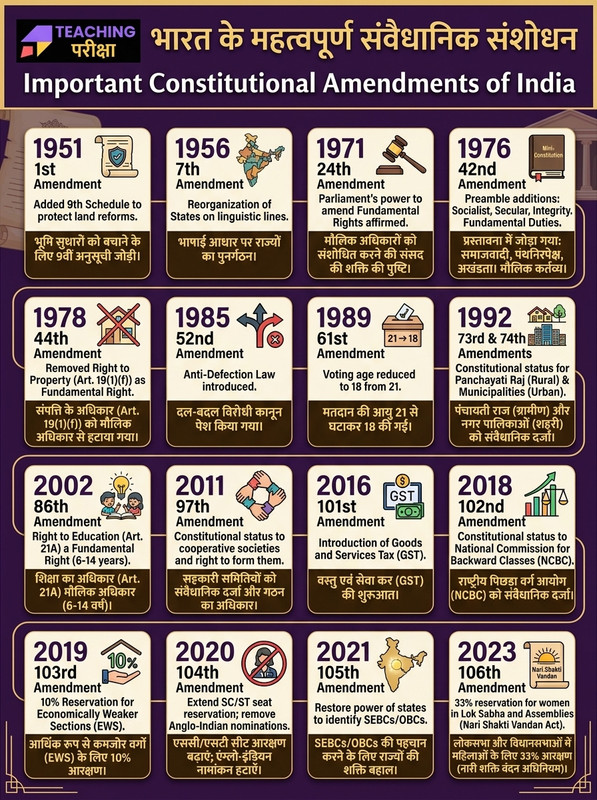
Timeline of Important Constitutional Amendments in India
1st Amendment Act
1951
It added the 9th Schedule to protect land reform laws from judicial review. इसने भूमि सुधार कानूनों को न्यायिक समीक्षा से बचाने के लिए 9वीं अनुसूची जोड़ी।
It introduced reasonable restrictions on freedom of speech, including "public order" and "friendly relations with foreign states" इसने बोलने की आज़ादी पर उचित पाबंदियाँ लगाईं, जिनमें "सार्वजनिक व्यवस्था" और "विदेशी राज्यों के साथ मैत्रीपूर्ण संबंध" शामिल थे।
7th Amendment Act
1956
Reorganized states on a linguistic basis. Abolished Part A, B, C and D state classification and created 14 states and 6 union territories. राज्यों का भाषाई आधार पर पुनर्गठन किया गया। भाग A, B, C और D राज्यों के वर्गीकरण को समाप्त कर दिया गया, और 14 राज्य तथा 6 केंद्र शासित प्रदेश बनाए गए।
24th Constitutional Amendment Act
1971
It affirmed the power of Parliament to amend any part of the Constitution, including Fundamental Rights. इसने संविधान के किसी भी भाग, जिसमें मौलिक अधिकार भी शामिल हैं, में संशोधन करने की संसद की शक्ति की पुष्टि की।
It made it mandatory for the President to give assent to a Constitutional Amendment Bill. इसने राष्ट्रपति के लिए संवैधानिक संशोधन विधेयक को अपनी सहमति देना अनिवार्य बना दिया।
42nd Amendment Act (The "Mini-Constitution")
1976
This is considered the most comprehensive amendment. इसे सबसे व्यापक संशोधन माना जाता है।
It added the words "Socialist", "Secular", and "Integrity" to the Preamble. इसने प्रस्तावना में "समाजवादी", "धर्मनिरपेक्ष" और "अखंडता" शब्द जोड़े।
It introduced Fundamental Duties for citizens under Article 51A. इसने अनुच्छेद 51A के तहत नागरिकों के लिए मौलिक कर्तव्यों की शुरुआत की।
44th Amendment Act
1978
This amendment reversed many changes brought by the 42nd Amendment post-Emergency. इस संशोधन ने आपातकाल के बाद 42वें संशोधन द्वारा लाए गए अनेक परिवर्तनों को उलट दिया।
It removed the Right to Property from the list of Fundamental Rights and made it a legal right. इसने संपत्ति के अधिकार को मौलिक अधिकारों की सूची से हटाकर एक कानूनी अधिकार बना दिया।
52nd Amendment Act
1985
It introduced the Anti-Defection Law via the 10th Schedule to curb political floor-crossing. इसने राजनीतिक दलबदल पर अंकुश लगाने के लिए 10वीं अनुसूची के माध्यम से दलबदल विरोधी कानून लागू किया।
61st Amendment Act
1989
It reduced the voting age for Lok Sabha and Assembly elections from 21 to 18 years. इसने लोकसभा और विधानसभा चुनावों के लिए मतदान की आयु 21 वर्ष से घटाकर 18 वर्ष कर दी।
73rd and 74th Amendment Acts
1992
The 73rd Amendment granted constitutional status to Panchayati Raj Institutions (rural local bodies). 73वें संशोधन ने पंचायती राज संस्थाओं (ग्रामीण स्थानीय निकायों) को संवैधानिक दर्जा प्रदान किया।
The 74th Amendment granted constitutional status to Urban Local Bodies such as municipalities. 74वें संशोधन ने नगरपालिकाओं जैसे शहरी स्थानीय निकायों को संवैधानिक दर्जा प्रदान किया।
86th Amendment Act
2002
It made free and compulsory education a Fundamental Right for children aged 6 to 14 years under Article 21A. इसने अनुच्छेद 21A के तहत 6 से 14 वर्ष की आयु के बच्चों के लिए मुफ्त और अनिवार्य शिक्षा को एक मौलिक अधिकार बना दिया।
97th Amendment Act
2011
It gave constitutional status to cooperative societies and made forming them a Fundamental Right. इसने सहकारी समितियों को संवैधानिक दर्जा प्रदान किया और उनका गठन करना एक मौलिक अधिकार बना दिया।
101st Amendment Act
2016
It introduced the Goods and Services Tax (GST) across India, unifying the indirect tax system. इसने पूरे भारत में वस्तु एवं सेवा कर (GST) लागू किया, जिससे अप्रत्यक्ष कर प्रणाली एकीकृत हो गई।
103rd Constitutional Amendment Act
2019
Provided 10% reservation for Economically Weaker Sections (EWS) in education and government jobs. शिक्षा और सरकारी नौकरियों में आर्थिक रूप से कमजोर वर्गों (EWS) के लिए 10% आरक्षण प्रदान किया गया।
104th Constitutional Amendment Act
2020
It extended the SC/ST reservation in Lok Sabha and State Assemblies for another 10 years. इसने लोकसभा और राज्य विधानसभाओं में SC/ST आरक्षण को और 10 वर्षों के लिए बढ़ा दिया।
It removed the reserved seats for the Anglo-Indian community. इसने एंग्लो-इंडियन समुदाय के लिए आरक्षित सीटें समाप्त कर दीं।
105th Amendment Act
2021
It restored the power of state governments to identify and maintain their own lists of Socially and Educationally Backward Classes (SEBCs/OBCs). इसने राज्य सरकारों को सामाजिक और शैक्षिक रूप से पिछड़े वर्गों (SEBCs/OBCs) की अपनी सूचियों को पहचानने और बनाए रखने का अधिकार पुनः प्रदान किया।
106th Amendment Act
2023
Known as the Nari Shakti Vandan Adhiniyam, it mandates a one-third reservation for women in the Lok Sabha, state assemblies, and the Delhi Assembly. 'नारी शक्ति वंदन अधिनियम' के नाम से जाना जाने वाला यह अधिनियम लोकसभा, राज्य विधानसभाओं और दिल्ली विधानसभा में महिलाओं के लिए एक-तिहाई आरक्षण अनिवार्य करता है।
Fundamental Rights
Article 14: Equality Before Law
The State shall not deny to any person equality before the law or the equal protection of the laws within the territory of India. राज्य, भारत के राज्यक्षेत्र में किसी व्यक्ति को विधि के समक्ष समता से या विधियों के समान संरक्षण से वंचित नहीं करेगा।
Real-World Example: Whether you are a prominent politician or a daily wage earner, if you commit a traffic violation, the legal procedure and penalty applied to you will be exactly the same. The law is blind to status.
Article 15: Prohibition of Discrimination
The State shall not discriminate against any citizen on grounds only of religion, race, caste, sex, or place of birth. राज्य केवल धर्म, मूलवंश, जाति, लिंग या जन्म स्थान के आधार पर किसी नागरिक के विरुद्ध भेदभाव नहीं करेगा।
Real-World Example: A citizen cannot be stopped from using public parks, government-funded wells, or entering restaurants based on their caste or religion. However, the state can make special provisions for women and children (e.g., reserved seating in public transport).
Article 16: Equality of Opportunity in Public Employment
There shall be equality of opportunity for all citizens in matters relating to employment or appointment to any office under the State. राज्य के अधीन किसी पद पर नियोजन या नियुक्ति से संबंधित विषयों में सभी नागरिकों के लिए अवसर की समता होगी (लोक नियोजन के विषय में अवसर की समता)।
Real-World Example: When a notification for the Super TET or BPSC exam is released, every eligible citizen has an equal right to apply. The reservations provided for SC, ST, and OBC categories are constitutional exceptions designed to ensure adequate representation, not a violation of this article.
Article 17: Abolition of Untouchability
"Untouchability" is abolished and its practice in any form is forbidden. "अस्पृश्यता" का अंत किया जाता है और उसका किसी भी रूप में आचरण निषिद्ध किया जाता है।
Real-World Example: Denying someone entry to a temple or refusing to serve them at a tea stall because of their caste is a punishable criminal offense under the Protection of Civil Rights Act, 1955.
Article 18: Abolition of Titles
No title, not being a military or academic distinction, shall be conferred by the State. राज्य, सेना या विद्या संबंधी सम्मान के सिवाय और कोई उपाधि प्रदान नहीं करेगा (उपाधियों का अंत)।
Real-World Example: The government can award you an academic doctorate (Dr.) or a military rank (Major), but it cannot grant aristocratic titles like Maharaja or Nawab.
Exam Trap: Awards like the Bharat Ratna or Padma Shri are national honors, not titles, and cannot be used as prefixes or suffixes to a name.
Right to Equality (समानता का अधिकार): Quick Revision
Article (अनुच्छेद) | English Title | Hindi Title |
Article 14 | Equality Before Law & Equal Protection | विधि के समक्ष समता और विधियों के समान संरक्षण |
Article 15 | Prohibition of Discrimination | धर्म, मूलवंश, जाति, लिंग या जन्म स्थान के आधार पर भेदभाव का निषेध |
Article 16 | Equality of Opportunity in Public Employment | लोक नियोजन के विषय में अवसर की समता |
Article 17 | Abolition of Untouchability | अस्पृश्यता का अंत |
Article 18 | Abolition of Titles | उपाधियों का अंत |
The Right to Freedom (स्वतंत्रता का अधिकार)
Protection of certain rights regarding freedom of speech, etc. वाक्-स्वातंत्र्य आदि विषयक कुछ अधिकारों का संरक्षण।
Article 19 originally contained seven rights, but the Right to Property was removed by the 44th Amendment Act. It now guarantees six democratic freedoms to all citizens:
Article 19: Protection of Six Fundamental Freedoms अनुच्छेद 19: छह मौलिक स्वतंत्रताओं का संरक्षण
19A) Freedom of Speech and Expression वाक् और अभिव्यक्ति की स्वतंत्रता |
19B) Peaceful assembly शांतिपूर्वक और बिना हथियारों के सम्मेलन की स्वतंत्रता |
19C) Forming Associations/Unions संगम या संघ बनाने की स्वतंत्रता |
19D) Free Movement throughout India अबाध संचरण (आवागमन) की स्वतंत्रता |
19E) Freedom to reside and settle in any part of India निवास की स्वतंत्रता |
19G) Freedom to practice any profession or carry on any occupation, trade, or business. व्यवसाय आदि की स्वतंत्रता |
Freedom of Speech and Expression (वाक् और अभिव्यक्ति की स्वतंत्रता)
Example: Your right to write this content or peacefully express a political opinion online. इस सामग्री को लिखने या ऑनलाइन शांतिपूर्वक कोई राजनीतिक राय व्यक्त करने का आपका अधिकार।
Freedom to Assemble Peaceably and Without Arms (शांतिपूर्वक और निरायुध सम्मेलन की स्वतंत्रता)
Example: Holding a peaceful student protest demanding a fair exam process. निष्पक्ष परीक्षा प्रक्रिया की मांग को लेकर शांतिपूर्ण छात्र विरोध प्रदर्शन।
Freedom to Form Associations or Unions (संगम या संघ या सहकारी समितियां बनाने की स्वतंत्रता)
Example: Teachers forming an educational union or NGO. शिक्षक एक शैक्षिक संघ या NGO बना रहे हैं।
Freedom to Move Freely Throughout the Territory of India (भारत के राज्यक्षेत्र में सर्वत्र अबाध संचरण की स्वतंत्रता)
Example: A resident of Bihar traveling to Kerala for tourism without needing a visa or special permit. बिहार का एक निवासी, जो बिना किसी वीज़ा या विशेष अनुमति के पर्यटन के लिए केरल की यात्रा कर रहा है।
Freedom to Reside and Settle in any part of the Territory of India (भारत के राज्यक्षेत्र के किसी भाग में निवास करने और बस जाने की स्वतंत्रता)
Example: An aspirant from Uttar Pradesh renting a room and permanently settling in Delhi for preparation. उत्तर प्रदेश का एक अभ्यर्थी, जो तैयारी के लिए दिल्ली में कमरा किराए पर लेकर स्थायी रूप से बस गया है।
Freedom to Practice any Profession, or to carry on any Occupation, Trade or Business (कोई वृत्ति, उपजीविका, व्यापार या कारबार करने की स्वतंत्रता)
Example: Choosing to become a teacher, starting a tech company, or opening a bookshop. शिक्षक बनने का चुनाव करना, कोई टेक कंपनी शुरू करना, या एक किताबों की दुकान खोलना।