

Immersive Technologies
Context: The Ministry of Information and Broadcasting is expanding India’s AVGC-XR ecosystem with a ₹250 crore allocation for Content Creator Labs in 15,500 institutions and the establishment of IICT Mumbai to promote immersive technologies.
About Immersive Technologies:
What it is?
- A suite of interactive technologies that blend the physical and virtual worlds, engaging multiple human senses (sight, sound, and touch) to create a heightened sense of presence and spatial immersion.
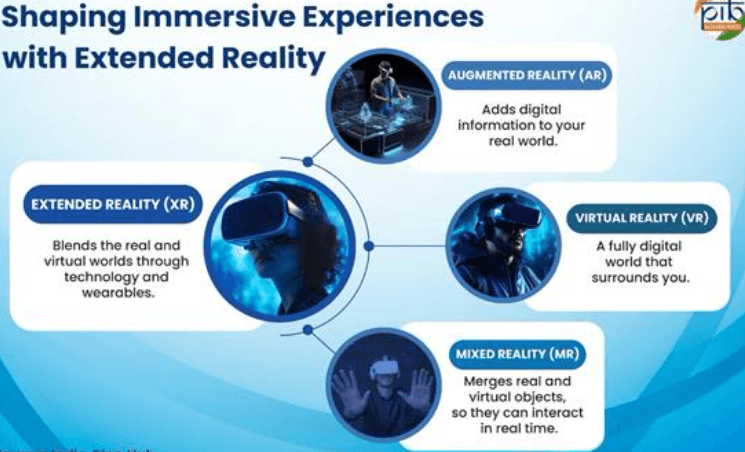
- Extended Reality (XR) Continuum:
- Virtual Reality (VR): Fully replaces the physical environment with an interactive, computer-generated 3D simulation accessed via headsets.
- Augmented Reality (AR): Overlays contextual digital information, graphics, or models onto the user’s real-world environment in real time (e.g., smart glasses, mobile apps).
- Mixed Reality (MR): Merges real and digital worlds where physical and digital objects co-exist and interact dynamically in real time.
- Complementary Modalities: Includes Haptic Technology (simulating touch via physical resistance, vibrations, and textures) and 360-degree video (omnidirectional spatial recording).

Key Data & Projections:
- Market Expansion: India’s immersive technology market is projected to grow from $1.26 billion (2023) to $7.82 billion (2030) at 29.8% CAGR, the fastest in Asia-Pacific.
- Gaming Sector Growth: India’s gaming industry is projected to expand from $3.8 billion (2024) to $9.2 billion by FY29.
- Educational Lab Rollout: Union Budget 2026–27 allocated ₹250 crore for AVGC Content Creator Labs in 15,000 schools and 500 colleges, coordinated by IICT Mumbai.
- National Digital Twin: The Department of Telecommunications aims to develop a National Digital Twin covering major urban centres by 2035.
Cross-Sectoral Applications in India:
- Pedagogy & Foundational Education: Translates abstract theoretical models into interactive 3D spatial simulations for schools.
E.g., IIT Madras researchers deploying AR/VR-enabled learning modules across rural schools to visualize history archives, human anatomy, and planetary systems.
- Urban Planning & Infrastructure Management: Virtual replicas (“Digital Twins”) integrate real-time 5G, IoT, and mobility data to model urban growth and stress-test public infrastructure before breaking ground.
E.g., DoT’s Sangam: Digital Twin initiative and Varanasi’s Urban 3D Spatial Planning project optimizing traffic, metro catchment, and pilgrimage logistics.
- Cultural Heritage Preservation & Tourism: Digitizes national artifacts and monuments into high-resolution virtual spaces for remote access and immersive site visits.
E.g., The Ministry of Culture’s JATAN software archiving national museum collections, paired with mobile AR virtual tours across ASI sites like Hampi and Nalanda.
- Creative Economy & Virtual Production: Powers next-generation entertainment through real-time virtual studios, motion capture, and indigenous gaming IP.
E.g., Uttar Pradesh developing an integrated AVGC-XR Park near the Noida International Airport (Jewar) and the International Film City.
Major Policy & Institutional Initiatives:
- Indian Institute of Creative Technologies (IICT), Mumbai: Established in 2025 as the National Centre of Excellence (NCoE), partnering with global tech leaders and currently delivering 18 specialized AVGC-XR professional courses.
- GENESIS Scheme (MeitY): Targets deep-tech innovation in Tier-II and Tier-III cities, currently backing 84 AR/VR startups and 106 technology incubators.
- WaveX Media-Tech Incubator: A specialized accelerator under MIB designed to support early-stage startups in commercializing spatial computing and virtual production tools.
- State AVGC-XR Ecosystem Policies: Sub-national frameworks driving local infrastructure, such as Karnataka’s Policy 3.0 (KITVEN Fund), Maharashtra’s ₹3,268 crore policy roadmap to 2050, and Tamil Nadu’s ELCOT Viyan CoE hub-and-spoke model.
- ESTIC-2026 Conclave: CSIR’s flagship science conference at Bharat Mandapam featuring dedicated thematic sessions on Generative XR and Spatial Computing.
Challenges Associated with Adoption:
- High Hardware Costs & Import Reliance: Advanced spatial headsets, GPU servers, and motion-capture rigs remain cost-prohibitive and heavily dependent on foreign component supply chains.
E.g., High import duties on enterprise XR headsets limiting their large-scale deployment across resource-constrained government schools.
- Bandwidth & Latency Constraints: High-fidelity interactive VR and real-time digital twins demand uninterrupted, ultra-low-latency 5G connectivity that is unevenly distributed across rural areas.
E.g., Interactive rural classroom simulations encountering rendering lag and buffering on edge networks outside core urban centers.
- Scarcity of Specialized Spatial Talent: Academic curricula face a shortage of trained faculty in real-time 3D game engines (Unreal Engine, Unity), 3D spatial audio, and computer vision engineering.
E.g., Domestic studios struggling to fill advanced roles in virtual production, shader programming, and haptic interface design.
- Health, Safety & Ergonomic Concerns: Prolonged usage of immersive headsets frequently induces cybersickness, visual fatigue, and disorientation, requiring strict operational guidelines for young users.
E.g., School-age children experiencing motion sickness or eye strain during long immersive headset sessions in classroom settings.
Way Ahead:
- Incentivize Domestic XR Hardware (Make in India): Introduce a targeted Production-Linked Incentive (PLI) scheme for near-eye displays, spatial tracking sensors, and affordable optical lenses to lower device costs.
- Integrate XR Curricula into STEM & Vocational Training: Embed 3D engine programming, spatial design, and digital asset modeling into National Skills Qualification Framework (NSQF) vocational courses and engineering syllabi.
- Establish Open-Source Digital Asset Repositories: Build a sovereign, royalty-free digital repository of Indian historical artifacts, architectural assets, and cultural environments to accelerate domestic content production.
- Formulate Responsible XR Standards & Data Privacy Guidelines: Establish clear standards under the Digital Personal Data Protection (DPDP) Act governing the collection of biometric, eye-tracking, and spatial mapping data captured by XR devices.
Conclusion:
Immersive technologies mark the next frontier of India’s digital evolution, moving the country from flat screen-based interactions to dynamic spatial computing. Achieving leadership in this domain requires transforming from a massive consumer market into an exporter of indigenous XR hardware, creative intellectual property, and real-time simulations. By aligning grassroots educational initiatives with targeted manufacturing and startup incentives, India can leverage immersive computing to drive inclusive growth and advance the vision of Viksit Bharat 2047.
How do Virtual Reality systems create a sense of immersion and presence for users? Discuss their applications in education, healthcare and industrial training. Examine the challenges associated with their large-scale deployment.



