
Prelims
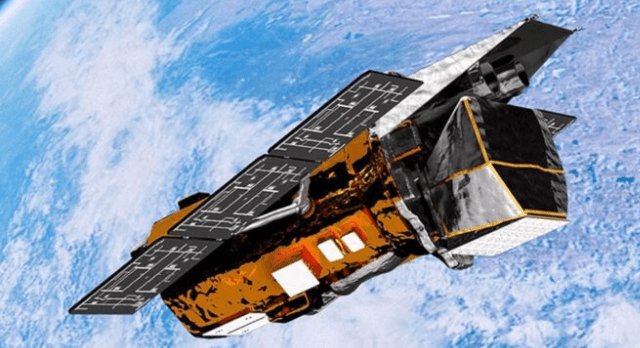
Neil Gehrels Swift Observatory
Context: NASA’s 1.5-tonne Neil Gehrels Swift Observatory is making an uncontrolled re-entry into Earth’s atmosphere, after completing an operational mission spanning 22 years.

About Neil Gehrels Swift Observatory:
What it is?
- A specialized multi-wavelength space telescope dedicated to transient high-energy astrophysics. It was engineered to autonomously detect Gamma-Ray Bursts (GRBs) and rapidly repoint its onboard optical, ultraviolet, and X-ray instruments within seconds to capture real-time cosmic afterglows.
History of Neil Gehrels Swift Observatory:
- Launch (2004): Launched on 20 November 2004 aboard a Delta II rocket under NASA’s MIDEX programme to study gamma-ray bursts and other high-energy cosmic phenomena.
- Renaming (2018): Renamed Neil Gehrels Swift Observatory in January 2018 to honour its principal investigator, Dr. Neil Gehrels, who died in 2017.
- Mission Extension & Re-entry: Originally designed for two years, Swift operated for over two decades, with declining orbital altitude eventually threatening atmospheric re-entry.
Organisation: Operated by NASA’s Goddard Space Flight Center, in collaboration with Penn State University, the UK Space Agency and the Italian Space Agency (ASI).
Aim: To investigate gamma-ray bursts, black holes and transient cosmic events, while providing rapid astronomical alerts to ground-based and space observatories.
Key Features of Swift:
- Autonomous Rapid-Slewing Capability: Uses reaction wheels to automatically reposition its telescopes within approximately 20–75 seconds, enabling rapid observation of newly detected cosmic explosions.
- Burst Alert Telescope (BAT): Detects hard X-rays and soft gamma rays (15–150 keV) using coded-mask imaging, monitoring approximately one-sixth of the sky.
- X-Ray Telescope (XRT): Uses grazing-incidence X-ray optics (0.2–10 keV) to precisely locate gamma-ray burst afterglows and analyse their spectral evolution.
- Ultraviolet/Optical Telescope (UVOT): A 30-cm optical-ultraviolet telescope that observes early afterglows, measures brightness and colour, and supports distance estimation.
Major Achievements:
- Gamma-Ray Burst Discoveries: Detected over 2,000 gamma-ray bursts, advancing understanding of stellar explosions and compact-object mergers involving neutron stars and black holes.
- Probing the Early Universe: Observed GRB 090423 (redshift ~8.2), providing insights into cosmic conditions approximately 630 million years after the Big Bang.
- Multi-Messenger Astronomy: Advanced studies of tidal disruption events and gravitational-wave counterparts, including electromagnetic observations associated with neutron-star merger GW170817.
- Transient Sky Cataloguing: Recorded supernovae, novae, active galactic nuclei and cometary activity, distributing rapid astronomical alerts through the General Coordinates Network (GCN).



