Mapping
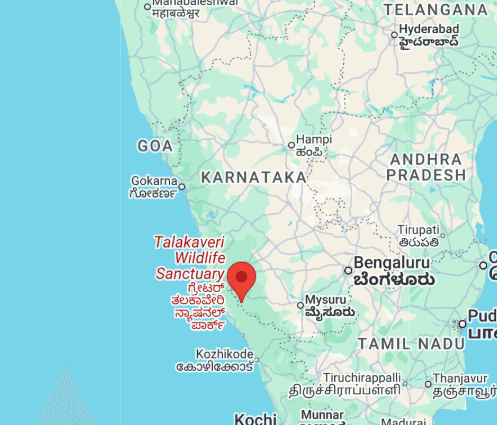
Talacauvery Wildlife Sanctuary
Context: Karnataka Forest Department personnel apprehended eight poachers following a late-night chase and exchange of fire in the Akkikandi forest range of Talakaveri Wildlife Sanctuary.

About Talakaveri Wildlife Sanctuary:
What it is?
- A protected wildlife sanctuary located within the central Western Ghats, encompassing dense tropical rainforest tracts, montane shola grasslands, and high-elevation ridges.
Located in: Situated in the Kodagu (Coorg) district of Karnataka, bordering the Ranipuram and Kottencheri hills of Kasaragod district in Kerala.
Background:
- Named after Talakaveri, the revered holy spring on the Brahmagiri hill range that marks the origin of the Cauvery (Kaveri) River situated on the eastern fringe of the reserve.
- Officially notified and established as a wildlife sanctuary on 1987, under the provisions of the Wildlife (Protection) Act, 1972, spanning an area of approximately 105 sq. km.
- Forms part of the UNESCO World Heritage Site clusters of the Western Ghats (sub-cluster Brahmagiri–Talakaveri).
Key Features of Talakaveri Wildlife Sanctuary:
- Tropical Evergreen Forests: Dominated by wet evergreen and semi-evergreen forests, featuring Dysoxylum malabaricum, Mesua ferrea and Artocarpus lakoocha, alongside shola-grasslands at higher elevations.
- Cauvery River Catchment: Protects the origin and upper catchment of the Cauvery River, sustaining perennial water flows and supporting the hydrological stability of southern India.
- Rich Endemic Biodiversity: Shelters threatened Western Ghats wildlife, including tigers, Asian elephants, leopards, small-clawed otters, stripe-necked mongooses and endangered lion-tailed macaques.
- Avian Diversity: Recognised as an Important Bird Area (IBA), supporting species such as the Malabar trogon, Nilgiri wood pigeon, Asian fairy-bluebird and great hornbill.
Significance:
- Connects Brahmagiri Wildlife Sanctuary with Kerala’s protected forests, facilitating seasonal wildlife migration, genetic exchange and habitat connectivity across the Western Ghats.
- Its forests regulate heavy rainfall exceeding 6,000 mm annually, reducing soil erosion and flash floods while sustaining the Cauvery basin’s water