Prelims
The Asia-Pacific Economic Cooperation (APEC) Summit
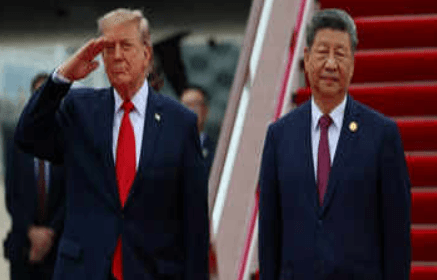
Context: US President Donald Trump arrived in Shenzhen, China, where he was personally received at the airport by Chinese President Xi Jinping to attend the 33rd Asia Pacific Economic Cooperation (APEC) Economic Leaders’ Meeting.

About The Asia-Pacific Economic Cooperation (APEC) Summit:
What it is?
- An intergovernmental regional economic forum of 21 Pacific Rim member economies established to leverage the growing economic interdependence of the Asia-Pacific region through free trade, investment liberalization, and economic-technical cooperation.
History:
- Establishment (1989): Proposed by former Australian Prime Minister Bob Hawke in January 1989 and formally established in November 1989 in Canberra, Australia, by 12 founding members (Australia, Brunei Darussalam, Canada, Indonesia, Japan, South Korea, Malaysia, New Zealand, the Philippines, Singapore, Thailand, and the United States).
- Expansion (1991–1998): Expanded to 21 member economies with the accession of China, Hong Kong (China), and Chinese Taipei (1991); Mexico and Papua New Guinea (1993); Chile (1994); and Peru, Russia, and Vietnam (1998)—while India remains an observer/applicant rather than a member.
- Institutionalization (1992–1993): Established a permanent Secretariat in Singapore (1992) and elevated the forum in 1993 when former US President Bill Clinton initiated the annual APEC Economic Leaders’ Meeting (AELM).
Host (2026):
Host & Theme: Hosted by China in Shenzhen under Building an Asia-Pacific Community to Prosper Together, prioritising openness, innovation and cooperation.
Aim: To promote regional economic integration, sustainable growth and shared prosperity through trade liberalisation, regulatory harmonisation and digital innovation under the APEC Putrajaya Vision 2040.
Key Features of APEC:
- Consensus-Based Decision-Making: Operates through voluntary, non-binding commitments and consensus, enabling flexible economic cooperation while respecting members’ sovereignty.
- Member Economies: Uses the term member economies rather than countries, allowing Hong Kong (China) and Chinese Taipei to participate alongside mainland China.
- Three Pillars of Cooperation: Focuses on trade and investment liberalisation, business facilitation and economic and technical cooperation (ECOTECH) to strengthen regional integration.
- Private-Sector Participation: Engages business leaders through the APEC Business Advisory Council (ABAC) and APEC CEO Summit, integrating industry perspectives into policymaking.
- Diplomatic Engagement: Provides a platform for bilateral and multilateral discussions among major powers, facilitating dialogue amid geopolitical and economic tensions.
Significance:
- APEC’s 21 economies account for nearly 40% of global population, 60% of GDP and 45% of trade, shaping global economic stability.
- Facilitates US–China dialogue amid trade tensions while highlighting India’s potential role in APEC through expanding Indo-Pacific economic integration.