
The Challenge Of Holding The Quad Together
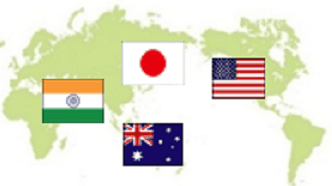
Context: Leaders of the Quadrilateral Security Dialogue (Quad)—India, Australia, Japan, and the United States—are scheduled to convene in Manila in November 2026 on the sidelines of the 49th ASEAN Summit.

About The Challenge Of Holding The Quad Together:
What It Is?
- An informal, strategic diplomatic partnership comprising four maritime democracies—Australia, India, Japan, and the United States—dedicated to supporting a “free, open, inclusive, and resilient Indo-Pacific”.
Institutional Nature: Operates without a permanent secretariat, treaty charter, or standing military alliance structure, relying instead on regular leader-level summits, ministerial dialogues, and functional working groups.
Evolution & Milestones:
- Origins (2004–2007): Emerged from coordinated joint disaster relief operations following the 2004 Indian Ocean tsunami, followed by an initial exploratory meeting in 2007 before going dormant.
- Revival (November 2017): Resurrected in Manila on the sidelines of the ASEAN Summit during President Trump’s first term amid rising maritime assertiveness in the Indo-Pacific.
- Leader-Level Elevation (2021–2024): Elevated to the head-of-state/government level in 2021, culminating in the 2024 Wilmington Summit before experiencing a pause in leader-level gatherings during 2025.
Operational Continuity Amid Political Turbulence (2025–2026):
Despite bilateral trade friction, tariff disputes, and shifting U.S. focus toward Europe and West Asia in 2025, the Quad sustained functional momentum across working-level and ministerial tracks:
- Sustained Ministerial Engagements: Quad Foreign Ministers met five times across 2025 and 2026 (twice in Washington, followed by New Delhi, Manila, and Atlanta) to keep diplomatic channels open and schedule the Manila summit.
- Indo-Pacific Maritime Surveillance Collaboration (IPMSC): Launched at the May 2026 New Delhi Foreign Ministers’ Meeting, upgrading the existing Indo-Pacific Partnership for Maritime Domain Awareness (IPMDA) to integrate satellite, aerial, and surface tracking into a near-real-time Common Operating Picture (COP).
- Critical Minerals & Supply Chain Resilience: Rolled out the Quad Critical Minerals Initiative Framework and backed undersea cable connectivity across Pacific Island nations alongside Open RAN 5G/6G telecommunications standards.
- Explicit Backing for ASEAN Centrality: Issued a dedicated Joint Statement on Cooperation with ASEAN in July 2026, anchoring Quad maritime, AI, and infrastructure initiatives within the ASEAN Outlook on the Indo-Pacific (AOIP).
Key Challenges to Holding the Quad Together:
- Uncertainty Over U.S. Strategic Bandwidth: Washington’s preoccupation with the Russia-Ukraine conflict, transatlantic burden-sharing, and hostilities in West Asia has raised questions about sustained U.S. commitment to the Indo-Pacific.
E.g., The White House’s review of the AUKUS security pact and unilateral tariff actions creating friction with traditional treaty allies and partners.
- Divergent Threat Perceptions & Bilateral Priorities: While all four nations favor a rules-based maritime order, their geographic focus and tolerance for direct confrontation with Beijing vary.
E.g., India balancing continental border challenges along the Line of Actual Control (LAC) and multi-alignment diplomacy with maritime deterrence, whereas Japan and the U.S. focus heavily on the East China Sea and Taiwan Strait.
- Hedging Through Alternative Minilaterals: Perceived unpredictability in Washington has prompted regional powers to diversify their security partnerships outside the Quad framework.
E.g., Deepening trilateral defense coordination among Japan, Australia, and India (JAI), Japan’s One Cooperative Effort Among Nations (OCEAN) framework, and expanded strategic outreach by European powers like France.
- ASEAN Skepticism & Regional Balancing: Southeast Asian states remain wary of being forced to choose sides or seeing the Quad overshadow ASEAN-led regional mechanisms.
E.g., Individual ASEAN members welcoming Quad public goods while refraining from formal institutional endorsement of the grouping.
Strategic Significance of the Manila Summit:
- Symbolism of Hosting in the Philippines: Convening in Manila—a frontline state facing persistent maritime coercion and sovereignty disputes in the South China Sea—sends a clear diplomatic signal against unilateral attempts to alter the regional status quo.
- Reaffirming ASEAN Centrality: Holding the summit alongside the ASEAN Summit directly counters narratives that the Quad seeks to supplant regional institutions, reinforcing alignment with Southeast Asian partners.
- Resetting U.S. Indo-Pacific Engagement: Provides President Trump an early platform to articulate his second-term Indo-Pacific vision and reassure allies of American deterrence in the Taiwan Strait and wider maritime commons.
Way Ahead:
- Institutionalize Operational Public Goods: Anchor the Quad’s relevance in tangible, non-military deliverables—such as the IPMSC maritime surveillance grid, trusted AI funding, undersea cables, and port infrastructure—that insulate the grouping from domestic political cycles.
- De-Escalate Bilateral Trade & Tariff Frictions: Resolve bilateral tariff disputes and supply-chain bottlenecks among Quad members so economic disagreements do not undermine strategic trust.
- Deepen Practical Synergy with ASEAN: Operationalize joint projects under the ASEAN Outlook on the Indo-Pacific (AOIP) in clean energy, counter-scam law enforcement, and disaster resilience to build organic Southeast Asian buy-in.
- Harmonize Minilateral Security Networks: Align Quad maritime initiatives seamlessly with complementary trilateral and bilateral frameworks (such as JAI and India-Philippines defense cooperation) to strengthen collective regional deterrence.
Conclusion:
The upcoming Quad Leaders’ Summit in Manila marks a vital inflection point in restoring high-level political momentum after a turbulent year of shifting geopolitical priorities. While working-level initiatives in maritime surveillance, critical minerals, and digital connectivity have kept the partnership functional, holding the Quad together long-term requires bridging bilateral trade frictions and securing consistent U.S. strategic focus. Anchoring its agenda in ASEAN centrality and tangible regional public goods will enable the Quad to remain a credible stabilizer in the Indo-Pacific.
What explains India’s growing emphasis on issue-based coalitions and minilateral arrangements in international diplomacy? Assess their contribution to India’s strategic objectives and the limitations of this approach.



