
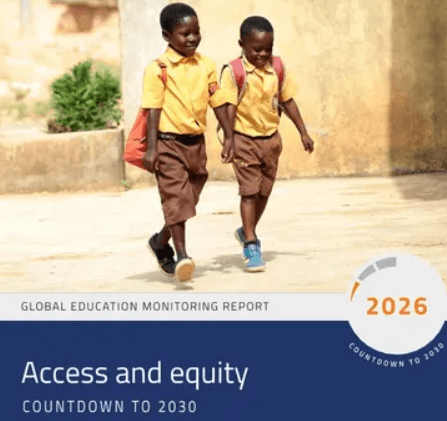
The Global Education Monitoring (GEM) Report 2026
Context: UNESCO’s 2026 Global Education Monitoring (GEM) Report revealed that while Indian women now outpace men in higher education, a sharp rural-urban divide leaves rural girls disadvantaged at the school-completion stage.

About The Global Education Monitoring (GEM) Report 2026:
What it is?
- An independent flagship annual report hosted and published by UNESCO, mandated under the Education 2030 Incheon Declaration and Framework for Action to monitor and track progress on Sustainable Development Goal 4 (SDG 4) and related global education indicators.
Key Findings in the Report (Global Level):
- Rise in Out-of-School Youth: Global out-of-school numbers rose for the seventh consecutive year to 273 million in 2024, excluding 13 million children in conflict-affected countries.
- Expansion in Enrolment: Since 2000, enrolment increased by 30% in primary and secondary, 45% in pre-primary and 161% in tertiary education.
- Secondary Completion: Upper secondary completion improved from 37% (2000) to 61% (2024), but achieving 95% completion may take until 2105.
- Decline in Grade Repetition: Grade repetition fell by 62% in primary and 38% in lower secondary since 2000, improving educational progression.
- Weak Educational Equity: Fewer than 10% of countries have strongly equity-oriented education financing systems, highlighting persistent inequalities in resource allocation.
- Overstated Pre-Primary Enrolment: Although 75% of five-year-olds attend school, 27% enter primary prematurely, while only 60% complete one year of preschool.
Key Findings on India:
- Rural Gender Disparity: India’s upper secondary GPI is 0.89 nationally, falling to 0.59 in rural areas, compared with gender parity in urban areas.
- Fast Progress: UNESCO classifies India as a fast-progress country, having reduced its initial upper secondary completion disparity by at least 65% since 2000.
- Female Lead in Higher Education: Women’s GER (31.2%) exceeds men’s (28.9%), with a GPI of 1.08 and seven consecutive years of female enrolment dominance.
- Rising Female Enrolment: Women’s higher education enrolment increased 42.2%, from 1.57 crore (2014–15) to 2.24 crore (2023–24).
- Improving School Retention: Secondary dropout rates declined to 7%, retention reached 51.9%, and girls constituted 48.4% of total school enrolment.
Positives Highlighted:
- Nutritional Support Driving Female Enrolment: Free school feeding programmes delivered disproportionate gains for female schooling.
E.g., Free school lunches in India demonstrated nearly twice the positive impact on primary enrolment for girls compared to boys in disadvantaged rural communities.
- Infrastructure Improvements Reducing Dropouts: Targeted water, sanitation, and hygiene (WASH) interventions supported retention during adolescence.
E.g., Constructing gender-segregated school toilets across rural schools led to higher enrolment and retention among adolescent girls.
- Community-Based Life-Skills Interventions: Local mentorship and empowerment programmes helped improve schooling transitions.
E.g., Girls’ clubs providing peer networks, life-skills training, and academic support modestly lifted secondary school completion rates in Karnataka.
- Closing the Initial Gender Disparity Gap: Coordinated national campaigns helped bridge historical gaps in school access.
E.g., India closing over 65% of its baseline gender gap in upper secondary completion over the past two and a half decades.
Challenges Associated:
- Persistent Rural-Urban Educational Divide: Rural adolescent girls face severe structural obstacles at the higher secondary transition point.
E.g., A completion parity of only 59 rural girls per 100 boys due to long school commutes, safety concerns, and domestic chores.
- Delayed School Completion and Grade Repetition: Overage enrolments and progression delays widen the gap between timely and ultimate graduation across low- and middle-income regions.
E.g., In low-income countries, the gap between timely and late lower secondary completion expanded to nine percentage points.
- Disparities in School Financing Redistribution: National education budgets frequently fail to channel funding toward the most marginalized populations.
E.g., Targeted school equity grants account for less than half a percent of total education budgets across half the countries that utilize them.
- Data Invisibility Across Wealth and Geographies: National monitoring systems often omit critical disaggregated indicators.
E.g., One in three countries fails to report education disparities by urban-rural location, and one in two does not report disparities by wealth quintile.
UNESCO Recommendations:
- Integrate National Benchmarks into Budgeting: Move beyond symbolic global pledges by embedding realistic, nationally set targets into domestic planning cycles and public budgets.
- Deploy Contextual, Multi-Sector Policy Packages: Avoid relying on isolated, short-term experimental interventions; instead, implement coordinated, long-term policy packages combining infrastructure, social protection, and institutional reform.
- Target Resources Toward Equity and Redistribution: Reorient public education financing to explicitly prioritize disadvantaged subnational regions, rural schools, and marginalized households through direct grants and social transfers.
- Refine Data Metrics and Disaggregation: Enhance monitoring frameworks by shifting from misleading gross enrolment ratios to completion and attainment metrics, integrating survey data with administrative registries to track marginalized groups.
Conclusion:
The 2026 GEM Report highlights that while India has made historic strides in women’s higher education, the rural-urban divide continues to limit secondary school completion for millions of rural girls. This gap illustrates that broad educational expansion does not automatically guarantee equity without deliberate, targeted redistribution. Sustaining long-term educational gains will require institutionalizing equitable public financing, upgrading rural secondary infrastructure, and tailoring policies to local socio-economic realities.
Identify the major institutional constraints affecting the quality of higher education in India. Examine the role of academic autonomy in overcoming these constraints.



