
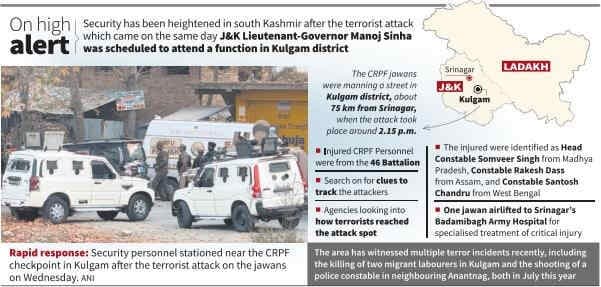
The Kulgam Terror Attack
Context: Three Central Reserve Police Force (CRPF) personnel from the 46 Battalion were injured when motorcycle-borne terrorists opened close-range fire at a security checkpoint in Kulgam district of Jammu and Kashmir.

About The Kulgam Terror Attack:
What It Is?
- A coordinated, hit-and-run terror ambush targeting a stationary paramilitary checkpost in south Kashmir, executed on the same day the Lieutenant-Governor visited the district to inaugurate a cultural festival.
Key Details of the Incident:
- Motorcycle-borne militants fired roughly 30 rounds in 15 seconds at close range before fleeing, captured on local CCTV surveillance.
- Constables Rakesh Dass and Santosh Chandru, along with Head Constable Somveer Singh, sustained bullet injuries; the critically wounded jawan was airlifted to Badamibagh Army Hospital in Srinagar.
- Reinforcements, armored vehicles, and cordon-and-search operations were immediately launched across south Kashmir to seal exit routes.
Recent Terrorism & Insurgency Incidents in India
- Kulgam Brick Kiln Attack: Terrorists targeted non-local workers at a brick kiln in Kulgam, killing two migrant laborers from Chhattisgarh to instill fear among external workforces.
- Anantnag Police Shooting: Militants carried out a targeted close-range shooting against a Jammu and Kashmir Police constable in neighboring Anantnag district.
- Sukma IED Blast in Chhattisgarh: Four CRPF officers sustained injuries when an Improvised Explosive Device (IED) detonated during a residual explosive defusal operation at the Alarmedgu camp in Sukma.
- Reasi & Kathua Ambush Waves: Cross-border terror modules shifted focus south of the Pir Panjal range, staging coordinated ambushes on security convoys and pilgrim buses in the Jammu division.
Reasons for Persistent Terror Attacks:
- Cross-Border State Sponsorship & Launchpads: Terrorist outfits continue to receive logistical support, encrypted communications, and infiltration cover across the Line of Control (LoC) and International Border.
E.g., Proxy handlers utilizing quadcopter drones to drop small arms, sticky bombs, and steel-core ammunition into border districts of Punjab and J&K.
- Shift to “Hybrid” Militancy & Hit-and-Run Tactics: Radicalized, part-time operatives without prior police records carry out low-footprint attacks using pistols or compact rifles before blending back into civilian life.
E.g., Motorcycle-borne attackers firing rapid bursts at stationary checkpoints in Akhran and dispersing through rural orchards before quick-reaction teams arrive.
- Subversion of High-Visibility Civil & Cultural Events: Militants intentionally time strikes to coincide with official visits or community festivals to undermine narratives of normalcy and deter public participation.
E.g., Staging the Kulgam firing on the exact day L-G Manoj Sinha inaugurated the Veshow Festival in the district.
- Exploitation of Dense Forest & Mountainous Terrain: Heavily forested ridges and natural caves provide concealment for small, well-trained foreign mercenary groups to evade aerial surveillance.
E.g., Foreign militants operating out of dense alpine forests in upper reaches of south Kashmir and the Pir Panjal belt.
Initiatives Taken to Counter Terrorism:
- Zero-Tolerance Policy & Operational Autonomy: Granting security forces operational freedom (“free hand”) alongside synchronized intelligence sharing via the Multi-Agency Centre (MAC).
- Comprehensive Integrated Border Management System (CIBMS): Deploying smart fencing, thermal imagers, underground sensors, and anti-drone radar grids along the LoC and International Border.
- Village Defence Guards (VDGs) & Local Resilience: Reviving and arming trained local volunteer networks in vulnerable rural and border pockets to serve as first-line deterrents.
- Crackdown on Terror Financing & Over Ground Workers (OGWs): Utilizing the Unlawful Activities (Prevention) Act (UAPA) and National Investigation Agency (NIA) property attachments to dismantle local support ecosystems.
Way Ahead:
- Upgrade Checkpoint Fortification & Surveillance: Equip static road checkpoints with bullet-resistant bunkers, AI-enabled automatic number plate recognition (ANPR) cameras, and rapid-response drone Overwatch.
- Deepen Human Intelligence (HUMINT) Networks: Rebuild grassroots community policing and local intelligence grids to preempt hybrid militants before they acquire weapons or select targets.
- Strengthen Counter-Drone & Tactical Communications: Deploy localized RF jammers and micro-radar systems across forward camps to intercept cross-border weapon drops.
- Sustain Socio-Economic Integration & Youth Engagement: Pair hard security operations with grassroots employment, tourism promotion, and cultural outreach to isolate extremist narratives from local youth.
Conclusion:
The close-range ambush in Kulgam underscores that while large-scale militant infrastructure in Jammu and Kashmir has been degraded, decentralized hit-and-run attacks remain a persistent security challenge. Countering these evolving tactics requires adapting static checkpoint defenses, dismantling Over Ground Worker (OGW) networks, and neutralizing cross-border logistical support. Combining firm counter-terror operations with sustained grassroots development remains essential to securing lasting peace in the region.
“The growing use of proxy actors has blurred the distinction between external aggression and internal security threats.” Substantiate with reference to cross-border terrorism. Evaluate the challenges this poses for India’s security response.



