

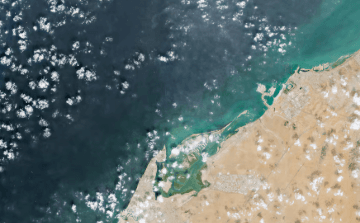
The Oil Spill off UAE
Context: High-resolution satellite imagery from the European Union’s Copernicus Sentinel-2 network confirmed that a massive marine oil spill off the United Arab Emirates (UAE) widened significantly, reaching close to the northern coastline.

About The Oil Spill off UAE:
What It Is?
- A major trans-boundary marine pollution emergency caused by heavy crude/fuel oil leaking from a damaged commercial tanker into the Persian Gulf, threatening critical coastal infrastructure and sensitive marine ecosystems.
The Incident:
- Vessel Involved: Maritime sources identified the damaged commercial tanker Gem No. 2 as the suspected source of the oil spill.
- Initial Cause: The tanker was reportedly struck by an unidentified projectile near the Strait of Hormuz, triggering a fire that was subsequently extinguished.
- Spatial Spread: Satellite imagery revealed extensive oil slicks spreading across open waters towards the coast of Umm Al Quwain, UAE.
- Emergency Response: UAE authorities initiated oil containment operations and closed affected beaches, including Al Hamriyah in Sharjah and coastal resorts in Ras Al Khaimah.
Recent Major Oil Spill Incidents:
- Manila Bay Spill, Philippines: The tanker MT Terra Nova, carrying 1.4 million liters of industrial fuel oil, capsized and sank off Limay, Bataan, releasing heavy oil slicks that disrupted municipal fisheries and contaminated coastal reserves.
- Pasir Panjang Terminal Spill, Singapore: The dredger Vox Maxima collided with the stationary bunker vessel Marine Honour, releasing ~400 tonnes of low-sulfur fuel oil that shut down resort beaches on Sentosa Island.
- Tobago Coast Spill / Gulfstream Incident: An abandoned, capsized barge leaked thousands of barrels of refined fuel oil along Tobago’s southern shore, triggering a national environmental emergency across sensitive reef tracts.
- Twelvepole Creek & North American Pipeline Spills: Multiple inland pipeline ruptures, including the Twelvepole Creek spill in West Virginia, released crude into riverine feeder tributaries, highlighting persistent transport infrastructure risks.
Implications of Oil Spills on Aquatic Ecosystems:
- Smothering and Hypoxia in Benthic Communities: Dense oil layers block sunlight penetration and hinder atmospheric gas exchange, depriving photosynthetic corals and benthic plants of oxygen.
E.g., Silt and oil emulsions smothering fragile coral reefs and seagrass beds in the Persian Gulf, where over 500 fish species feed and breed.
- Thermal Regulation Breakdown in Marine Fauna: Floating oil coats the feathers of diving seabirds and the fur of marine mammals, stripping away their natural waterproofing and insulation.
E.g., Hypothermia and drowning among foraging seabirds and shorebirds trapped in surface slicks.
- Bioaccumulation & Food-Chain Toxicity: Toxic polycyclic aromatic hydrocarbons (PAHs) bioaccumulate in marine organisms, impairing reproductive systems and elevating mortality across higher trophic levels.
E.g., Ingestion of hydrocarbon chemical residues by filter-feeding bivalves and pelagic fish, leading to long-term liver lesions and population declines.
- Destruction of Mangrove & Nursery Habitats: Heavy crude coats the aerial roots (pneumatophores) of coastal mangroves, choking the respiratory pores essential for tree survival.
E.g., Complete die-offs in intertidal mangrove forests that serve as primary spawning nurseries for shrimp, crabs, and juvenile reef fish.
Solutions to Contain and Mitigate Oil Spills:
- Mechanical Containment (Booms and Skimmers): Deploying floating containment booms around the stricken vessel to encircle surface slicks, followed by weir or oleophilic skimmers that vacuum the separated oil into collection barges.
- Chemical Dispersion & Solidification Agents: Applying certified chemical dispersants via aircraft or support vessels to break down heavy slicks into tiny droplets, accelerating natural microbial dilution.
- Bioremediation Techniques: Introducing specialized hydrocarbon-degrading bacteria (such as Alcanivorax borkumensis) along with nitrogen and phosphorus nutrients to metabolize remaining oil films into harmless byproducts.
- Sorbent Barriers & In-Situ Burning: Deploying hydrophobic sorbent booms made of polypropylene or natural fibers to soak up thin slicks, or conducting controlled in-situ burns within fire-resistant booms when sea conditions allow.
Conclusion:
The escalating oil slick off the UAE highlights how geopolitical conflicts and maritime security incidents create severe environmental risks for fragile marine corridors. Preserving vital coastal habitats and safeguarding regional desalination infrastructure requires swift containment, cross-emirate coordination, and continuous satellite-guided monitoring. Going forward, establishing multilateral maritime environmental rapid-response protocols will be essential to mitigating ecological fallout across vulnerable international waterways.
Oil spills pose a severe threat to marine ecosystems. Preventing oil spills through stringent safety measures and regulations remains a crucial aspect of minimizing their impact on the environment. Discuss.



