The Renewable Energy Revolution in India
Context: Union Minister for New and Renewable Energy outlined India’s transition into a decentralized, people-led solar economy, highlighting that over 21 lakh of the 65 lakh households under the PM Surya Ghar Muft Bijli Yojana have achieved zero electricity bills.

About The Renewable Energy Revolution in India:
What is Renewable Energy?
- Energy derived from natural, non-fossil sources that replenish more rapidly than they are consumed—predominantly solar, wind, biomass, small/large hydropower, and green hydrogen derivatives.
Key Data / Stats:
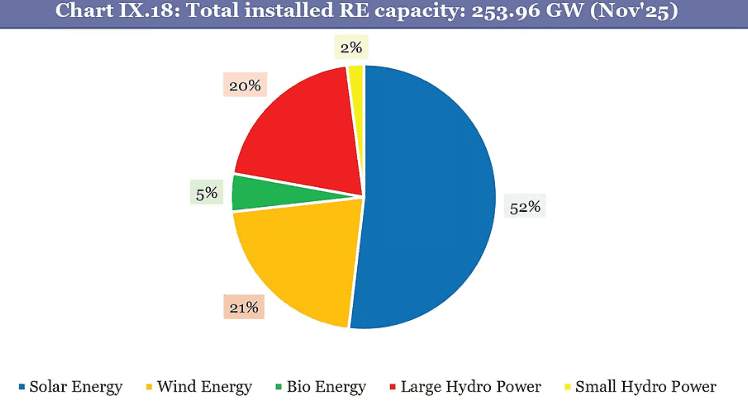
- Exponential Capacity Growth: Cumulative installed solar capacity surged by over 6,000%, expanding from 2.8 GW in 2014 to roughly 171 GW.
- Plummeting Tariffs: Solar generation tariffs crashed from around ₹8–₹10 per unit in 2014–15 to grid bids as low as ₹2.15 per unit.
- Panchamrit Early Milestone: India is the only G20 economy to have met its pledge of generating 50% of its cumulative electric capacity from non-fossil fuel sources five years ahead of the 2030 target.
- Rooftop & Rural Decentralization: Under the PM Surya Ghar: Muft Bijli Yojana, more than 21 lakh out of 65 lakh rooftop-solar-adopting homes have recorded zero electricity bills, while PM-KUSUM has deployed over 30 lakh standalone agricultural solar pumps.
Evolution of Renewable Energy in India:
- Phase I (Pre-2014 Foundation): Dominated primarily by wind power and small hydropower, with utility solar generation remaining a niche segment with high capital costs (~2.8 GW installed capacity) requiring high feed-in tariffs.
- Phase II (2014–2020 Utility-Scale Scale-Up): The National Solar Mission target was revised to 100 GW, shifting project allocation to competitive reverse bidding auctions and creating mega-solar parks across resource-rich drylands.
- Phase III (2021–2025 Manufacturing & Deep Decarbonization): Post-COP26 Panchamrit pledges targeted 500 GW of non-fossil energy by 2030; introduced Production Linked Incentives (PLI) for high-efficiency solar modules and launched the National Green Hydrogen Mission.
- Phase IV (2026+ Storage, Rooftops & Grid Integration): Transitioning toward Round-the-Clock (RTC) renewables by coupling solar and wind with Battery Energy Storage Systems (BESS), deploying localized rooftop installations via PM Surya Ghar, and integrating smart grids.
Key Initiatives Taken So Far:
- PM Surya Ghar: Muft Bijli Yojana: A ₹75,000-crore initiative supporting rooftop solar installations across 1 crore households, providing up to 300 units of free solar power monthly and net-metering export revenues.
- PM-KUSUM Scheme: De-dieselizing farm operations by providing capital subsidies for standalone solar agricultural water pumps and solarizing rural feeder lines.
- Production-Linked Incentive (PLI) Schemes for Solar PV: Domestic manufacturing capacity has expanded to over 225 GW of solar modules and ~45 GW of solar cells, reducing dependence on imported components.
- Green Energy Corridors (GEC Phase III): A Cabinet-cleared program allocating ₹50,000 crore alongside new transmission lines to evacuate 50 GWh of renewable and stored energy to high-demand industrial centers.
Challenges Associated with Renewable Energy:
- Grid Intermittency and High Storage Costs: Solar and wind are non-continuous energy sources requiring heavy investments in battery storage (BESS) and pumped hydro to balance peak evening demand.
E.g., The Central Electricity Authority (CEA) projects that India requires 236 GWh of battery storage capacity by 2031–32 to maintain grid stability.
- Upstream Supply Chain Vulnerabilities: While downstream solar module assembly has scaled domestically, India remains reliant on imports for upstream raw materials like polysilicon ingots and wafers.
E.g., Fluctuations in global polysilicon and critical mineral prices create margin volatility for domestic cell manufacturers.
- Financial Stress Among State DISCOMs: Poor financial health, delayed tariff subsidy reimbursements, and legacy contract renegotiations by state distribution companies slow power purchase agreements (PPAs).
E.g., Delays in DISCOM payments and disputes over rooftop net-metering approvals holding back commercial rooftop rollouts.
- Land Acquisition and Transmission Bottlenecks: Developing mega-parks requires large contiguous tracts of land and dedicated inter-state transmission lines.
E.g., Laying transmission lines across western arid zones (like the Khavda hybrid park) encountering local environmental restrictions and land clearance hurdles.
Way Ahead:
- Accelerate Upstream Domestic Manufacturing: Channel PLI incentives into capital-intensive polysilicon, ingot, and wafer facilities, alongside domestic electrolyser fabrication for the National Green Hydrogen Mission.
- Scale Battery Storage (BESS) & Pumped Hydro: Combine viable gap funding (VGF) for grid-scale lithium/sodium-ion batteries with pumped storage hydropower projects to supply reliable Round-the-Clock (RTC) renewable power.
- Financially Modernize State Power Utilities (DISCOMs): Fast-track the installation of smart prepaid meters and automate prompt PPA clearance mechanisms to lower DISCOM losses and support prompt renewable payments.
- Deepen South-South Multilateral Cooperation: Leverage the International Solar Alliance (ISA) and the $200-million Africa Solar Facility to export Indian engineering expertise, rural off-grid solar tech, and trained technical workforces across developing nations.
Conclusion:
India’s renewable energy transformation has evolved from centralized utility projects into a citizen-led movement that strengthens energy independence and creates localized employment. Balancing this rapid expansion requires pairing clean generation with affordable battery storage, upgrading transmission grids, and expanding domestic wafer manufacturing. By combining sound industrial policy with multilateral leadership through the ISA, India is establishing an equitable clean-energy template for the Global South.
“The transition towards renewable energy is creating a new geography of resource dependence.” Explain the geographical factors shaping the distribution of renewable energy potential. Assess the emerging implications for industrial location and regional inequalities.