
The Rise of Animal Products in Agricultural Trade
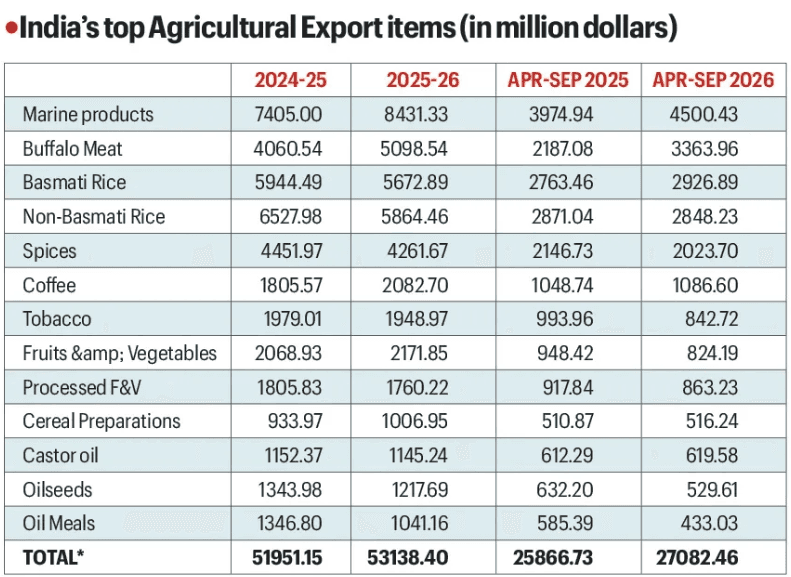
Context: Department of Commerce data (H1 FY27) shows marine products (3.4 billion) emerging as India’s top agricultural exports, surpassing traditional crops, including basmati rice.

About The Rise of Animal Products in Agricultural Trade:
What it is?
- Livestock and fisheries now contribute roughly 40% to India’s agricultural GDP, up from about 30% a decade ago, mirroring a broader transition from cereal-centric farm output toward high-value animal protein.
- Driven by disease surveillance, integrated cold-chain logistics, and modern export-oriented abattoirs, animal products have decoupled from the export bans, export duties, and climate vulnerabilities that frequently restrict traditional field crops.
Key Data & Export Trends (H1 FY 2026–27):
- Outpacing Agricultural Exports: While overall agri-exports rose 4.7% to 4.5 billion) and buffalo meat 53.8% ($3.4 billion).
- Record Marine Exports: Seafood exports reached a record 1.5 billion in H1 FY27) and double-digit growth in major Asian markets and Russia.
- Rising Buffalo Meat Export Value: Average realisation increased from $2,716.8/tonne (FY23) to $4,368.2/tonne (H1 FY27), with annual exports projected to exceed 526.3M), Egypt (346.6M), Indonesia (255.5M).
- Product Upgrading & Premium Price Realization: Strict sanitary compliance has shifted global perceptions of Indian carabeef from a low-end cattle beef substitute to a lean, halal-certified premium meat.
E.g., Mandatory export registration only for modern integrated abattoirs meeting international sanitary and phytosanitary (SPS) standards.
- Aquaculture Expansion & Disease-Free Certification: Rapid growth of commercial vannamei shrimp farming across Andhra Pradesh, Odisha, and Gujarat supported by pathogen-free hatcheries.
E.g., Expanding shrimp shipments to non-US destinations (EU, China, Japan) to insulate exporters from unilateral tariff actions.
- Insulation from Domestic Inflation Controls: Unlike wheat, non-basmati rice, and sugar, exports of buffalo meat and seafood rarely face sudden domestic export bans or minimum export price (MEP) restrictions.
E.g., Steady export operations continuing uninterrupted even as the government barred domestic sugar shipments and imposed rice export curbs.
Reversal of Traditional Agri-Trade Trends: Emerging Import Pressures
- Structural Turn to Net Cotton Importer: Stagnant domestic yields post-Bt cotton and bollworm resistance have turned India into a net cotton importer, with shipments crossing $2 billion in FY27.
- Edible Oils & Pulses Tariff Reductions: To contain food inflation following El Niño-induced dry spells, import duties were cut on crude palm, soybean (to 11%), and sunflower oil (to 5.5%), alongside duty-free imports of pulses.
- Sugar Export Restrictions: Plunging reservoir levels in Maharashtra and Karnataka reduced sugarcane crushing, prompting a comprehensive export ban and duty-free imports of 10 lakh tonnes of raw sugar.
- Weather-Driven Crop Volatility: The uneven 2026 monsoon exposed the vulnerability of rain-fed field crops to climate shocks, in stark contrast to the steady commercial performance of livestock and aquaculture.
Challenges Associated with Animal Product Exports:
- Stringent Non-Tariff Barriers & SPS Measures: Advanced destination markets frequently impose strict anti-microbial residue limits, ethoxyquin testing, and health certificates.
E.g., Rejections and border detentions of Indian seafood consignments in the US and EU over trace antibiotic residues.
- Biosecurity Risks & Foot-and-Mouth Disease (FMD): Persistent endemic risks of animal diseases restrict Indian meat shipments from entering high-value Western markets like North America and the EU.
E.g., Indian buffalo meat restricted primarily to developing Asian and African markets pending nationwide FMD-free certification without vaccination.
- High Environmental & Effluent Footprint: Coastal brackish-water aquaculture and large slaughterhouse facilities generate saline effluent and solid waste that create friction with local ecosystems.
E.g., Coastal groundwater salinization and mangrove degradation concerns raised around intensive shrimp ponds in the Godavari delta.
- Geopolitical & Freight Disruptions: Maritime instability and conflict in West Asia raise insurance premiums and container transit times along core red meat and fish trade routes.
E.g., Surging refrigerated (reefer) container freight rates to the Gulf, requiring government interventions such as the RELIEF scheme under ECGC.
Way Ahead:
- Accelerate FMD-Free Zone Recognition: Fast-track the National Animal Disease Control Programme (NADCP) to establish OIE-recognized disease-free zones, opening premium European and East Asian beef markets.
- Diversify Marine Product Portfolios: Move beyond frozen raw shrimp into ready-to-eat value-added products, finfish culture, seaweed, and cage farming under the Pradhan Mantri Matsya Sampada Yojana (PMMSY).
- Modernize Cold Chains & Portside Testing: Upgrade dedicated cold-storage corridors and accredited pre-shipment testing laboratories to eliminate residue rejections.
- Promote Traceability via Digital Platforms: Scale blockchain-backed digital origin tracking to guarantee quality and food safety compliance for global buyers.
Conclusion:
The rise of marine products and buffalo meat marks a structural transition in India’s agricultural trade, establishing livestock and fisheries as the primary drivers of farm exports. While traditional field crops face domestic supply pressures and climate volatility, animal products have expanded through market diversification and improved value realization. Sustaining this momentum requires reinforcing biosecurity standards, modernizing processing infrastructure, and securing disease-free status to enter premium global markets.
Secure answer writing practice question“India’s agricultural landscape is witnessing a gradual shift from crop-dominated production towards greater diversification into livestock and fisheries.” Discuss the factors driving this transformation and its implications for regional patterns of agricultural development.



