
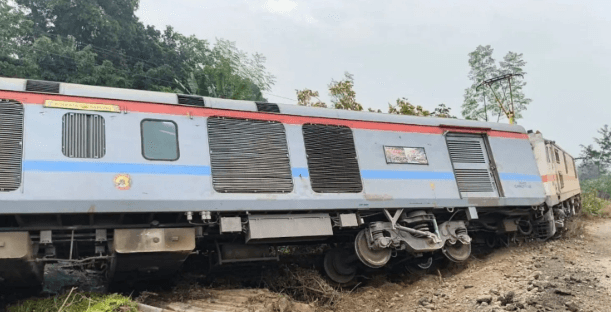
The Sairang Express Accident
Context: The locomotive and five passenger carriages of the Mizoram-bound Kolkata-Sairang Express derailed near Digaru station in Assam’s Kamrup district.

About The Sairang Express Accident:
What It Is?
- A railway derailment involving a passenger express train operated under the Northeast Frontier Railway (NFR) zone during a routine loop-line reception maneuver.
Key Incident Details:
- Occurred around 6:54 a.m. at Digaru Railway Station in Kamrup district, Assam, while holding the train to allow a higher-priority train to pass.
- NFR officials stated that the loco pilot lost control of the train’s speed during reception, though unverified online accounts also alleged an emergency brake failure.
- Official statements reported zero fatalities and confirmed all passengers were safe, though local accounts noted a few minor-to-moderate injuries during evacuation and recovery.
Recent Major Railway Accidents in India:
- Kanchanjunga Express Collision: A goods train rammed into the stationary Sealdah-bound Kanchanjunga Express near New Jalpaiguri in West Bengal due to signalling failure and Signal Passing at Danger (SPAD), causing 10 fatalities.
- Howrah-CSMT Mail Derailment: Eighteen coaches of the Mumbai-bound express train derailed near Barabamboo in Jharkhand after colliding with derailed wagons of an adjacent freight train, killing 2 passengers.
- Chandigarh-Dibrugarh Express Derailment: Multiple coaches derailed near Gonda in Uttar Pradesh following suspected track weld failure and alignment defects, resulting in 4 deaths.
- Bagmati Express Collision: The Mysuru-Darbhanga Bagmati Express collided with a stationary goods train at Kavaraippettai station near Chennai after inadvertently entering a loop line instead of the main track.
Key Causes of Railway Accidents in India:
- Engineering & Track Maintenance Deficits: According to a 2022 CAG audit, derailments accounted for ~75% of consequential accidents (2017–2021), with track defects—such as rail fractures, metal fatigue, and underutilization of track-maintenance machines (idle 16% of available days)—acting as primary triggers.
E.g., Extreme seasonal temperature swings causing rail buckling or thermal fractures on high-density corridors.
- Geotechnical Instability & Ballast Fouling: Breakdown of crushed stone ballast under heavy axle loads traps moisture and erodes the track bed, misaligning concrete sleepers and distorting track geometry.
E.g., Delayed “deep-screening” (cleaning fouled ballast) leading to uneven track settlement during monsoon downpours.
- Human Error & Crew Fatigue: Loco pilot over-speeding, braking anomalies, and Signal Passing at Danger (SPAD)—often exacerbated by duty hours exceeding prescribed limits—contributed directly to 154 derailment cases in the CAG review.
E.g., Loco pilots failing to decelerate within safe thresholds when diverted onto loop lines with lower speed restrictions.
- Signalling & Interlocking Vulnerabilities: Failures in electronic interlocking relays, communication breakdowns, and improperly set points and crossings can route trains onto occupied or unsafe tracks.
E.g., Improper point-machine switching directing high-speed mainline trains onto loop lines occupied by stationary freight rakes.
Initiatives Taken So Far:
- Indigenous ‘Kavach’ Automatic Train Protection (ATP): Deployment of an indigenously developed cab-signalling and collision-avoidance system that automatically applies brakes if a loco pilot overspeeds or passes a red signal.
- Rashtriya Rail Sanraksha Kosh (RRSK): Creation of a dedicated non-lapsable safety fund to finance critical track renewals, bridge rehabilitation, and rolling-stock upgrades.
- Transition to LHB Coaches: Phasing out legacy ICF coaches in favor of Linke Hofmann Busch (LHB) stainless-steel coaches featuring anti-climbing technology that prevents coaches from telescoping during derailments.
- Ultrasonic Flaw Detection (USFD) & Electronic Interlocking: Regular ultrasonic scanning of rails to detect internal micro-cracks alongside centralized electronic interlocking systems to eliminate manual point-setting errors.
Way Ahead:
- Accelerate Mission-Mode ‘Kavach’ Rollout: Fast-track the installation of Kavach ATP across all high-density network (HDN) and non-HDN routes, including Northeast Frontier corridors, to neutralize human speed errors.
E.g., Integrating Kavach onboard units on all locomotives operating along single-line and steep-gradient routes in Assam and the Northeast.
- Strict Enforcement of Crew Duty Rosters & Vigilance Controls: Mandate automated crew-management systems to cap continuous duty hours and install Vigilance Control Devices (VCD) with AI fatigue-monitoring cameras in cabs.
E.g., Automatic audio-visual alerts and emergency brake triggers if a loco pilot fails to acknowledge vigilance prompts within 60 seconds.
- Mechanize Track Maintenance & Deep-Screening: Eliminate idle time of track-laying and ballast-cleaning machines through predictive scheduling and continuous track-recording car diagnostics.
E.g., Deploying automated sensor-equipped inspection coaches to detect rail geometry deviations before they reach critical thresholds.
- Time-Bound Accident Inquiries & Accountability: Enforce strict deadlines for Commissioner of Railway Safety (CRS) inquiry reports—addressing the CAG finding that 63% of inquiries were delayed—to ensure swift corrective enforcement.
E.g., Creating a centralized digital tracking dashboard to monitor compliance with CRS safety recommendations across all 19 railway zones.
Conclusion:
The Sairang Express derailment serves as a stark reminder that even without casualties, lapses in speed control, braking reliability, and track management pose severe risks to passenger safety. Addressing the root causes of derailments requires shifting from reactive post-accident inquiries to proactive, technology-driven prevention. Accelerating the nationwide deployment of Kavach, enforcing strict crew-rest norms, and modernizing track maintenance are essential to building a zero-accident railway network.
By addressing the root causes of accidents and implementing preventive measures, railway accidents in India can be significantly reduced, ensuring safer journeys for passengers and enhancing the overall efficiency of the rail network. Examine.



