
UP शिक्षा सेवा चयन आयोग 2026: Avarodh Panel (Waitlist) System Abolished in Teacher Recruitment — New Rules, Vacancies & What Changes for Candidates
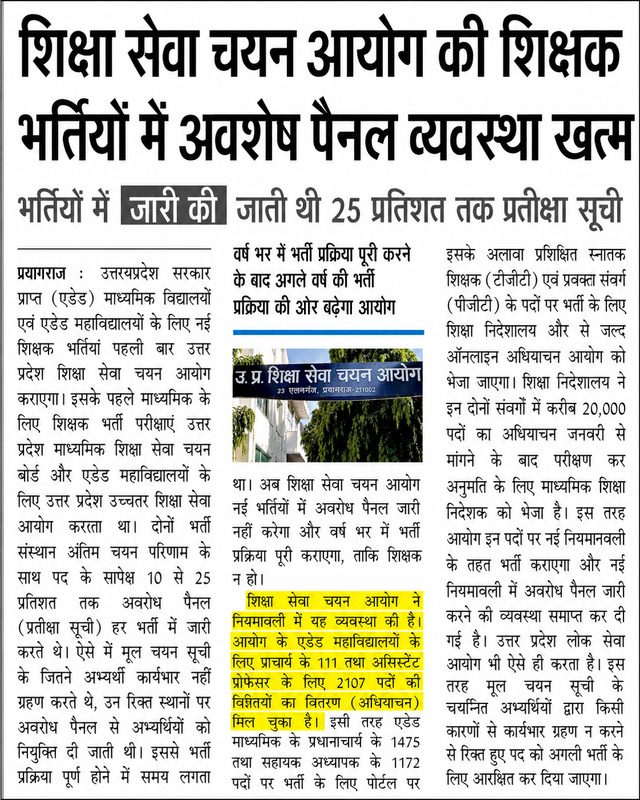
UP Shiksha Seva Chayan Aayog 2026 has made a landmark change in Uttar Pradesh teacher recruitment: the long-standing Avarodh Panel (अवरोध पैनल) — the waiting list system maintained in all aided school and college teacher appointments — has been formally abolished. This structural change, embedded into the new recruitment rules (नियमावली) of the Uttar Pradesh Education Service Selection Commission, marks the most significant overhaul in UP teacher hiring in years.
What Is the Avarodh Panel — and Why Was It Used?
To understand why abolishing it matters, you first need to understand what the Avarodh Panel was and how it worked.
The Old System
When UP's teacher recruitment agencies — the Uttar Pradesh Madhyamik Shiksha Seva Chayan Board (for aided secondary schools) and the Uttar Pradesh Uchchtar Shiksha Seva Aayog (for aided colleges) — released their final selection lists, they did not just announce the selected candidates. They also issued an additional waiting list — the Avarodh Panel (अवरोध पैनल) or Prateeksha Soochi (प्रतीक्षा सूची) — containing 10% to 25% extra candidates over and above the actual number of vacancies.
Why the Waitlist Existed
The logic behind the Avarodh Panel was straightforward: not every candidate on the final selection list actually joins. Some candidates withdraw, some join other government jobs, some miss the document verification deadline, and some decline the posting location. When these vacancies arose, institutions had to wait months for the next recruitment cycle. The waitlist was a buffer — a ready supply of pre-approved candidates who could be immediately appointed to fill seats left vacant by original selectees.
Old System Parameter | Detail |
|---|---|
Waitlist Size | 10% to 25% over actual vacancy count |
Issued By | UP Madhyamik Shiksha Seva Chayan Board (secondary) and UP Uchchtar Shiksha Seva Aayog (college) |
Purpose | Fill vacancies left when selected candidates did not join |
Problem It Created | Prolonged recruitment timelines; waitlisted candidates remained in limbo for months or years |
What Has Changed Under UP Shiksha Seva Chayan Aayog's New Rules?
The New System — No More Avarodh Panel
The Uttar Pradesh Shiksha Seva Chayan Aayog (शिक्षा सेवा चयन आयोग) — the newly established unified body that has now absorbed the functions of both the old secondary board and the higher education commission — has eliminated the Avarodh Panel from its recruitment framework entirely.
New System Parameter | Detail |
|---|---|
Avarodh Panel (Waitlist) | Abolished — will no longer be issued |
Unfilled Vacancies | Carried forward to next year's recruitment |
Recruitment Calendar | One full cycle per year — completed before moving to next |
Legal Complications | Significantly reduced — no panel-based disputes |
Authority | UP Shiksha Seva Chayan Aayog (unified new body) |
Current Vacancy Pipeline Under UP Shiksha Seva Chayan Aayog 2026
Aided Colleges (एडेड महाविद्यालय) — Vacancies Received
Post | Number of Vacancies | Status |
|---|---|---|
Principal (प्राचार्य) | 111 | Notification received on portal |
Assistant Professor (सहायक प्रोफेसर) | 2,107 | Notification received on portal |
Aided Secondary Schools (एडेड माध्यमिक विद्यालय) — Vacancies Received
Post | Number of Vacancies | Status |
|---|---|---|
Principal (प्राचार्य) | 1,475 | Notification received on portal |
Head Teacher (प्रधानाध्यापक) | 1,172 | Notification received on portal |
TGT and PGT Posts — Under Processing
Post | Number of Vacancies | Status |
|---|---|---|
Trained Graduate Teacher — TGT (प्रशिक्षण स्नातक शिक्षक) | ~20,000 (combined) | Collected from districts — sent to Secondary Education Director for processing approval |
Lecturer Cadre — PGT (प्रवक्ता संवर्ग) | Included in ~20,000 | Same — awaiting notification from Education Directorate |
The Education Directorate (शिक्षा निदेशालय) has collected approximately 20,000 combined TGT and PGT vacancies from districts across UP. These have been sent to the Director of Secondary Education (माध्यमिक शिक्षा निदेशक) for verification and approval. Once cleared, a formal notification will be sent to the Commission.
Total Vacancy Summary
Category | Approximate Vacancies |
|---|---|
College Principals | 111 |
Assistant Professors | 2,107 |
Secondary School Principals | 1,475 |
Head Teachers | 1,172 |
TGT Posts | ~10,000+ (from ~20,000 combined) |
PGT Posts | ~10,000+ (from ~20,000 combined) |
Total Pipeline | ~25,000+ |
Who Is UP Shiksha Seva Chayan Aayog — The New Unified Authority
Old Body | What It Did | Now Replaced By |
|---|---|---|
UP Madhyamik Shiksha Seva Chayan Board | Recruited teachers for aided secondary schools (Class 9–12) | UP Shiksha Seva Chayan Aayog |
UP Uchchtar Shiksha Seva Aayog | Recruited teachers and principals for aided colleges | UP Shiksha Seva Chayan Aayog |
What This Means for Different Categories of Candidates
If You Are a Fresh Teacher Recruitment Aspirant
This change works strongly in your favour. The new single Commission will run annual, time-bound recruitment cycles with no backlog from old panels. You know exactly when to expect notifications, when exams will happen, and when results will be declared — because the Commission commits to completing one cycle before starting the next.
If You Were on an Avarodh Panel from Previous Recruitments
If you are currently on a waitlist from a previous recruitment done by the old boards (not the new Commission), your panel status is governed by the rules of those old bodies — not the new Commission's framework. The abolition of the Avarodh Panel applies to new recruitments conducted by the Shiksha Seva Chayan Aayog going forward.
Any pending panel appointments from the Chayan Board or the old Uchchtar Shiksha Seva Aayog remain subject to the rules under which those panels were originally issued. Candidates in that position should follow the orders of the respective courts or the old boards for their appointments.
If You Are a Currently Serving Teacher in an Aided School or College
This change does not affect your service conditions, salary, or posting. It only affects the process for future recruitment of new teachers in aided institutions.
If You Are Preparing for TGT or PGT
With approximately 20,000 TGT and PGT vacancies currently being processed by the Education Directorate, a large-scale notification is expected soon. Under the new system, once the Commission receives the formal notification from the Directorate, the recruitment timeline will be announced and the process will run to completion without any panel-based extensions.
Full Recruitment Process Under New Rules — Step by Step
Under the Shiksha Seva Chayan Aayog's new framework, every recruitment will follow this clean sequence:
Step | Process | Notes |
|---|---|---|
1 | Education Directorate / institutions collect vacancies from districts | Already done for TGT/PGT (~20,000) |
2 | Directorate sends vacancy notification to Commission | In progress for TGT/PGT |
3 | Commission releases official recruitment advertisement on portal | After receiving notification |
4 | Online application window opens for eligible candidates | Dates announced with advertisement |
5 | Written examination conducted | As per schedule |
6 | Result declared + final selection list published | No waitlist issued |
7 | Document verification and joining of selected candidates | Within specified time limit |
8 | Unfilled vacancies (due to non-joining) rolled to next year | New system — replaces panel |
9 | Commission moves to next year's recruitment cycle | Clean annual rotation |
Official portal |
CLICK HERE TO JOIN FULL COURSE - Click Here