UPTET Exam Pattern 2026: Paper 1 & 2 Complete Guide
UPTET Exam Pattern 2026 is one of the most important things every candidate should understand before starting preparation. Knowing the latest syllabus and paper pattern helps you prepare in the right direction and score better in the exam.
The Uttar Pradesh Teacher Eligibility Test (UPTET) is conducted for candidates who want to become primary and upper primary teachers in Uttar Pradesh schools.
This guide covers:
UPTET Exam Pattern
Paper 1 Syllabus
Paper 2 Syllabus
Marks distribution
Preparation tips
What is UPTET?
UPTET stands for Uttar Pradesh Teacher Eligibility Test. It is a state-level teaching eligibility exam for candidates aiming to become teachers in government and aided schools in Uttar Pradesh.
There are two papers:
Paper 1
For candidates who want to teach Classes 1 to 5
Paper 2
For candidates who want to teach Classes 6 to 8
Candidates who want to teach Classes 1 to 8 can appear for both papers.
UPTET 2026 Exam Date
UPTET Exam Date & Time | |||
Exam | Date | Timing | Shift |
UP TET Paper I | 02, 03 & 04 July 2026 | 9:30 AM to 12 Noon | Shift 1 |
UP TET Paper II | 2:30 PM to 5 PM | Shift 1 | |
Conducting Body | Uttar Pradesh Education Service Selection Commission (UPESSC) |
UPTET Exam Pattern 2026
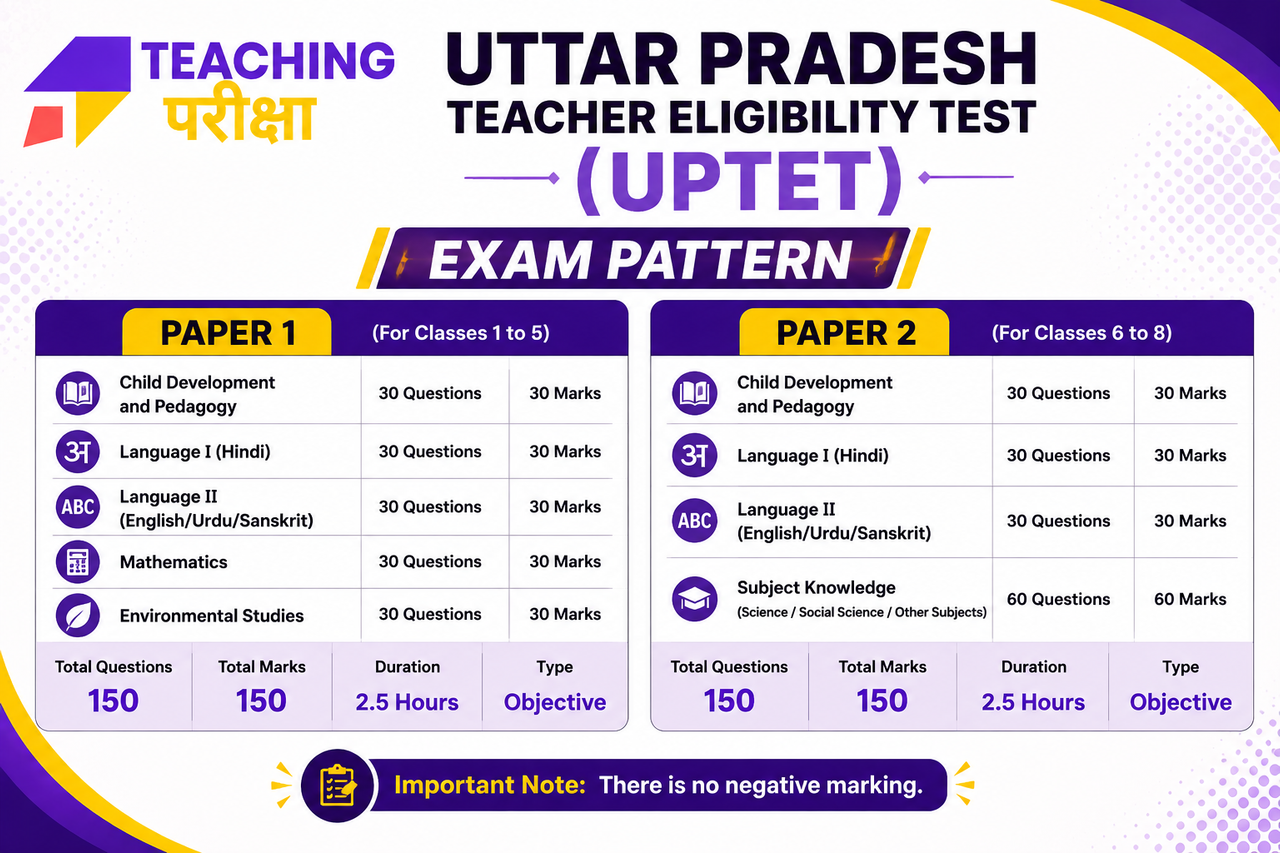
Paper 1 Exam Pattern (Primary Level)
Subject | Questions | Marks |
|---|---|---|
Child Development & Pedagogy | 30 | 30 |
Language I (Hindi) | 30 | 30 |
Language II (English/Urdu/Sanskrit) | 30 | 30 |
Mathematics | 30 | 30 |
Environmental Studies | 30 | 30 |
Total
150 Questions
150 Marks
Duration: 2 Hours 30 Minutes
No Negative Marking
Paper 2 Exam Pattern (Upper Primary Level)
Subject | Questions | Marks |
|---|---|---|
Child Development & Pedagogy | 30 | 30 |
Language I | 30 | 30 |
Language II | 30 | 30 |
Mathematics & Science OR Social Science | 60 | 60 |
Total
150 Questions
150 Marks
Duration: 2 Hours 30 Minutes
No Negative Marking
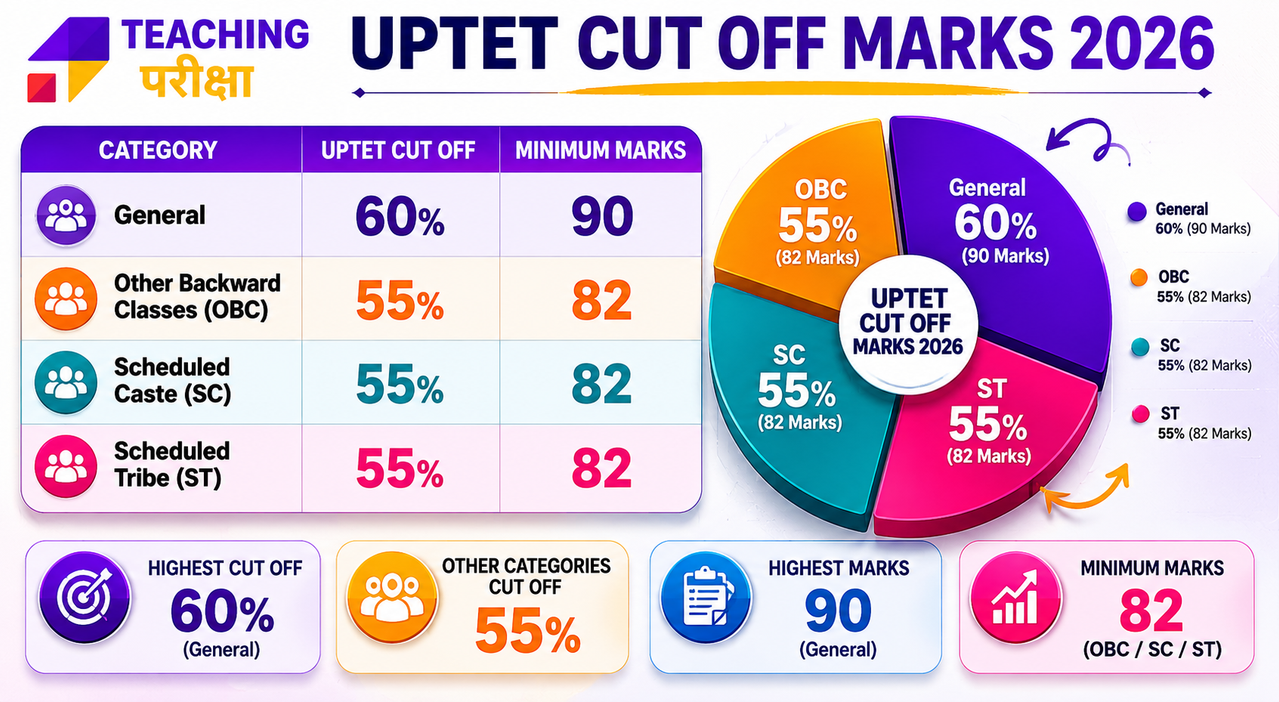
UPTET Qualifying Marks
General Category
60% = 90 Marks
Reserved Category
55% = 82–83 Marks (as per rules)
UPTET Cut Off Marks 2026
Category | UPTET Cut Off | Minimum Marks |
|---|---|---|
General | 60% | 90 |
Other Backward Classes (OBC) | 55% | 82 |
Scheduled Caste (SC) | 55% | 82 |
Scheduled Tribe (ST) | 55% | 82 |
The Detailed Syllabus for UPTET Paper-I is as follows:
Subject / Section | Key Topics Covered |
|---|---|
Child Development and Pedagogy | Child Development Meaning, need, scope, and stages of child development Physical, mental, emotional, social, and language development Development of expressive ability, creativity, and creative skills Bases of child development and influencing factors such as heredity and environment (family, social, school, and mass media) Learning and Its Theories Meaning of learning and factors affecting learning Effective methods of learning Laws of learning by Thorndike and their importance Major learning theories and their classroom applications, trial and error theory, Pavlov’s conditioning theory, Skinner’s operant conditioning, Kohler’s insight theory, Piaget’s theory, Vygotsky’s theory Learning curve, meaning, and types Causes and remedies of learning difficulties Teaching and Teaching Methods Meaning and objectives of teaching Teaching principles, sources, techniques, and innovative teaching methods Micro-teaching and basic teaching skills Inclusive Education (Guidance and Counselling) Meaning, identification, types, and remedies of inclusive education Inclusion related to disadvantaged groups based on language, religion, caste, region, colour, gender, and physical challenges (visually impaired, hearing impaired, speech impaired), and mental challenges Teaching aids, materials, methods, TLM, and activities for inclusion Tools and techniques for assessing the learning of inclusive children Special teaching methods for inclusive children (such as Braille) Guidance and counselling for inclusive children, meaning, objectives, types, methods, needs, and scope Supporting institutions and departments: Psychological laboratories (UP, Prayagraj), Divisional psychological centres, District hospitals, DIET institutions, Inspection and supervision systems, Community and school support committees, Government and non-government organisations. Importance of guidance and counselling in child learning Learning and Teaching How children think and learn Reasons for success and failure in school performance Learning as a social process Child as a problem solver and scientific thinker Alternative concepts in learning and understanding children’s errors Motivation and learning Factors influencing learning, personal and environmental |
Language 1 – Hindi | हिंदी (विषय-वस्तु) अपठित अनुच्छेद हिंदी वर्णमाला (स्वर और व्यंजन) वर्णों के मेल से मात्रिक तथा अमात्रिक शब्दों की पहचान वाक्य रचना हिंदी की सभी ध्वनियों के पारस्परिक अंतर की जानकारी, विशेष रूप से श, स, ष, ब, व, ड़, ढ़, क्ष, त्र, ज्ञ तथा न की ध्वनियाँ हिंदी भाषा की सभी ध्वनियों, वर्णों, अनुस्वार, अनुनासिक और चंद्रबिंदु के बीच अंतर संयुक्ताक्षर एवं अनुनासिक ध्वनियों के प्रयोग से बने शब्द सभी प्रकार की मात्राएँ विराम चिह्नों का प्रयोग, जैसे अल्प विराम, अर्ध विराम, पूर्ण विराम, प्रश्नवाचक, विस्मयबोधक विलोम, समानार्थी, तुकांत, अतुकांत तथा समान ध्वनि वाले शब्द संज्ञा, सर्वनाम, क्रिया और विशेषण के भेद वचन, लिंग और काल प्रत्यय, उपसर्ग, तत्सम, तद्भव और देशज शब्दों की पहचान एवं उनमें अंतर लोकोक्तियाँ और मुहावरों के अर्थ संधि: स्वर संधि (दीर्घ संधि, गुण संधि, वृद्धि संधि, यण संधि, अयादि संधि), व्यंजन संधि, विसर्ग संधि वाच्य, समास और अलंकार के भेद कवियों और लेखकों की रचनाएँ भाषा विकास का अध्यापन अधिगम और अर्जन भाषा अध्यापन के सिद्धांत सुनने और बोलने की भूमिका, भाषा का कार्य तथा बालक भाषा का प्रयोग किस प्रकार एक उपकरण के रूप में करता है मौखिक और लिखित रूप में विचारों की अभिव्यक्ति के लिए भाषा अधिगम में व्याकरण की भूमिका भिन्न-भिन्न कक्षाओं में भाषा पढ़ाने की चुनौतियाँ, जैसे भाषा की कठिनाइयाँ, त्रुटियाँ और विकार भाषा कौशल भाषा बोधगम्यता और प्रवीणता का मूल्यांकन, बोलना, सुनना, पढ़ना और लिखना अध्यापन-अधिगम सामग्री, जैसे पाठ्यपुस्तकें, मल्टीमीडिया सामग्री और कक्षा के बहुभाषी संसाधन उपचारात्मक अध्यापन |
Language 2 – English / Urdu / Sanskrit | Unseen passage Sentences (subject and predicate, kinds of sentences) Parts of speech (noun, pronoun, verb, adjective, adverb, preposition, conjunction) Tenses (present, past, future) Articles Punctuation Word formation Active and passive voice Singular and plural Gender |
Mathematics | Numbers and operations (addition, subtraction, multiplication, division) LCM and HCF Fractions and decimals Basic rules Percentage Profit and loss Simple interest Geometry (shapes, angles, triangles, circles) Money Measurement (time, weight, capacity, length, temperature) Perimeter and area Calendar Data handling Volume and capacity Time and distance Data presentation and interpretation Pedagogical Issues Nature of mathematical thinking Place of mathematics in curriculum Mathematical language Community mathematics Formal and informal assessment Teaching difficulties Error analysis Diagnostic and remedial teaching |
Environmental Studies (EVS) (Science, History, Geography, Civics, and Environment) | Family Food, health, and cleanliness Shelter Plants and animals Our surroundings Festivals Occupations Water Transport and communication Games and sports India, rivers, mountains, forests, transport Our state Constitution Governance system (local bodies, panchayats, municipal corporations, state and national governance) National symbols, festivals, voting, national unity Environment, importance, conservation, social responsibility, and government schemes Pedagogical Issues Concept and scope of EVS Importance of integrated EVS EVS and environmental education Learning theories Relationship between science and social science Concept presentation Activities and practical work Discussion Continuous and comprehensive evaluation Teaching materials and tools Problems in teaching EVS |
The Detailed Syllabus for UPTET Paper-II (Social Studies) is as follows:
Subject / Section | Key Topics Covered |
|---|---|
Child Development and Pedagogy | Child Development Meaning, need, scope, and stages of child development Physical, mental, emotional, social, and language development Development of expression ability, creativity, and creative potential Foundations of child development and influencing factors such as heredity and environment (family, society, school, and mass media) Learning and Its Theories Meaning of learning and factors influencing learning Effective learning methods Laws of learning by Thorndike and their importance in learning Major learning theories and their classroom applications: Trial and Error Theory (Thorndike), Conditioning Theory (Pavlov), Operant Conditioning Theory (Skinner), Insight Theory (Kohler), Cognitive Development Theory (Piaget), Socio-cultural Theory (Vygotsky) Learning curve, its meaning and types Causes of learning difficulties and their remedies Teaching and Teaching Methods Meaning and objectives of teaching Communication, principles of teaching, sources, and techniques Teaching methods and innovative approaches (micro-teaching) Basic teaching skills Inclusive Education (Guidance and Counselling) Meaning, identification, types, and remedies related to inclusive education Inclusion of disadvantaged groups based on language, religion, caste, region, colour, gender, physical disabilities (visual, hearing, speech), and mental challenges Teaching aids, materials, methods, TLM, and activities for inclusion Tools and techniques to assess the learning of inclusive children Special teaching methods for inclusive children (such as Braille) Guidance and counselling for inclusive children: meaning, objectives, types, methods, needs, and scope Supporting departments and institutions: Psychological laboratories (UP, Prayagraj), Divisional psychological centres, District hospitals, DIET institutions and trained mentors, Inspection and supervision system, Community and school support committees, Government and non-government organisations Importance of guidance and counselling in child learning Learning and Teaching How children think and learn Reasons for success and failure in school performance Learning as a social process Child as a problem solver and scientific investigator Alternative concepts in learning and understanding children’s errors Motivation and learning Factors influencing learning, personal and environmental |
Language 1 – Hindi | Grammar and reading comprehension अपठित गद्यांश संज्ञा, सर्वनाम, विशेषण, क्रिया वाच्य वाक्य रचना विराम चिह्न पर्यायवाची, विलोम समास संधि मुहावरे और लोकोक्तियाँ उपसर्ग, प्रत्यय तत्सम, तद्भव सकर्मक और अकर्मक क्रिया अलंकार भाषा विकास का अध्यापनः- अधिगम अर्जन। भाषा अध्यापन के सिद्धान्त। सुनने और बोलने की भूमिका; भाषा का कार्य तथा बालक इसे किस प्रकार एक उपकरण के रूप में प्रयोग करते हैं। मौखिक और लिखित रूप में विचारों के संप्रेषण के लिए किसी भाषा के अधिगम में व्याकरण की भूमिका पर विवेचित संदर्श। एक भिन्न कक्षा में भाषा पढ़ाने की चुनौतियां, भाषा की कठिनाइयां, त्रुटियां और विकार। भाषा कौशल। भाषा बोधगम्यता और प्रवीणता का मूल्यांकन करनाः बोलना, सुनना, पढ़ना और लिखना। अध्यापन-अधिगम सामग्रियांः पाठ्यपुस्तक, मल्टी मीडिया सामग्री, कक्षा का बहुभाषायी संसाधन । उपचारात्मक अध्यापन। |
Language 2 – English / Urdu / Sanskrit | Unseen passage Nouns and their kinds Pronouns and their kinds Verbs and their kinds Adjectives (kinds and degrees) Adverbs and their kinds Prepositions and their kinds Conjunctions and their kinds Interjections Singular and plural Subject and predicate Negative and interrogative sentences Masculine and feminine genders Punctuation Root words and suffixes Phrasal verbs Use of somebody, nobody, anybody Parts of speech Narration Active and passive voice Antonyms and synonyms Homophones Use of requests in sentences Silent letters in words |
Mathematics | Natural numbers, whole numbers, rational numbers Integers, LCM, and HCF Square root and cube root Algebraic expressions and identities Linear, quadratic, and simultaneous equations Geometry (parallel lines, quadrilaterals, triangles, circles, tangents) Commercial mathematics (ratio, proportion, percentage, profit and loss, simple and compound interest, tax, banking) Statistics (classification of data, mean, median, mode, bar, and pie charts) Probability Mensuration Exponents Pedagogical Issues Nature of mathematical and logical thinking Place of mathematics in the curriculum Mathematical language Community mathematics Assessment Remedial teaching Teaching difficulties |
Science | Science in daily life and technological development Living and non-living things Classification of plants and animals Human body systems Nutrition in plants and animals Health, hygiene, and diseases Matter, force, motion, energy, sound, light, electricity, and magnetism Environment, air, water, soil, pollution, and conservation Natural resources and alternative energy sources Carbon and its compounds Pedagogical Issues Nature and structure of science Aims and objectives of science education Scientific inquiry and experimentation Innovation and creativity Teaching-learning materials Assessment Remedial teaching |
Social Studies | History Sources of history Stone Age and Copper Age culture Vedic culture 6th century BC India Early Indian states Mauryan Empire Gupta period Rajput period South Indian states Arrival of Islam Delhi Sultanate Mughal Empire Arrival of Europeans British expansion Renaissance in India Rise of nationalism Freedom movement Partition and independent India Civics Society Rural and urban life Self-government District administration Constitution Democracy in India Traffic safety State and central governance National security Foreign policy Citizen rights and protection Geography Earth in the solar system Globe and locations Earth’s movements Maps Earth structure India’s physical features Soil, vegetation, wildlife, climate Economic resources Trade and communication Uttar Pradesh geography Population and urbanisation Natural disasters and disaster management Environmental Studies Natural resources Natural balance Population growth and environment Pollution Waste management Environment Day and environmental awareness Home Science Health, nutrition, hygiene, food preservation, and household management Physical Education and Sports Physical education, yoga, games, national and international sports, and first aid Music Swar knowledge, ragas, rhythm, patriotic and devotional songs Agriculture and Horticulture Soil, irrigation, crops, fruits, vegetables, preservation, and climate science Pedagogical Issues (Social Studies) Concepts and methods of social studies teaching Classroom processes, activities, and discussion Project work and assessment |
UPTET Syllabus PDF Download Link
UPTET syllabus PDF | |
UPTET Paper 1 Syllabus PDF Download | |
UPTET Paper 2 Syllabus PDF Download | |
Read Full News ▶YouTube BY DANISH SIR
Candidates preparing for teaching examinations can evaluate their readiness with live Teaching Pariksha Online Mock Tests & Practice Sets.