
Why India Needs a Comprehensive National Urbanisation Policy?
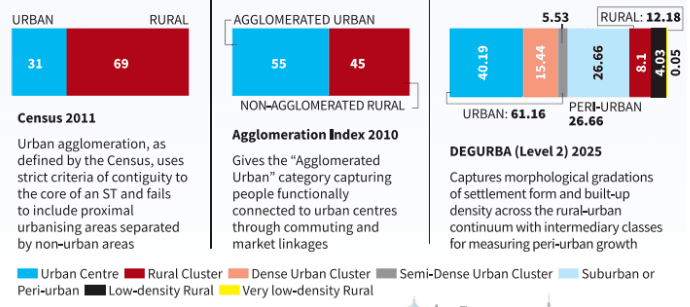
Context: India’s upcoming Census, after a 16-year gap, will retain 2011 urban classification criteria, potentially undercounting urbanisation and highlighting the need for a unified National Urbanisation Policy (NUP).
About Why India Needs a Comprehensive National Urbanisation Policy?
What is it?
- The proposed National Urbanisation Policy (NUP) seeks to establish a unified framework for managing India’s rapidly expanding urban and peri-urban settlements.
- It advocates shifting from rigid rural-urban classifications to functional urban regions, integrating land use, infrastructure, economic activity and environmental planning.
Classification Framework:
- Statutory Towns: Settlements formally notified by state governments under municipal legislation (e.g., Municipal Corporations, Municipalities, Nagar Panchayats), irrespective of demographic size.
- Census Towns: Settlements that are administratively governed as rural Gram Panchayats but satisfy three demographic benchmarks:
- Minimum population of 5,000.
- Minimum density of 400 persons per sq. km.
- At least 75% of the male main working population engaged in non-agricultural pursuits.
- The Continuum Reality: Modern urban development in India spills over municipal administrative borders into fast-growing peri-urban belts, where land use, labor markets, and daily commutes are functionally urban while local administration remains rural.

Key Data & Stats on Indian Urbanization:
- Urban Population Growth: Census 2011 recorded 377 million urban residents across ~8,000 settlements; UN projections indicate 44% urbanisation today, exceeding 720 million people by 2050.
- Functional Urbanisation Undercount: The Economic Survey cited satellite data suggesting India was already 63% urban in 2015, revealing gaps in conventional census classification.
- Rapid Peri-Urban Expansion: Peri-urban areas are growing at 4.15% annually, significantly faster than core municipal areas (2.9%).\
- Urban Planning Deficits: Around 52% of statutory towns and 76% of census towns lack master plans, while nine states retain outdated town-planning laws.
- Weak Municipal Finances: Municipal revenues remain near 1% of GDP, with property taxes contributing just 0.15%, far below Brazil (7.4%) and South Africa (6%).
Structural Limitations of the Rural-Urban Binary:
- Governance and Technical Capacity Deficits: Rural Panchayats lack the engineering manpower, technical capacity, and statutory authority needed to manage high-density urban requirements.
E.g., The Bhiwandi logistics hub near Mumbai spans 60 villages and 9 census towns with over 91.8% non-agricultural employment, yet basic infrastructure, fire safety, and sanitation remain under rural village panchayats.
- Outdated Town Planning Legal Frameworks: Reliance on outdated planning legislation leaves transitioning peri-urban towns without statutory development zoning.
E.g., States continuing to draft municipal master plans based on the 1985 Model Town and Country Planning Law, which predates the 74th Amendment and ignores climate-resilient spatial zoning.
- Fiscal Distortions and Inequitable Transfers: Settlements trapped in the Census Town category are excluded from dedicated urban municipal financing, capital grants, and municipal bond markets.
E.g., Fast-growing peri-urban industrial belts relying on small rural untied grants that are insufficient to finance civic storm-water drainage or piped sewerage networks.
- Jurisdictional Mismatch for Environmental Governance: Environmental and civic problems operate across natural, functional regions rather than administrative boundaries.
E.g., Over 65% of Delhi’s winter PM 2.5 air pollution originates beyond city limits, rendering standalone municipal clean-air action plans ineffective.
Seven Systems Transformations for a National Urbanisation Policy:
- Standardise Urban Settlement Classification: Establish clear, periodic statutory reviews using satellite imaging and geospatial economic data to classify settlements along the rural-urban continuum, avoiding reliance solely on decennial censuses.
- Modernise Spatial & Regional Planning: Extend statutory regional master planning below the million-plus city threshold to guide land-use conversion, transit-oriented development, and climate adaptation in peri-urban belts.
- Reorient Urban Finance Architecture: Enhance own-source municipal revenues (such as digital property-tax reforms) and expand predictable, formula-based transfers to replace unpredictable, scheme-based grants.
- Institutionalize a National Urbanisation Council: Create a high-level inter-governmental platform—akin to the GST Council—to coordinate urban policies, resolve inter-state boundary disputes, and align central, state, and local investments.
- Anchor Sectoral Reforms on Functional Geographies: Restructure infrastructure and environmental planning around functional units—such as airsheds, river basins, and commuter corridors—rather than rigid municipal jurisdictions.
- Align Political and Fiscal Reform Incentives: Tie central capital assistance to state-level devolution of the 18 municipal functions under the Twelfth Schedule, incentivizing states to merge peri-urban areas into adjoining urban bodies.
- Foster City Knowledge Networks and Local Innovation: Build municipal shared-service platforms and technical project preparation facilities (PPFs) to help tier-2 and tier-3 towns design bankable infrastructure projects.
Way Ahead:
- Operationalize 16th Finance Commission Transition Incentives: Leverage the ₹10,000-crore Urbanisation Premium to encourage states to systematically merge peri-urban fringe villages into contiguous Urban Local Bodies (ULBs).
- Activate Metropolitan and District Planning Committees (MPCs/DPCs): Enforce Articles 243ZD and 243ZE of the Constitution to make MPCs and DPCs functioning statutory coordinators of regional infrastructure, rather than paper institutions.
- Deploy City Economic Region (CER) Corridors: Utilize the Union Budget’s ₹5,000-crore CER allocations to fund integrated public transit and shared civic utilities across multi-jurisdictional urban clusters.
- Mandate Devolution of the 3Fs (Funds, Functions, Functionaries): Require states to pair the urban notification of census towns with actual administrative staff recruitment powers and financial revenue sources.
Conclusion:
Measuring urban India using decades-old census yardsticks obscures the rapid economic growth occurring along the rural-urban continuum. Leaving dense peri-urban corridors under rural local governance deprives them of essential municipal services, statutory spatial planning, and adequate civic finance. Formulating a National Urbanisation Policy that shifts planning from rigid administrative borders to dynamic, functional economic regions will be vital to building sustainable, productive, and climate-resilient cities.
Recognising transitional urban areas is essential for inclusive urbanisation. Assess the socio-economic vulnerabilities of such regions. Suggest measures to strengthen their development planning.



