
Why Strong El Niño Does Not Always Cause Drought?
Context: Despite a ferocious El Niño developing in the Pacific with sea surface temperature anomalies approaching 2°C and pushing the 2026 southwest monsoon to a 13% deficit, historical climate records show that even a severe El Niño does not automatically result in a monsoon failure or drought in India.
About Why Strong El Niño Does Not Always Cause Drought?
What is Normal State (Walker Circulation)?
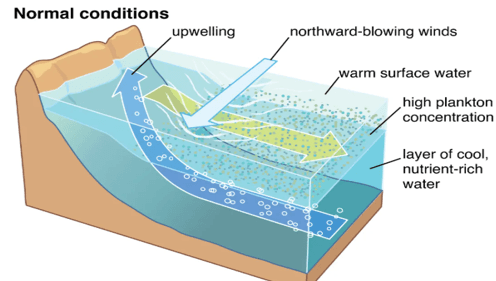
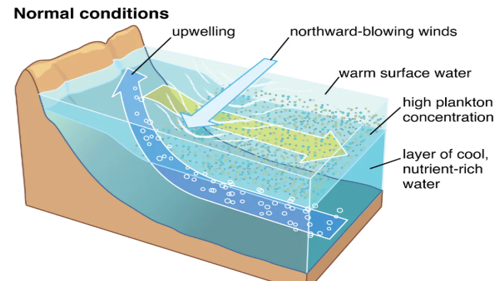
- Under normal conditions, trade winds blow east-to-west across the equatorial Pacific, pooling warm surface waters around Indonesia and driving deep atmospheric convection and rainfall, while cold, nutrient-rich water upwells along the western coast of South America.
What is El Niño Perturbation?
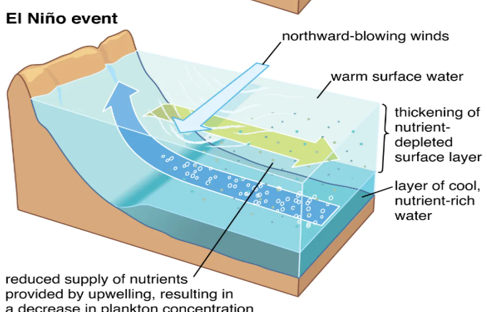
- Every 2 to 7 years, trade winds weaken or reverse. The warm pool sloshes back eastward toward South America, shifting the core of convective storms away from the western Pacific.
Mechanics of Monsoon Suppression:
- The immense column of rising warm, moist air over the eastern/central Pacific forces air to descend elsewhere in the tropical loop.
- A primary descending branch sinks directly over the Indian subcontinent, warming and drying the atmosphere, which suppresses convective cloud formation and weakens the southwesterly monsoon winds.
Key Data / Stats on El Niño & Indian Monsoon:
- El Niño–Monsoon Correlation: Since 1950, five of seven moderate or strong El Niño years reportedly recorded deficient Indian monsoons, highlighting the association between El Niño and reduced rainfall.
- 1997 Anomaly vs. 2015 & 2026: Despite strong El Niño conditions (+1.64°C), India received normal rainfall in 1997, unlike 2015 and reportedly 2026, which recorded significant rainfall deficits.
- 2026 Regional Rainfall Extremes: The southwest monsoon reportedly received only 87.4% of its Long Period Average (LPA), with East and Northeast India experiencing exceptionally severe rainfall deficits.
- Agricultural Dependence: Around 40% of India’s net cultivated area is rain-fed, making agricultural production, rural livelihoods and food security highly vulnerable to monsoon variability.
Factors Explaining Why a Strong El Niño Does Not Guarantee Drought:
- The Indian Ocean Dipole (IOD) Cushion:
- The IOD represents a see-saw of sea surface temperatures between the western Indian Ocean (near Africa) and the eastern Indian Ocean (near Indonesia).
- When a Positive IOD develops, warmer waters in the western Indian Ocean stimulate convection and channel extra moisture across the Arabian Sea into the subcontinent, offsetting El Niño’s drying effect.
E.g., A strong positive IOD neutralized the massive 1997 El Niño; conversely, in 2015, altered circumpolar wind belts around Antarctica prevented the dipole from tipping, leaving the country vulnerable to drought.
- Spatial Location of the Warm Pool (Canonical vs. Modoki):
- When maximum Pacific warming is concentrated in the far eastern Pacific near South America (as occurred in 1997), the descending arm of the Walker circulation is displaced further away from South Asia.
- If the warmest water pools in the Central Pacific (El Niño Modoki), the descending, dry air column settles directly over the Indian landmass, significantly heightening drought probability.
- Intraseasonal Tropical Pulses (Madden-Julian Oscillation – MJO):
- The MJO is a traveling planetary wave of clouds and rain that circles the tropics every 30 to 60 days.
- E.g., In August 2023, the MJO stalled over the Western Hemisphere and Africa, contributing to India’s driest August in 122 years, before a late-season IOD shift revived rainfall in September.
- Synoptic Mid-Latitude Systems & Arabian Sea Dynamics:
- Independent weather systems—such as anomalous high-pressure ridges over the Iranian plateau or unpredicted low-pressure systems over the Arabian Sea—can draw substantial moisture inland, overriding Pacific-induced drying signals as seen in 1983 and 1997.
Agricultural & Economic Implications of Deficient Monsoons:
- Kharif Sowing Disruptions & Yield Losses: Prolonged dry spells during critical vegetative phases suppress acreage and yield for water-intensive staples such as paddy, pulses, and oilseeds.
E.g., Rainfall deficits across southern and central peninsular states in 2026 triggering localized drought declarations and lowering farm incomes.
- Depleted Hydrological Reserves & Groundwater Stress: Inadequate monsoon recharge depletes major multi-purpose reservoirs and shallow aquifers, creating subsequent shortages for rabi irrigation and urban drinking water.
E.g., Precautionary water rationing and agricultural power curbs deployed across river basins in Maharashtra and Karnataka.
- Food Inflation and Macroeconomic Volatility: Lower farm output strains rural demand, drives up headline food inflation, and forces administrative trade curbs such as export bans on rice, wheat, or sugar.
- Forecasting and Prediction Limits: The non-linear interplay between ENSO, the IOD, and short-term atmospheric waves frequently challenges ensemble climate models, complicating seasonal planning for agrarian stakeholders.
Way Ahead:
- Advance Multi-Ocean Coupled Forecasting Models: Refine the Indian Meteorological Department’s dynamic monsoon models to place greater real-time observational weight on Indian Ocean dipole dynamics and intraseasonal tropical waves alongside traditional Pacific Niño indices.
- Expand Climate-Resilient & Low-Water Agriculture: Accelerate the adoption of drought-resistant seeds, short-duration crop varieties, and climate-resilient crops (such as millets and pulses) in rain-fed agro-ecological zones.
- Scale Decentralized Water-Harvesting Infrastructure: Deepen micro-irrigation systems, farm ponds, and community recharge structures (leveraging digital tools like Punah Bharan) to drought-proof rural watersheds.
- Modernize Crop Insurance and Agrarian Safety Nets: Enhance the reach and payout speed of the PM Fasal Bima Yojana using automated satellite and drone-based yield assessments to protect smallholder farmers from dry-season shocks.
Conclusion:
The divergence between Pacific Sea temperatures and Indian rainfall demonstrates that El Niño is a major risk factor rather than a predetermined guarantee of drought. Regional ocean-atmosphere interactions, notably the Indian Ocean Dipole and intra-seasonal weather pulses, exert a powerful counterbalancing influence that can either mitigate or compound rainfall deficits. As climate change alters global ocean circulation and intensifies weather extremes, building local water resilience and refining multi-basin meteorological models will be crucial to safeguarding India’s agricultural economy.
Ocean-atmosphere interactions in the Pacific exert a disproportionate influence on the Indian monsoon system. Elucidate.



