Prelims
Hampi’s Islamic Heritage
Context: Recent historical and architectural surveys of the ruins at Hampi (the erstwhile imperial capital of the Vijayanagara Empire) have spotlighted its scattered mosques, Sufi dargahs, Muslim quarters, and Indo-Saracenic secular structures.

About Hampi’s Islamic Heritage:
What It Is?
- A rich tapestry of religious monuments, residential quarters, epigraphic records, and hybrid Indo-Islamic royal architecture embedded within the Vijayanagara heartland, reflecting centuries of military alliance, trade, and socio-cultural integration between Vijayanagara rulers and their Muslim subjects and neighbors.
Key Monuments and Architectural Features:
- Ahmed Khan Mosque (Dharmasala):
- Dravidian-Islamic Synthesis: Built in 1439 CE by Ahmad Khan, a servant of King Devaraya II, for the monarch’s merit, the structure resembles a traditional pillared granite mandapam open on the east and enclosed on three sides.
- Liturgical Orientation: Features a delicately carved mihrab set into the center of the western wall to indicate the direction of Mecca, blending local temple masonry techniques with Islamic prayer requirements.
- Inscriptional Evidence: Contains a Kannada inscription recording its construction, reflecting state-sanctioned religious patronage.
- Kaddirampura Tombs and Dargah:
- Funerary Architecture: Located east of the royal center in Kaddirampura, featuring two imposing, well-proportioned domed tombs set within a large walled compound.
- Epigraphic Dating: A Kannada inscription within the complex documents that Syed Peer Ali erected a dome here in 1505 CE during the reign of Vira Narasimha.
- Gori Kelagana Grama (Historic Muslim Quarter):
- Dedicated Urban Settlement: Situated along the hill slopes adjacent to the Ahmed Khan Mosque, containing ruins of tombs, stepwells, and residential structures.
- Historical Identification: Identified via a 1564 CE Vittalasamy Temple inscription as ‘Gori Kelagana Grama’, housing Muslim archers, royal bodyguards, horse traders, and Shia commanders granted asylum by rulers like Devaraya II and Rama Raya.
- Indo-Saracenic Royal Structures (Lotus Mahal, Elephant Stables & Queen’s Bath):
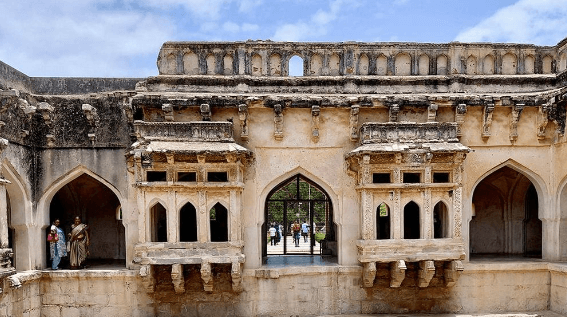
- Hybrid Secular Design: Royal and military buildings—including the Lotus Mahal, Elephant Stables, Guards’ Quarters, Muhammadan Watch Tower, and Queen’s Bath—adopt pointed Islamic arches, vaulted domes, and stucco ornamentation alongside traditional tiered Hindu roofs.
- Cross-Cultural Exchange: Demonstrates how diplomatic exchanges and conflicts with neighboring Deccani Sultanates directly enriched Vijayanagara’s courtly architecture.
- Temple Bas-Reliefs & Courtly Symbols:
- Visual Documentation: Stone bas-reliefs on the Hazara Rama Temple walls and the ceremonial Mahanavami Dibba depict Muslim horse traders, cavalry handlers, and courtly attendants.
- Inclusive Court Protocol: Chronicles by Ferishta and foreign travelers (Domingo Paes, Abdur Razzak) note that rulers like Devaraya II and Rama Raya placed a copy of the Holy Quran on a raised dais in court so Muslim officers could pay obeisance without violating their faith.