Prelims
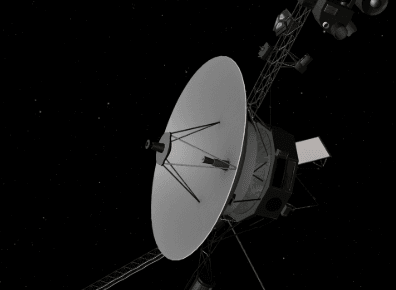
NASA's Voyager 1
Context: NASA’s Voyager 1, the farthest human-made object, is set to reach one light-day from Earth (25.9 billion km) on November 18, 2026, with radio signals taking 24 hours one way.

About NASA’s Voyager 1:
What it is?
- An unmanned deep-space robotic probe launched in 1977 as part of NASA’s Voyager program to explore the outer planets of the Solar System and subsequently continue onward as humanity’s longest-running interstellar explorer.
Organisation: Operated by NASA and managed by its Jet Propulsion Laboratory (JPL), with communication maintained through the Deep Space Network (DSN).
History:
- Launch (1977): Launched on September 5, 1977, from Cape Canaveral, 16 days after Voyager 2, but followed a faster trajectory to Jupiter and Saturn.
- Planetary Exploration: Used a rare 175-year planetary alignment and gravity assists to explore Jupiter (1979) and Saturn (1980) before heading towards interstellar space.
- Interstellar Milestone (2012): Became the first spacecraft to cross the heliopause on August 25, 2012, entering interstellar space beyond the Sun’s heliosphere.
Aim: Originally launched to study Jupiter, Saturn and their moons, the mission later expanded to explore interstellar space beyond the Sun’s heliosphere.
Key Features of Voyager 1:
- Nuclear Power Source: Uses three Radioisotope Thermoelectric Generators (RTGs) powered by plutonium-238, enabling operations far beyond the reach of solar power.
- Remote Reprogrammability: Features remotely programmable onboard computers, allowing NASA to fix software errors and maintain operations across billions of kilometres.
- Interstellar Scientific Instruments: Carries instruments measuring cosmic rays, charged particles, magnetic fields and plasma waves to study the interstellar environment.
- Deep Space Communication: Uses a 3.7-metre high-gain antenna and NASA’s Deep Space Network stations in the US, Spain and Australia for long-distance communication.
- Voyager Golden Record: Carries a gold-plated record containing Earth’s sounds, music, images and greetings in 55 languages, curated under Carl Sagan.
Uses & Scientific Contributions:
- Discovered active volcanoes on Jupiter’s moon Io, studied Saturn’s complex rings and examined Titan’s nitrogen-rich atmosphere.
- Provides direct measurements of cosmic rays, plasma and magnetic fields beyond the heliosphere, improving understanding of interstellar space.
- Demonstrates long-duration spacecraft reliability and communication, while its iconic 1990 Pale Blue Dot image highlights Earth’s place in the universe.