Prelims
The Tokamak
Context: Despite advances in magnetic confinement fusion, including China’s EAST plasma records, major engineering challenges remain, and no tokamak has achieved net commercial electricity generation.

About The Tokamak:
What it is?
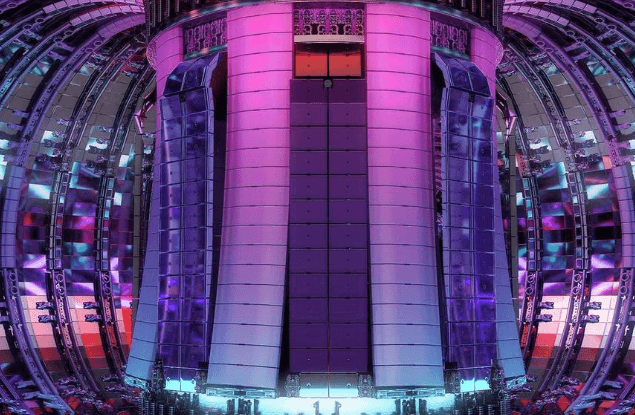
- A magnetic confinement fusion device that uses powerful magnetic fields to trap and stabilize superheated plasma inside a torus-shaped (doughnut-shaped) vacuum chamber to replicate the nuclear fusion process that powers stars. The term is a Russian acronym for “toroidal chamber with magnetic coils,” first conceptualized in the early 1950s by Soviet physicists Igor Tamm and Andrei Sakharov.
Global Tokamaks:
- ITER (France): The world’s largest experimental tokamak, supported by seven international members, including India, aims to generate 500 MW of fusion power using 50 MW of plasma heating power.
- EAST (China): The Experimental Advanced Superconducting Tokamak in Hefei achieved a record of 1,066 seconds of high-confinement plasma, marking progress towards sustained nuclear fusion.
- Indian Tokamaks: The Institute for Plasma Research (IPR), Gandhinagar, operates ADITYA-U and SST-1, while Bengaluru-based Pranos Fusion developed PRAGYA, a privately built compact research tokamak.
How It Works?
- Toroidal Chamber: Uses a doughnut-shaped chamber that eliminates open ends, allowing magnetic fields to confine charged plasma particles and prevent their escape.
- Helical Magnetic Fields: Combines toroidal and poloidal magnetic fields to create twisted magnetic pathways, reducing plasma drift and improving confinement stability.
- Extreme Plasma Heating: Heats deuterium and tritium fuel above 100 million °C using electrical currents, radiofrequency waves and high-energy neutral particle beams.
- Energy Extraction: Fusion releases high-energy neutrons that heat a surrounding lithium blanket, enabling electricity generation through turbines while producing additional tritium fuel.
Key Features:
- Magnetic Confinement: Uses powerful toroidal, poloidal and shaping magnetic fields to suspend extremely hot plasma without direct contact with the chamber walls.
- High Energy Density: Fusion of deuterium and tritium releases approximately 3.4 × 10¹⁴ joules per kilogram, offering vastly greater energy density than fossil fuels.
- Tritium Breeding Blanket: Uses lithium-containing materials to absorb fusion neutrons and produce tritium, supporting long-term fuel availability for future fusion reactors.
- Inherent Safety: Contains only small amounts of active fuel, ensuring that plasma disruptions or equipment failures rapidly stop fusion without triggering a runaway chain reaction.
Limitations:
- Extremely hot plasma experiences turbulence and magnetic instabilities, which can disrupt confinement and damage the reactor’s internal components.
- High-energy fusion neutrons damage reactor walls through radiation exposure, causing material weakening and increasing maintenance and replacement requirements.
- Sustained fusion requires advanced cooling, powerful magnets and substantial investment; no commercial tokamak has yet achieved net electricity generation.