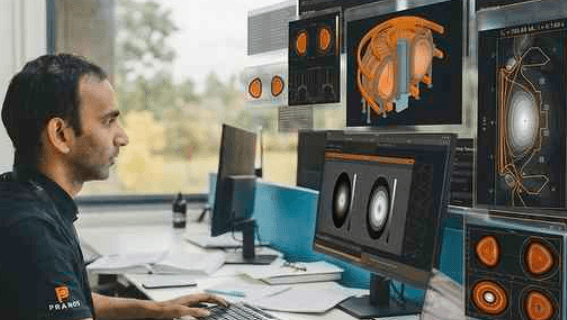
Pranos Fusion: India's First Private Fusion Reactor PRANIK and PRAGYA Tokamak
Context: Bengaluru-based Pranos Fusion announced plans to finalise the design of PRANIK, India’s first privately developed fusion reactor, by 2027, following the development of PRAGYA, a compact tokamak for plasma confinement research.

About Pranos Fusion: India’s First Private Fusion Reactor PRANIK and PRAGYA Tokamak
What it is?
- India’s first private nuclear fusion energy company, dedicated to developing compact, magnetically confined fusion systems (tokamaks) using advanced plasma physics, high-temperature superconducting magnets, and proprietary control software.
Headquarters: Bengaluru, Karnataka.
Founders: Founded in 2024 by Shaurya Kaushal (CEO) and Roshan George (COO).
Aim: To establish an indigenous commercial fusion energy stack in India, commercializing compact, low-cost fusion reactors to generate baseload, zero-carbon electricity without generating long-lived high-level radioactive waste or risking runaway fission reactions.
Key Technology Features & Platforms:
- PRAGYA (Prototype Testbed): A compact, low-aspect-ratio research tokamak developed as a proving ground to benchmark stable plasma control, magnetic shaping, and high-heat flux materials.
- PRANIK Reactor Roadmap: The startup’s flagship commercial-scale tokamak design—targeted for blueprint finalization by 2027—engineered to heat deuterium-tritium plasma to over 100 million degrees Celsius to trigger net-positive thermonuclear fusion.
- High-Temperature Superconducting (HTS) Magnets (‘MAGGA’): Employs advanced HTS tape coils capable of generating magnetic field strengths around 20 Tesla, allowing the reactor core to be significantly smaller and less capital-intensive than traditional public megaprojects.
- Digital Twin & Simulation Stack (‘JENGA’): Utilizes an in-house simulation, design, and real-time control software platform that models plasma behavior, magnetohydrodynamic (MHD) instabilities, and magnetic containment before physical testing.
- Inherent Safety & Domestic Fuel Advantage: Operates on hydrogen isotopes rather than enriched fissile materials like uranium, eliminating proliferation hazards and the physical possibility of catastrophic meltdown events.
Significance:
- Promotes private-sector participation in India’s nuclear fusion research, strengthening indigenous technological capabilities and fostering a competitive deeptech ecosystem.
- Fusion offers the potential for abundant, low-carbon and reliable electricity, complementing renewable energy and strengthening India’s long-term energy security.