Quad Grouping: Manila Summit 2026 and India’s Strategic Role
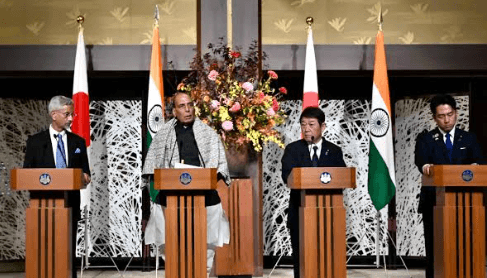
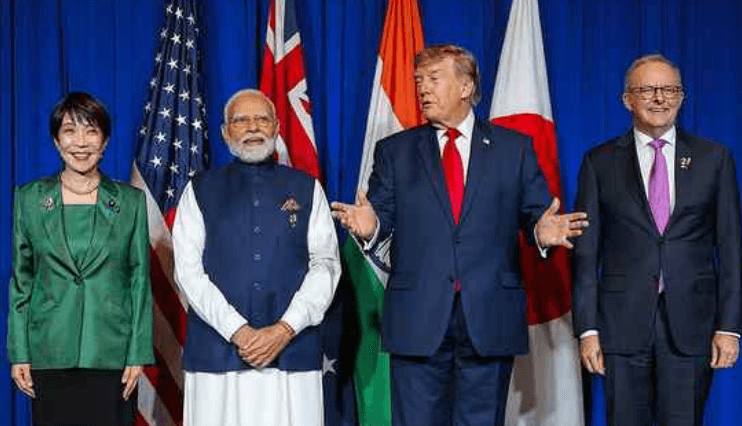
Context: Leaders of the Quad (India, US, Japan and Australia) met in Manila, Philippines, on November 17, 2026, for the first Quad Leaders’ Summit hosted by a non-member country.

About Quad Grouping: Manila Summit 2026 and India’s Strategic Role
What It Is?
- The summit-level gathering of the four maritime democracies—Australia, India, Japan, and the United States—held on the sidelines of the ASEAN and East Asia Summits to mark nearly a decade since the Quad’s 2017 revival and the 10th anniversary of the Free and Open Indo-Pacific vision articulated by former Japanese PM Shinzo Abe in 2016.
Key Outcomes of the Manila Summit:
- Opposition to Maritime & Economic Coercion: Strongly opposed destabilizing unilateral actions seeking to change the regional status quo by force or coercion, as well as arbitrary export restrictions and supply-chain weaponization.
- Inaugural Quad Business Leaders’ Forum (2027): Announced the launch of the first Quad Business Forum to be hosted by India in Mumbai in early 2027, bringing together industry leaders, policymakers, and officials to boost private-sector deals and supply-chain partnerships.
- Indo-Pacific Maritime Surveillance Collaboration & Joint Patrols: Operationalized the expanded maritime domain awareness framework and scheduled the first-ever Quad-context joint maritime patrol exercise in 2027 involving P-8 and P-3C surveillance aircraft.
- Quad AI Accelerator: Affirmed the operationalization of the AI Accelerator (first announced in Atlanta) to coordinate funding, technical assistance, and deployment of trusted Artificial Intelligence across the Indo-Pacific.
- Expansion of Cable Connectivity & Resilience: Welcomed new undersea communications cable projects in the Indian Ocean alongside an expanded Australian contribution focusing on submarine electricity cables to strengthen regional energy security.
- Enhanced Quad Cybersecurity & Counterterrorism Cooperation: Announced joint frameworks to counter escalating regional cyber incidents while unequivocally condemning cross-border terrorism and violent extremism.
- Unwavering Support for ASEAN Centrality: Reaffirmed commitment to ASEAN unity and regional architecture by convening directly alongside ASEAN summits in Manila.
Challenges Faced by the Quad Grouping:
- Economic Coercion & Critical Supply Chain Chokepoints: Heavy reliance on concentrated supply chains exposes member economies to arbitrary export controls on strategic inputs.
E.g., Recent export restrictions imposed by China on critical minerals and heavy infrastructure machinery such as Tunnel Boring Machines (TBMs), directly impacting Indian infrastructure and metro-rail projects.
- Divergent Geopolitical Bandwidth & Great-Power Balancing: Shifting U.S. diplomatic focus toward major-power summitry (such as the proposed U.S.-China-Russia “G-3” talks in Shenzhen) and conflicts in Europe and West Asia creates uncertainty over sustained Indo-Pacific prioritization.
E.g., India balancing its Quad maritime commitments with its strategic autonomy, continental border management along the LAC, and energy/seafarer security during the Strait of Hormuz blockade.
- Institutional Informality & Execution Speed: Operating without a permanent secretariat or binding treaty structure can slow the translation of high-level summit pledges into rapid ground-level infrastructure delivery.
E.g., Delays in scaling alternative regional economic frameworks after earlier U.S.-led trade initiatives like the Indo-Pacific Economic Framework (IPEF) were shelved.
- Navigating ASEAN Sensitivities: Southeast Asian nations welcome Quad public goods but remain cautious about overt strategic alignment that might provoke regional polarization.
E.g., India pairing its Manila Quad participation with bilateral and ASEAN-India commitments—such as free e-visas for ASEAN tourists and a seafarers’ safety initiative—to reassure regional partners of non-confrontational intent.
Strategic Significance of the Summit:
- Reinvigorating Top-Level Political Momentum: Restores leader-level summits after a two-year hiatus (since Wilmington in 2024), signaling institutional continuity across new political leaderships in the U.S. and Japan.
- Symbolic Solidification of ASEAN Centrality: Hosting the summit in Manila—a frontline South China Sea state—demonstrates direct solidarity with Southeast Asian sovereignty while countering claims that the Quad sidelines ASEAN.
- Transition from Maritime Awareness to Operational Coordination: Scheduling coordinated P-8 and P-3C maritime patrol aircraft exercises in 2027 marks a concrete step forward in interoperable regional deterrence.
- Elevating India’s Geo-Economic & Technological Role: Hosting the inaugural 2027 Quad Business Leaders’ Forum in Mumbai and anchoring Indian Ocean undersea cable projects positions India as a central hub for trusted supply chains and digital connectivity.
- Collective Response to Non-Traditional & Hybrid Threats: Establishes coordinated guardrails against cross-border terrorism, state-backed cyberattacks, and arbitrary export restrictions threatening regional economic stability.
Conclusion:
The 2026 Manila Summit revitalizes the Quad as a resilient, action-oriented coalition capable of adapting to shifting leaderships and global geopolitical turbulence. By pairing concrete maritime surveillance and undersea connectivity projects with private-sector mobilization through the Mumbai Business Forum, the grouping is translating its Free and Open Indo-Pacific vision into tangible regional public goods. Sustaining this momentum will require insulating bilateral trade ties from friction while consistently delivering economic and security resilience for partner nations across the Indo-Pacific.
Discuss the significance of the Quad in strengthening a free, open and resilient Indo-Pacific. How does cooperation in critical minerals expand the scope of the grouping?