The Fourth India-Japan 2+2 Ministerial Meeting
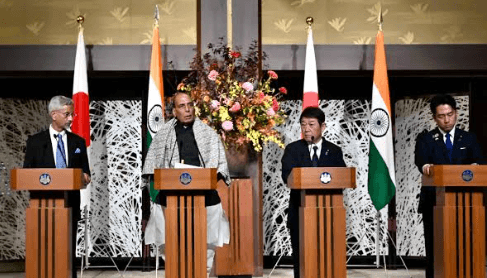
Context: India and Japan held their Fourth 2+2 Foreign and Defence Ministerial Meeting in Tokyo, co-chaired by India’s Rajnath Singh and S. Jaishankar alongside Japan’s Motegi Toshimitsu and Koizumi Shinjiro.

About The Fourth India-Japan 2+2 Ministerial Meeting:
What It Is:
- The highest-level institutionalized diplomatic and defense dialogue mechanism between India and Japan, bringing together their Foreign and Defense Ministers to coordinate strategic, military, economic security, and Indo-Pacific policies under the Special Strategic and Global Partnership.
History & Evolution:
- Initiated following the 2018 Annual Summit between PM Narendra Modi and former PM Shinzo Abe to elevate bilateral security consultations, with earlier editions held in New Delhi (2019), Tokyo (2022), and New Delhi (2024), leading up to the fourth edition in Tokyo (November 2026).
Key Outcomes of the Fourth 2+2 Meeting:
- First-Ever Live-Fire Training in India: Signed a Letter of Intent (LoI) enabling the Japan Self-Defense Forces (JSDF) to conduct live-fire training—including surface-to-ship missile drills—at Indian firing ranges for the first time, alongside deepening air exercises like Veer Guardian 26.
- Defense Co-Development & UNICORN Timeline: Committed to finalizing arrangements for the Unified Complex Radio Antenna (UNICORN) naval mast system and India’s Acceptance of Necessity (AoN) by February 2027 under the “Design with Japan, Make in India” framework, alongside exploring joint naval shipbuilding.
- Operationalizing Maritime Security & Coast Guard Ties: Moved swiftly under the Memorandum of Arrangement on Maritime Security Cooperation to expand Maritime Domain Awareness (MDA), mine countermeasures, and Humanitarian Assistance and Disaster Relief (HADR), while preparing for India to host the 5th Coast Guard Global Summit in February 2027.
- Economic Security & Resilient Supply Chains: Operationalized the Joint Declaration on Economic Security Cooperation across five strategic sectors—semiconductors, critical minerals, ICT, clean energy, and pharmaceuticals—to counter arbitrary export restrictions and non-market overcapacity.
- AI, Space & Undersea Digital Connectivity: Agreed to co-create AI ecosystems under the Japan-India AI Cooperation Initiative (JAI), strengthen AI-enabled cybersecurity, expand Space Situational Awareness (SSA), and build redundant undersea communications cable networks.
- Indo-Pacific & ASEAN Minilateral Synergy: Aligned India’s IPOI and MAHASAGAR visions with Japan’s updated Free and Open Indo-Pacific (FOIP), welcoming new trilateral formats such as the India-Japan-Philippines Track 1.5 Dialogue and the India-Japan-Indonesia naval PASSEX.
- Counterterrorism, UNSC Reform & 75th Anniversary: Condemned cross-border terrorism (naming LeT and JeM), reaffirmed mutual support for permanent UNSC seats and non-permanent bids (2028–29 and 2033–34), and designated 2027 as the India-Japan Year of Shared Horizons marking 75 years of diplomatic ties.
Challenges to India-Japan Bilateral Relations:
- Asymmetric Bilateral Trade Deficit & Market Access Barriers: Despite the 2011 Comprehensive Economic Partnership Agreement (CEPA), bilateral trade remains heavily skewed in Japan’s favor due to stringent non-tariff barriers and technical standards in Japanese markets.
E.g., Indian pharmaceuticals, marine products, and agricultural exports facing lengthy regulatory approvals and strict sanitary/phytosanitary hurdles in Japan.
- Slow Pace of Defense Technology Transfer & Procurement: Bureaucratic differences in defense acquisition procedures, intellectual property protections, and cost-sharing have historically delayed co-development projects.
E.g., Prolonged negotiations over the US-2 amphibious aircraft deal and multi-year timelines required to finalize the UNICORN naval mast agreement.
- Execution Delays in Flagship Infrastructure Projects: Land acquisition bottlenecks, local regulatory clearances, and currency-fluctuation costs have slowed Japanese-funded connectivity projects in India.
E.g., Cost overruns and timeline extensions in the Mumbai-Ahmedabad High-Speed Rail (Bullet Train) corridor and certain Northeast road connectivity initiatives.
- Divergent Tactical Approaches to Eurasian Geopolitics: While both nations converge strongly on Indo-Pacific maritime security, differences persist in their historical ties and sanctions posture toward Russia.
E.g., Japan aligning closely with G7 sanctions on Moscow following the Ukraine conflict, whereas India maintains strategic autonomy and long-standing defense/energy ties with Russia.
Way Ahead:
- Fast-Track Defense Co-Production Milestones: Adhere strictly to the February 2027 AoN target for the UNICORN system and establish a joint defense R&D fund to scale co-development in unmanned systems, naval shipbuilding, and aero-engines.
- Rebalance Trade via CEPA Upgrade: Review and modernize the India-Japan CEPA to address non-tariff barriers, integrate Indian IT/AI talent into Japan’s aging workforce, and boost Indian exports of generic drugs and processed foods.
- Operationalize Critical Mineral & Semiconductor Alliances: Translate the Track 1.5 Economic Security Dialogue into concrete joint ventures for rare-earth processing, semiconductor fab equipment, and clean-energy supply chains.
- Expand Indo-Pacific Trilateral & ASEAN Outreach: Institutionalize joint maritime surveillance, undersea cable deployment, and capacity-building projects with Southeast Asian and Pacific Island partners alongside Quad initiatives.
- Leverage the 2027 Year of Shared Horizons: Utilize the 75th anniversary of diplomatic relations to deepen university exchanges, skill-mobility corridors, and sub-national Sister-State/Prefecture partnerships.
Conclusion:
The Fourth India-Japan 2+2 Ministerial Meeting marks a decisive leap from strategic convergence to tangible operational interoperability, anchored by historic live-fire training access in India and co-development under “Design with Japan, Make in India.” By pairing defense modernization with coordinated supply-chain resilience in semiconductors, critical minerals, and AI, both democracies are fortifying a rules-based Indo-Pacific order against unilateral and economic coercion. Sustaining this momentum will require resolving trade asymmetries and accelerating on-ground execution of bilateral industrial and infrastructure projects.
“The India–Japan partnership is moving from strategic convergence towards strategic coordination.” Explain the factors underlying this transition and the areas in which operational cooperation can be deepened. Assess the constraints to its emergence as a consequential security partnership.