

Prelims
The Arabian Black Electric Ray
Context: Scientists from the Zoological Survey of India (ZSI) discovered a new species of deep-sea electric ray, named the Arabian Black Electric Ray (Tetronarce ramanamurthyi), in the southeastern Arabian Sea.

About The Arabian Black Electric Ray:
What it is?
- A newly described species of deep-sea cartilaginous fish (chondrichthyan) belonging to the electric ray family Torpedinidae and order Torpediniformes. It is named in honour of M. V. Ramana Murthy, Mission Director of the Deep Ocean Mission, for his contributions to marine science and ocean engineering.
Habitat: Inhabits the benthic deep-water continental shelf and upper bathyal slopes of the southeastern Arabian Sea off southwestern India, dwelling along the sea floor in the northern Indian Ocean.
Key Characteristics:
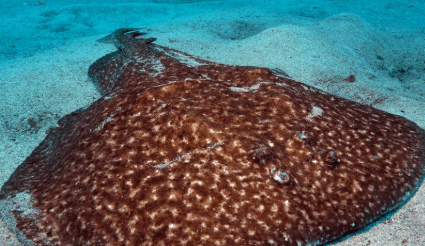
- Distinctive Colouration and Disc Shape: Features a dark bluish-black to brown upper surface and a flattened pectoral disc wider than its length, distinguishing its morphology.
- Smooth Respiratory Spiracles: Lacks fleshy projections (papillae) around spiracles behind the eyes, enabling water intake for respiration while resting on muddy seabeds.
- Compact Electric Organs: Possesses paired kidney-shaped electric organs derived from modified muscles, generating shocks for defence and prey capture, smaller than those of related rays.
- Genetic Distinctiveness: Mitochondrial COI and ND2 gene sequencing revealed 2.2–6.7% genetic divergence from other Tetronarce species, confirming a distinct evolutionary lineage.
Significance:
- Establishes the first confirmed presence of Tetronarce in the northern Indian Ocean, addressing gaps in its evolutionary history and geographical distribution.
- Highlights the value of India’s Deep Ocean Mission and monitoring commercial trawl bycatch for discovering and conserving vulnerable deep-sea species.



