Prelims
The Ganga Water Sharing Treaty (1996)
Context: Ahead of the 1996 Ganga Water Sharing Treaty’s expiry on December 12, 2026, India and Bangladesh held their 91st Joint Committee meeting in Dhaka. Bangladesh reportedly favours renewing the existing treaty, despite bilateral tensions and domestic concerns in India.

About The Ganga Water Sharing Treaty (1996):
What it is?
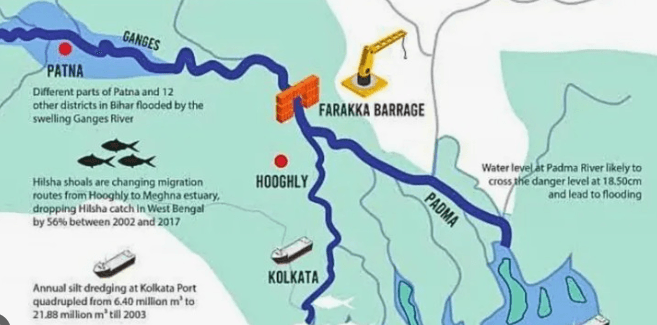
- A landmark 30-year bilateral water-sharing agreement between India and Bangladesh governing the allocation of Ganga river waters at the Farakka Barrage (Murshidabad, West Bengal) during the annual dry season (January 1 to May 31)—the only formal water-sharing treaty among the 54 transboundary rivers shared by both nations.
Established in: Signed on December 12, 1996, in New Delhi by H. D. Deve Gowda and Sheikh Hasina for 30 years, renewable by mutual consent.
History:
- Farakka Barrage Dispute (1950s–1976): India’s diversion of Ganga waters into the Hooghly to maintain Kolkata Port’s navigability raised downstream concerns in Bangladesh.
- Ad Hoc Agreements (1977–1988): Temporary agreements in 1977, 1982 and 1985 preceded the comprehensive 1996 treaty.
Aim: To ensure equitable and predictable sharing of lean-season Ganga waters at Farakka and promote bilateral river basin cooperation.
Key Features of the Treaty:
- Three-Tier Allocation Formula: Governs water sharing between January 1 and May 31, based on historical flow data (1949–1988).
| Water availability | Allocation |
| 70,000 cusecs or less | Equal sharing (50:50) |
| 70,000–75,000 cusecs | Bangladesh: 35,000 cusecs; India: balance |
| 75,000 cusecs or more | India: 40,000 cusecs; Bangladesh: balance |
- Minimum Flow Guarantee: Both countries receive 35,000 cusecs each during three alternating 10-day periods between March 11 and May 10.
- Emergency Consultation (Article II): Mandates immediate consultations based on equity and the no-harm principle when flows fall below 50,000 cusecs.
- Institutional Monitoring: A Joint Committee monitors flows at Farakka and Hardinge Bridge, with unresolved disputes referred to the Joint Rivers Commission and respective governments.
- Validity and Renewal (Article XII): Valid until December 12, 2026, with renewal requiring mutual consent.
Implications of Expiry or Renegotiation:
- Expiry without renewal would end treaty-specific water-sharing obligations, threatening Bangladesh’s agriculture, dry-season water security and Sundarbans ecology.
- Renegotiation could address Bihar and West Bengal’s irrigation, drinking water and siltation concerns while testing India’s Neighbourhood First policy and water diplomacy.