The Global Innovation Index (GII) 2026
Context: The World Intellectual Property Organization (WIPO) released the Global Innovation Index (GII) 2026, ranking 139 economies by innovation performance and identifying leading science and technology clusters.

About The Global Innovation Index (GII) 2026:
What it is?
- A global, comprehensive benchmarking framework and working tool for policymakers that measures multidimensional innovation capabilities, evaluates national innovation inputs and outputs, and maps the world’s top 100 Science and Technology (S&T) clusters.
Established in: First published in 2007 (now in its 19th annual edition in 2026).
Organisation: Published annually by the World Intellectual Property Organization (WIPO), a UN specialized agency, in partnership with the Portulans Institute and international corporate and academic collaborators.
Criteria & Conceptual Framework:
Scores and benchmarks countries across seven pillars grouped into two sub-indices:
- Innovation Input Sub-Index (5 Pillars): Institutions, Human Capital & Research, Infrastructure, Market Sophistication, and Business Sophistication.
- Innovation Output Sub-Index (2 Pillars): Knowledge & Technology Outputs, and Creative Outputs.
Aim: To assess global innovation performance beyond R&D spending, guide policymaking and help countries identify strengths, weaknesses and innovation gaps.
Key Findings of GII 2026:
- Venture Capital Concentration: Global VC funding reached $510 billion in 2025, with AI attracting over 53%, while deal numbers declined, indicating investment concentration.
- Global R&D Spending: Worldwide R&D expenditure reached $3.4 trillion, around 2% of global GDP, with corporate investment led by AI, software and aerospace.
- Technology Adoption: Industrial robots reached 4.7 million units, while EVs accounted for 25% of new car sales. However, technology adoption slowed and renewable energy costs increased.
- Deep-Science Startups: Over 30,000 deep-science ventures, valued at $7.6 trillion, have emerged since 2000, with nearly half holding patents.
- Middle-Income Innovation Gap: Countries like India and Vietnam outperform their income levels in innovation but face limitations in R&D investment and industry-academia collaboration.
Key Rankings of GII 2026:
- Top 5 Most Innovative Economies (GII 2026):
- Switzerland
- Sweden
- United States
- South Korea
- Singapore
- Income Group Leaders:
- High-Income: Switzerland (1st)
- Upper-Middle-Income: China (10th)
- Lower-Middle-Income: India (38th)
- Low-Income: Rwanda (96th)
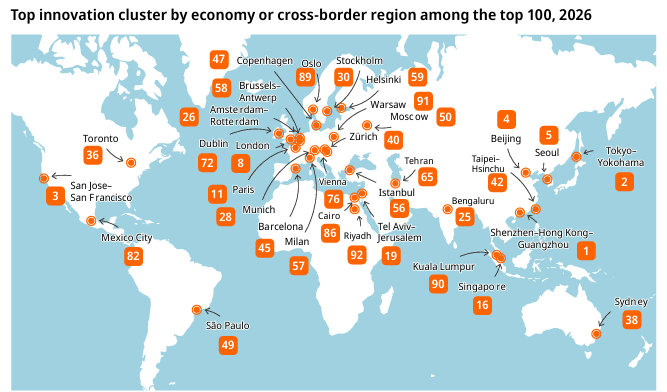
- Top 5 Science and Technology Clusters
- Shenzhen–Hong Kong–Guangzhou (China/Hong Kong)
- Tokyo–Yokohama (Japan)
- San Jose–San Francisco (USA)
- Beijing (China)
- Seoul (South Korea)
India and WIPO:
- Overall Ranking: India ranks 38th globally, leading both the Central and Southern Asia region and the lower-middle-income economies.
- Innovation Overperformance: India and Vietnam remain the longest-standing innovation overperformers, exceeding income-based expectations for 16 consecutive years (2011–2026).
- Key Strengths: India ranks 15th in Knowledge and Technology Outputs, 1st in ICT services exports and 4th in late-stage venture capital deals.
- Global Innovation Clusters: Four Indian cities feature among the world’s top 100 S&T clusters: Bengaluru (25th), Delhi (27th), Mumbai (43rd) and Chennai (79th).