Prelims
The Indira Gandhi Prize for Peace, Disarmament and Development
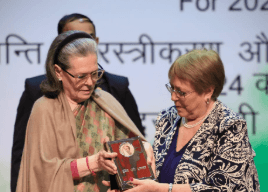
Context: Mozambican freedom fighter and women’s rights advocate Graça Machel received the 2025 Indira Gandhi Prize for Peace, Disarmament and Development from Sonia Gandhi in New Delhi.

About The Indira Gandhi Prize for Peace, Disarmament and Development:
What it is?
- A prestigious annual international honour awarded to individuals or organizations in recognition of creative and transformative efforts toward promoting international peace, nuclear disarmament, racial equality, economic cooperation, and sustainable global development.
Organisation: Administered and conferred by the Indira Gandhi Memorial Trust and financed through an endowment established by the Government of India.
History:
- Instituted in 1985 by the Government of India to commemorate former Prime Minister Indira Gandhi’s contributions to global peace, the Non-Aligned Movement, and human well-being.
- First awarded in 1986 to Parliamentarians for Global Action, its distinguished laureates include Mikhail Gorbachev (1987), UNICEF (1989), Jimmy Carter (1997), Kofi Annan (2003), Wangari Maathai (2006), Dr. Manmohan Singh (2017), Sir David Attenborough (2019), Michelle Bachelet (2024), and Graça Machel (2025).
Eligibility:
- Open to any living person or active organization worldwide without any distinction of nationality, race, gender, or religion.
- Candidates must be nominated during their lifetime (posthumous nominations are not considered unless an awardee passes away after formal selection).
Selection Process:
- Nominations: Invited annually until September 30 from past laureates, former jury members, Indian and foreign parliamentarians, and reputed national and international peace organisations.
- Jury Scrutiny & Consensus: An independent 5–9-member international jury, appointed by the Indira Gandhi Memorial Trust Chairperson, evaluates nominations through consensus, with its decision final and binding.
Key Features of the Prize:
- Monetary Award: Carries a ₹1 crore cash prize (or foreign currency equivalent), recognising outstanding contributions to international peace, disarmament and development.
- Distinctive Trophy: Features a 2-billion-year-old Haematite Jasper trophy, similar to the stone at Shakti Sthal, adorned with Indira Gandhi’s miniature portrait and silver detailing.
- Five Thematic Pillars: Recognises contributions to international peace, economic cooperation, developing nations, scientific advancement for human welfare, and expansion of human freedom.
- Flexible Jury Discretion: Allows the jury to share the prize among multiple laureates or withhold it if no suitable candidate meets the selection criteria.
- Global South & Grassroots Solidarity: Honours Graça Machel, Mozambique’s first Education Minister and author of the landmark 1996 UN report on children in armed conflict, recognising her humanitarian advocacy.