Prelims
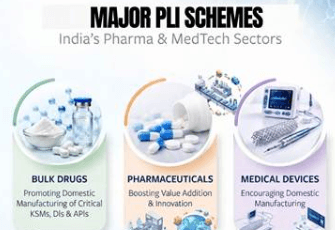
The PLI Scheme for Promoting Domestic Manufacturing of Medical Devices (PLI-MD)
Context: The Government of India has invited fresh applications under the Production Linked Incentive Scheme for Promoting Domestic Manufacturing of Medical Devices (PLI-MD), extending the scheme’s tenure up to FY 2035–36.

About The PLI Scheme for Promoting Domestic Manufacturing of Medical Devices (PLI-MD):
What it is?
- A flagship sectoral incentive scheme designed to provide financial rewards on incremental sales of domestically manufactured medical devices and critical components, thereby boosting indigenous manufacturing capacity and attracting global and domestic investment.
Launched in: Originally launched in FY 2020–21 by the Department of Pharmaceuticals, Ministry of Chemicals and Fertilizers.
Aim: To promote Aatmanirbhar Bharat and Make in India by reducing medical equipment imports, strengthening domestic supply chains and advancing indigenous manufacturing of 3T MRI, PET-CT and ultrasound systems.
Eligibility Criteria:
- Open to registered domestic and global manufacturing entities setting up production lines in India across the designated target segments.
- Applicants are allowed a gestation period of 3 years to establish manufacturing facilities.
- Removal of the mandatory minimum sales threshold to claim incentives, along with trimmed minimum capital investment criteria.
Key Features of the Extended Scheme:
- Four Distinct Target Segments (TS): Focuses incentives across specialized segments:
- TS 1: Medical consumables, disposables, and implants.
- TS 2: Critical components and sub-assemblies (boosting the MSME sector).
- TS 3: High-end medical devices currently at a nascent stage of domestic manufacturing.
- TS 4: High-end medical devices presently only assembled in India.
- Tailored Tapering Incentive Structure: Offers targeted incentive rates based on the degree of technical complexity:
- Averaging ~5% for Consumables & Implants (TS 1).
- Averaging ~9% for Critical Components and Nascent High-End Devices (TS 2 & TS 3).
- Averaging 6% for Assembled High-End Equipment (TS 4).
- Removal of Sales Thresholds: Eliminates minimum incremental sales requirements for receiving incentives, reducing entry barriers and improving scheme accessibility for emerging startups and MSMEs.
- Domestic Value Chain Integration: Promotes indigenous manufacturing of critical components such as X-ray tubes, detectors and RF coils, shifting production from basic assembly to end-to-end manufacturing.
- Financial Support and Extended Timeline: Utilises approximately ₹2,700 crore in unallocated funds, extending support until FY 2035–36 to accommodate lengthy R&D, clinical trials and regulatory approvals.
Significance:
- Reduces 75–80% reliance on imported high-end medical equipment through domestic manufacturing, strengthening healthcare security and saving foreign exchange.
- Provides around 9% incentives for critical components, strengthening MSMEs, advancing Aatmanirbhar Bharat and boosting medical device exports.