Prelims
Viability Gap Funding Scheme for development of 92 GWh Grid-Scale Energy Storage Systems
Context: The Union Cabinet approved a ₹14,500 crore Viability Gap Funding (VGF) Scheme spanning FY 2026–27 to FY 2030–31 to support the creation of 92 GWh of grid-scale energy storage capacity.

About Viability Gap Funding Scheme for development of 92 GWh Grid-Scale Energy Storage Systems:
What it is?
- A targeted financial incentive program providing capital grant support through Viability Gap Funding (VGF) to bridge the initial commercial deficit in setting up commercial, utility-scale energy storage infrastructure. It adds capacity equivalent to 170% of India’s current grid storage base, moving toward the national target of 411 GWh by 2031–32.
Aim: To make energy storage commercially viable, manage renewable energy intermittency, stabilise the grid, ensure affordable Round-the-Clock (RTC) green power and reduce import dependence through domestic manufacturing.
Key Features of the Scheme:
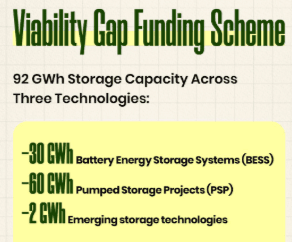
- Diversified 92 GWh Technology Allocation: Targets a multi-technology storage portfolio comprising:
- 60 GWh of Hydro Pumped Storage Plant (PSP) capacity.
- 30 GWh of Battery Energy Storage Systems (BESS).
- 2 GWh dedicated to alternative and emerging storage technologies.
- Tariff-Based Competitive Bidding: Projects and VGF support will be awarded through transparent competitive auctions, favouring developers offering the lowest storage tariffs and requiring minimal government assistance.
- 40% Domestic Content Requirement (DCR): VGF-supported BESS projects must use at least 40% domestically sourced components, promoting indigenous battery manufacturing under the Aatmanirbhar Bharat initiative.
- DISCOM and Multi-Sector Participation: Public and private DISCOMs can receive VGF support for BESS and pumped storage projects, while other storage technologies can involve wider industry participation.
- Significant Capital Investment: The government’s ₹14,500 crore VGF allocation is expected to attract approximately ₹97,600 crore in public and private investments in energy storage infrastructure.
- Five-Year Implementation Period: The scheme will operate from FY 2026–27 to FY 2030–31, allowing time for developing battery storage facilities and hydro-pumped storage projects.
Significance:
- Helps store surplus solar and wind power for peak demand periods, improving grid stability, reducing renewable energy wastage and dependence on thermal power.
- The 40% domestic content requirement promotes local battery manufacturing, reduces import dependence and strengthens India’s clean energy supply chain alongside PLI incentives.