Prelims
The Public Accounts Committee (PAC)
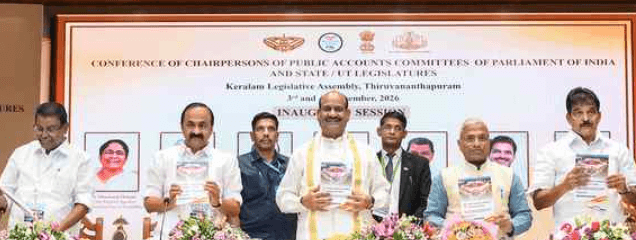
Context: A nationwide Conference of Chairpersons of Public Accounts Committees (PAC) of Parliament and State/UT Legislatures was held in Thiruvananthapuram, Kerala, focusing on “Audit, Accountability and Good Governance – The Evolving Role of the Public Accounts Committee.”

About The Public Accounts Committee (PAC):
What it is?
- The premier financial standing committee of Parliament (and state legislatures) functioning as a post-facto expenditure audit watchdog. It is tasked with examining the appropriation accounts, annual finance accounts, and audit findings submitted by the Comptroller and Auditor General of India (C&AG) to enforce executive accountability to the legislature.
Origin:
- First established in 1921 under the provisions of the Government of India Act, 1919 (Montagu-Chelmsford Reforms).
- Following independence, it became a full parliamentary committee under the Rules of Procedure and Conduct of Business in Lok Sabha (Rule 308).
- Since 1967, an established parliamentary convention dictates that the Chairperson of the PAC is appointed by the Lok Sabha Speaker from among the Opposition.
Aim: To ascertain that public moneys voted by Parliament were disbursed for the designated services within the authorized limits, ensure administrative adherence to financial propriety, and prevent executive waste, fraud, and fiscal indiscipline.
Members & Composition:
- Comprises a total of 22 members—15 from Lok Sabha and 7 from Rajya Sabha.
- Elected annually by Parliament from amongst its members according to the principle of Proportional Representation by means of the Single Transferable Vote (PR-STV).
- A Minister cannot be elected as a member; if a member is appointed a Minister, they cease to be part of the committee.
- The Chairperson is appointed by the Speaker of the Lok Sabha from amongst its Lok Sabha members.
Key Functions of the Public Accounts Committee (PAC):
- Scrutiny of C&AG Audit Reports: Examines C&AG reports under Article 151, including Appropriation Accounts, Finance Accounts and departmental audits, to identify financial irregularities and ensure accountability.
- Verification of Legal and Appropriation Limits: Ensures public funds are spent within parliamentary approval, used for authorised purposes and not diverted or reallocated without proper sanction.
- Investigation of Excess Expenditure: Examines spending that exceeds parliamentary grants, seeks explanations from ministries and recommends regularisation of excess expenditure through Parliament.
- Ensuring Financial Propriety and Economy: Checks whether government expenditure follows financial discipline, economy and efficiency, identifying wasteful spending, misuse of funds and financial irregularities.
- Tracking Executive Action: Reviews Action Taken Notes (ATNs) submitted by ministries on earlier recommendations and presents Action Taken Reports (ATRs) to Parliament to monitor corrective measures.
Resolutions Adopted at the 2026 Conference:
- Standardised Timelines for Action Taken Notes: Proposes uniform deadlines across States and UTs for submitting ATNs on audit findings and PAC recommendations, ensuring timely government responses.
- Nationwide Implementation of Digital APMS: Calls for introducing an Audit Para Monitoring System (APMS) across State/UT legislatures to digitally track pending audit objections and accelerate their resolution.
- Advanced Forensic Collaboration with C&AG: Strengthens cooperation with the C&AG using forensic audits, AI and data analytics to detect financial irregularities and identify high-risk government sectors.
- Mandatory Sittings and Sub-Committees: Recommends at least three PAC meetings monthly and specialised sub-committees to clear pending audit objections and improve legislative financial oversight.
- Knowledge Sharing and Capacity Building: Proposes a common digital knowledge portal for Union and State PACs, alongside technical training to strengthen financial scrutiny and institutional coordination.