Prelims
The Viksit Bharat Initiative for Statistical Transformation, Analytics & Research (VISTAR) Scheme
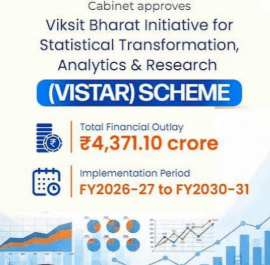
Context: The Union Cabinet approved the ‘Viksit Bharat Initiative for Statistical Transformation, Analytics & Research (VISTAR)’, a Central Sector Scheme spanning FY 2026–27 to FY 2030–31 with an outlay of ₹4,371.10 crore.

About The Viksit Bharat Initiative for Statistical Transformation, Analytics & Research (VISTAR) Scheme:
What it is?
- A comprehensive, flagship Central Sector Scheme that consolidates and upgrades all statistical and data governance operations of the central government, modernizing survey methodologies, digital platforms, and administrative statistics across three structured components:
- Comprehensive Statistical Operations and Ecosystem Strengthening
- Support for Statistical Strengthening (SSS 2.0)
- Economic Census (8th EC)
Organisation: Ministry of Statistics and Programme Implementation (MoSPI).
Aim: To modernise India’s official statistical system using AI, ML and interoperable datasets, bridging information gaps and generating timely, reliable socioeconomic indicators for evidence-based policymaking.
Key Features of the Scheme:
- Survey Expansion and Modernisation: Expands major surveys from 43 to 59 during the 16th Finance Commission cycle, integrating digital data collection and AI/ML-based validation to improve accuracy.
- New High-Frequency Economic Indicators: Introduces the Headline Index of Services Production and Index of Unincorporated Sector Enterprises to track emerging economic activities and improve statistical coverage.
- Integration of Big Data: Incorporates mobile location data, barcode scans and e-commerce transactions to supplement traditional surveys, reduce respondent burden and enable frequent economic monitoring.
- SSS 2.0 for State-Level Capacity Building: Provides performance-linked grants to States/UTs for district GDP, State IIP and localised Periodic Labour Force Survey (PLFS), Household Consumption Expenditure Survey (HCES) and Annual Survey of Unincorporated Sector Enterprise estimates (ASUSE), strengthening decentralised statistical systems.
- 8th Economic Census: Enumerates non-agricultural establishments at Gram Panchayat and urban Ward levels, supporting the Statistical Business Register (SBR) and improved measurement of informal economic activities.
Significance:
- Enables granular, interoperable statistical datasets, helping governments design targeted district-level policies and improve evidence-based resource allocation.
- Improves estimates of unorganised enterprises, employment and economic output, strengthening GDP calculations and inclusive economic policymaking.