The World Bank’s Poverty & Equity Brief
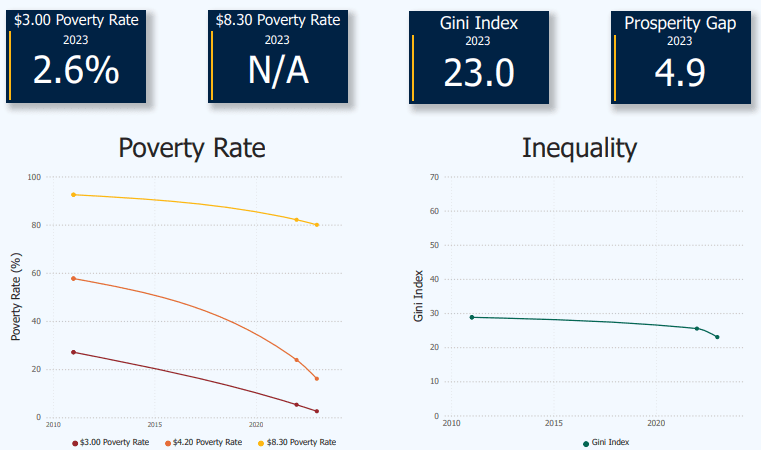
Context: The World Bank’s October 2026 Poverty & Equity Brief revealed that India’s extreme poverty rate (living on less than 3.00/day in 2021 PPP) fell sharply to 2.6% in 2023, down from 5.3% in 2022–23 and 27.1% in 2011.</p> <figure class="ca-img-wrap"><img decoding="async" src="https://www.insightsonindia.com/wp-content/uploads/2026/11/Poverty-Equity-Brief.png" alt="World Bank’s Poverty & Equity Brief" class="ca-zoomable" data-alt="World Bank’s Poverty & Equity Brief" data-caption="World Bank’s Poverty & Equity Brief" loading="lazy"><figcaption class="ca-img-caption">World Bank’s Poverty & Equity Brief</figcaption></figure> <p><strong><u>About </u></strong><strong>The World Bank’s Poverty & Equity Brief</strong><strong><u>:</u></strong></p> <p><strong><u>What It Is?</u></strong></p> <ul> <li>A semi-annual country-level assessment published by the World Bank that tracks trends in monetary and multidimensional poverty, shared prosperity, and inequality using standardized regional microdata (such as the South Asia Micro Database).</li> </ul> <p><strong><u>Methodology & Benchmarks:</u></strong> It measures poverty using 2021 Purchasing Power Parity (PPP) thresholds—Extreme Poverty (3.00/day), Lower-Middle Income (8.30/day)—integrating official Household Consumption Expenditure Surveys (HCES) and Periodic Labour Force Surveys (PLFS).
Key Findings in the Report:
- Sharp Fall in Extreme Poverty: Extreme poverty (4.20/day) Benchmark: Poverty at the 8.30/day): The share of population below the $8.30/day threshold declined to 80.0% (~115 crore people) in 2023 from over 90% in 2011.
- Rural-Urban Convergence: At the $4.20 line, rural poverty stood at 19.3% compared to 8.6% in urban areas, reflecting significant progress in rural areas that narrowed the spatial divide.
- Multidimensional Poverty Decline: Multidimensional poverty dropped to 15.5% in 2022–23, mirroring non-monetary improvements measured by the Multidimensional Poverty Index (which fell from 53.8% in 2005–06 to 16.4% in 2019–21).
- Decline in Consumption Inequality: The Gini index for consumption fell to 23.0 in 2023 from 25.5 in 2022–23 and 28.8 in 2011–12 (though the report noted the metric may understate inequality by under-capturing wealthy households).
- Future Projections: Poverty at the $4.20/day line is projected to ease gradually to 14.2% in 2026 and further to 12.1% by 2028.
Positives Highlighted in the Report:
- Robust Employment Expansion: Employment increased by 13.4 crore between 2017 and 2023—nearly twice the growth rate of the working-age population.
- Surge in Female Labour Participation: Job growth was largely driven by rural women entering paid work, boosting the number of household earners.
- Impact of Expanded Social Safety Nets: Targeted social transfers, wide-scale food subsidies, and rural infrastructure investments helped protect vulnerable households against price shocks.
- Universal Basic Infrastructure Access: Multidimensional indicators showed broad access to basic amenities, with only 1.0% of the population lacking electricity and 6.4% lacking basic drinking water access.
Challenges Highlighted in the Report:
- Geographic Poverty Concentration: About 57% of India’s remaining poor are concentrated in a contiguous northern-eastern belt extending from Uttar Pradesh to West Bengal.
- Pronounced Wage Disparities: The top 10% of wage earners earned roughly 13 times the median earnings of the bottom 10% in 2023.
- Stagnant Real Incomes & Low Productivity: Job creation remained predominantly concentrated in lower-productivity informal or agricultural activities, leaving real earnings broadly unchanged.
- Rising Youth Unemployment: Overall youth unemployment increased from 14.6% in Q1 FY2025–26 to 15.9% in Q1 FY2026–27, with the rise felt most noticeably among young rural women.
Way Ahead:
- Targeted Industrialization in High-Poverty States: Focus industrial incentives, public capital expenditure, and MSME corridors on the Uttar Pradesh–to–West Bengal belt to generate localized, productive jobs.
- Transition from Low-Productivity to Formal Work: Facilitate the movement of rural and female workers into higher-value manufacturing, food processing, and rural services to raise real wages.
- Targeted Youth Skilling Initiatives: Redesign technical and vocational training to align directly with modern industrial demand, lowering youth unemployment rates.
- Strengthen Data Granularity & Measurement: Continuously modernize employment surveys and update the 2011 Census frame to accurately reflect urban growth and demographic changes.
Conclusion:
India’s progress in reducing extreme poverty to 2.6% marks a major socio-economic milestone driven by expanding social safety nets and female workforce entry. However, the clustering of 57% of the remaining poor in specific states alongside stagnant real earnings underscores the need for regional interventions. Sustaining inclusive growth on the path to Viksit Bharat 2047 will rely on generating productive, high-wage jobs in less-industrialized regions and curbing youth unemployment.
“Poverty in India is multidimensional and cannot be addressed through income-based interventions alone”. Examine this statement. Suggest a holistic policy framework to tackle poverty.