CME
Biotechnology Research and Innovation Council (BRIC)
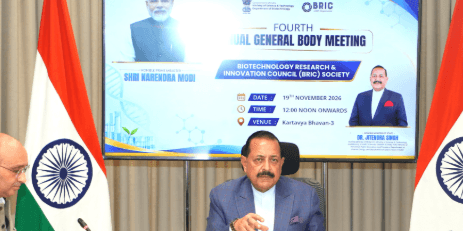
Context: At BRIC’s 4th AGM, Dr. Jitendra Singh highlighted India’s bioeconomy targets of USD 300 billion by 2030 and USD 1 trillion by 2047, stressing research commercialisation and industry partnerships.

About Biotechnology Research and Innovation Council (BRIC):
What is it?
- An integrated scientific research organisation under the Department of Biotechnology (DBT), Ministry of Science and Technology, bringing together biotechnology research institutions through shared infrastructure, collaborative research and unified governance.
Aim: To strengthen India’s biotechnology ecosystem by promoting interdisciplinary research, scientific innovation, industry partnerships and commercialisation, contributing to India’s bioeconomy goals.
Key Features of BRIC:
- Brings biotechnology institutions under a collaborative framework, enabling shared infrastructure, resources and governance while preserving their individual scientific strengths.
- Ranked 1st in health sciences and 2nd in biological sciences among Indian government institutions for two consecutive years, according to the Nature Index India.
- Promotes the conversion of scientific discoveries into market-ready technologies, diagnostics, therapeutics and sustainable biomaterials through industry partnerships and entrepreneurship programmes.
- Encourages collaboration across AI, biology, agriculture and healthcare, alongside initiatives such as Vaibhav Connect to engage Indian scientific talent abroad.
- Supports initiatives like the Entrepreneur-in-Residence programme and the D.E.S.I.G.N. for BioE3 Challenge, which received over 6,000 proposals, while strengthening institutional governance.
Significance:
- Supports India’s ambition to grow its bioeconomy from over USD 195 billion to USD 300 billion by 2030 and USD 1 trillion by 2047.
- Accelerates indigenous innovation in healthcare, agriculture, disease diagnostics and sustainable materials, reducing dependence on imported technologies.
- Strengthens India’s ecosystem of 11,000+ biotechnology startups by encouraging research commercialisation, industry investment and high-skilled employment.
Relevance for UPSC Examination
- GS Paper II: Government institutions, scientific research governance and institutional reforms.
- GS Paper III: Biotechnology, indigenous innovation, research and development, startups, bioeconomy and technology commercialisation.