E20 Ethanol Blending Controversy in India
Context: The Ministry of Petroleum and Natural Gas and public sector Oil Marketing Companies (OMCs) rejected claims by the Karnataka Government that retail petrol contains 26–31% ethanol.

About E20 Ethanol Blending Controversy in India:
What is E20?
- A motor fuel blend comprising 20% anhydrous ethanol (bioethanol) and 80% motor gasoline (petrol) by volume, conforming to standard IS 17021.
Key Statistics on Ethanol Blending in India:
- Nationwide Testing Compliance: 893 samples tested across 27 States and UTs (including 56 in Karnataka) fell within the 19–21% limit, averaging 19.30% in Karnataka.
- Forex Savings & Oil Substitution: Since Ethanol Supply Year (ESY) 2014–15, the programme has saved over ₹1.97 lakh crore in foreign exchange and replaced ~316 lakh metric tonnes of crude oil.
- Emissions & Farm Transfers: Generated a reduction of roughly 952 lakh metric tonnes in CO2 emissions and directed more than ₹1.66 lakh crore in payments to domestic farmers.
- Procurement Volumes: During ESY 2025–26, OMCs procured 1,089 crore litres of ethanol and blended 1,134 crore litres against total petrol sales of approximately 5,673 crore litres.
Evolution of Ethanol Blending in India
- Pilot Phase (2001–2003): Began as small-scale pilot initiatives across select states to evaluate blending 5% ethanol in motor spirit.
- National Policy on Biofuels (2018): Expanded feedstock eligibility beyond sugarcane juice to surplus food grains, damaged rice, and maize to ensure round-the-year availability.
- Target Preponement (2021–2022): The Central Government advanced the national target of 20% ethanol blending (E20) from 2030 to 2025–26 based on the NITI Aayog Roadmap.
- Commercial Rollout & Standardization (2023–2026): Scaled E20 availability across retail fuel stations under updated IS 17021:2018 standards (Amendment No. 3, August 2025).
Key Initiatives Taken So Far:
- National Policy on Biofuels & Amendments: Provided regulatory backing, streamlined inter-state transport, and designated differentiated pricing for ethanol based on feedstock.
- Interest Subvention Schemes: Offered concessional loan subsidies to set up new 1G (grain/molasses) and 2G (cellulosic) ethanol distillation plants.
- Automated Terminal Blending: Installed calibrated proportioning and automated blending units at refinery depots to eliminate manual tampering.
- Quality Coordination Cells (QCC): Instituted multi-tier monitoring under the Centre for High Technology (CHT) to run nationwide compliance testing of fuel batches.
Flaws Flagged by OMCs in the Karnataka Testing Exercise
- Non-Compliance with Statutory Sampling Protocol: Samples were drawn unilaterally without OMC participation or joint labeling, violating the 2005 Control Order under the Essential Commodities Act and Marketing Discipline Guidelines (MDG) 2024.
- Absence of Retention Samples & Reports: The state department failed to furnish parallel retention samples, outlet-wise tracking sheets, or detailed laboratory workups to OMCs for independent counter-testing.
- Incomplete Gas Chromatography Methodology: Test certificates vaguely cited “Ethanol % by Gas Chromatography” without showing standard ASTM D4815/D6839 dilution procedures (1:1 with oxygenate-free fuel) or calibration against E10 reference material.
- Inconsistent Density Physics: The reported samples showed lower densities (0.742–0.749 g/cc) despite claiming 26–31% ethanol; because ethanol has a higher density than petrol, higher blending must raise the overall density, not lower it below standard E20 levels (0.752–0.760 g/cc).
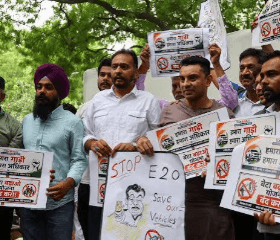
The Debate on Mileage Drop & Consumer Losses:
| Activist Claims | Ministry / ARAI / SIAM Position |
| Blanket 10% Mileage Drop: Assumed a blanket 10% fuel efficiency loss across all on-road vehicles. | Calibrated Efficiency Impact: Tests show only a 1–2% loss in E20-calibrated engines and 3–6% in uncalibrated older vehicles. |
| ₹62,000 Crore Fuel Loss: Claimed massive economic losses suffered annually by retail fuel consumers. | Unscientific Assessment: Extrapolating a 10% drop across the entire national vehicle fleet is methodologically invalid. |
| ₹39,000 Crore Repair Costs: Alleged engine damage, fuel line corrosion, and frequent mechanical failures. | Lack of Corroborating Data: Over 34 crore vehicles run daily on E20 without reported systemic mechanical breakdown spikes. |
| Incentive for Over-Blending: Hinted that commercial retailers profit by loading fuel with cheaper bioethanol. | Negative Commercial Incentive: Excess ethanol procurement raises blending costs for OMCs rather than providing a margin benefit. |
Way Ahead:
- Mandate Joint Verifiable Sampling: Conduct all retail fuel quality audits strictly through joint sampling frameworks involving state authorities, OMCs, and accredited referral laboratories.
- Accelerate Fleet E20 Calibration: Encourage auto manufacturers to roll out full material-compatible and E20-tuned engines across new two-wheelers and four-wheelers.
- Public Traceability Dashboards: Publish depot-level automated blending logs and QCC testing reports on digital platforms to foster transparency.
- Standardize State Testing Capabilities: Equip state legal metrology laboratories with standardized Gas Chromatography equipment and certified reference fuels to eliminate testing variations.
Conclusion:
The controversy highlights the friction between state-level enforcement procedures and national fuel quality standards. Resolving such technical disputes requires strict adherence to statutory sampling procedures and validated laboratory methodologies. Strengthening transparent, joint quality audits will protect consumer confidence while keeping India’s biofuels and energy security goals on track.
Why is India accelerating its shift towards the E20 fuel mandate? Discuss its expected advantages and the key challenges in its implementation.