The 1.5°C Overshoot Narrative
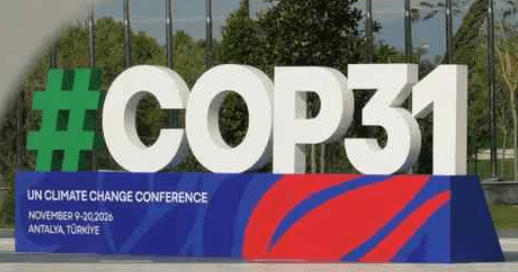
Context: COP31 opened in Antalya, Türkiye, adopting an India-backed Climate Finance Work Programme (CFWP) amid EU objections and concerns over the 1.5°C warming overshoot and developed nations’ climate commitments.

About The 1.5°C Overshoot Narrative:
What it is?
- A modeling and policy framing where global mean surface temperatures temporarily exceed the Paris Agreement’s (1.5 degree C) threshold in the near term, with the theoretical expectation of pulling temperatures back below (1.5 degree C) by 2100 through massive Carbon Dioxide Removal (CDR).
- Policy Function: Functions as a political release valve, keeping the aspirational (1.5 degree C) target alive on paper while developed emitters delay immediate, deep emissions reductions.
- Core Asymmetry: Relies on unproven technological negative emissions and land-intensive biological sinks primarily situated across the Global South to absorb the continued high emissions of the Global North.
Key Data & Stats from COP31 & Climate Reports:
- Scale of Carbon Removal Needed: The UNEP Limiting Overshoot report shows reversing just 0.1°C of temperature overshoot requires removing 220 billion tonnes of CO₂, equivalent to five years of current total global emissions.
- Current Direct Air Capture (DAC) Capacity: While terrestrial forests and soils remove ~2.2 billion tonnes of CO₂ annually, modern DAC removes only ~2 million tonnes, facing steep scale-up costs of up to $600 per tonne.
- Global South Land Encroachment: National climate pledges currently assume access to nearly 1.2 billion hectares of land for CO₂ removal and offsetting, predominantly located in developing countries.
- Widening Adaptation Finance Deficit: The UNEP Adaptation Gap Report 2026 reveals public international adaptation flows stood at 31.7 billion in 2024, falling drastically short of the estimated 365 billion needed annually by 2035.
- Fossil Fuel Primacy in Developed Economies: As of 2025, fossil fuels continued to supply 83% of primary energy in the United States and 73% in the European Union.
Unmet Commitments and Contradictions of Developed Nations
- Fossil Fuel Expansion Approvals: Rather than phasing out hydrocarbons, major developed economies continue approving long-term extraction projects.
E.g., The U.S. proposing 1.3 billion acres of waters for offshore drilling, Norway issuing 70 new Arctic/offshore blocks, the UK greenlighting the Jackdaw field, and Australia approving 37 fossil fuel projects since 2022.
- Financial Obfuscation and Retractions: Developed countries claimed $137 billion in mobilised climate finance in 2024, yet independent assessments place its grant-equivalent value at only $33–45 billion, with ~65% delivered as debt-creating commercial loans.
E.g., The U.S. rescinding $4 billion in pledges to the Green Climate Fund (GCF) and the UK nearly halving its multilateral climate contributions.
- Outsourcing Mitigation Commitments: Wealthy nations offset domestic emissions by purchasing cheap overseas credits rather than cutting emissions at home.
E.g., Switzerland planning to meet one-third of its 2030 NDC via foreign offset credits (such as cookstove projects in Ghana) while its domestic emissions hovered only 22% below 1990 levels in 2024.
- Unilateral Trade Protectionism (CBAM): Mechanisms like the EU’s Carbon Border Adjustment Mechanism impose carbon tariffs on steel, aluminium, and cement, penalizing industrialization in developing countries lacking low-carbon capital.
E.g., Indian and African industrial exporters facing added compliance costs and export barriers while denied affordable green technology transfers.
Critical agenda COP31:
- Standalone Climate Finance Work Programme (CFWP): Formally adopted as a dedicated plenary agenda item to track developed nations’ Article 9.1 obligations, focusing on predictable, grant-based public finance despite initial EU objections.
- Exclusion of Tripling Adaptation Finance: Dropped as an independent agenda item and relegated to informal consultations, sidelining developing nations’ calls for binding roadmaps to bridge the $305B+ annual adaptation gap.
- Referral of Unilateral Trade Measures (CBAM): Excluded from the formal agenda and routed to the existing three-year dialogue platform in Bonn, deferring debates on trade penalties versus Common But Differentiated Responsibilities (CBDR).
- GCF Replenishment Under Existing Tracks: Retained within the standard financial mechanism agenda rather than creating a separate review track, with the seventh formal review of the financial mechanism deferred to COP32.
- Inclusion of Consultations on Mountains and Climate: Agreed to hold dedicated consultations on mountain ecosystems to be considered for research dialogues alongside the Subsidiary Body for Scientific and Technological Advice (SBSTA).
Way Ahead:
- Ground Negotiations in Remaining Carbon Budgets: Re-center COP negotiations on the quantitative, fair-share allocation of the remaining global carbon budget, holding historic emitters accountable for their historical overuse.
- Mandate Net-Negative Timelines for Developed Nations: Require developed economies to achieve net-zero well before 2050 and deliver domestic net-negative emissions without using foreign land and forest sinks.
- Operationalize Grant-Based Public Climate Finance: Use the newly adopted CFWP to enforce Article 9.1 obligations, ensuring the $300 billion NCQG mobilization target translates into non-debt, grant-equivalent public assistance.
- Dismantle Intellectual Property Barriers: Establish multilateral technology-sharing mechanisms under the UNFCCC to transfer green industrial technologies and grid storage patents to the Global South without commercial premiums.
- Acknowledge Socio-Ecological Constraints of Overshoot: Subject all proposed overshoot scenarios to strict scientific reviews that evaluate the risks of irreversible tipping points, indigenous land dispossession, and food security impacts.
Conclusion:
The opening of COP31 demonstrates that substituting the “overshoot” narrative for near-term climate action risks excusing continued fossil fuel expansion in the developed world. Relying on speculative, future carbon removal shifts the ecological and financial burden onto the land and resources of developing nations. Meaningful climate progress requires developed countries to implement immediate domestic emissions cuts, provide predictable, grant-based public finance, and address the real adaptation needs of the Global South.
Examine the limitations of the consensus-based decision-making model under the United Nations Framework Convention on Climate Change (UNFCCC). Why has it failed to ensure timely and effective climate action? Suggest reforms to democratise global climate negotiations.