Prelims
National HPV Vaccination Campaign
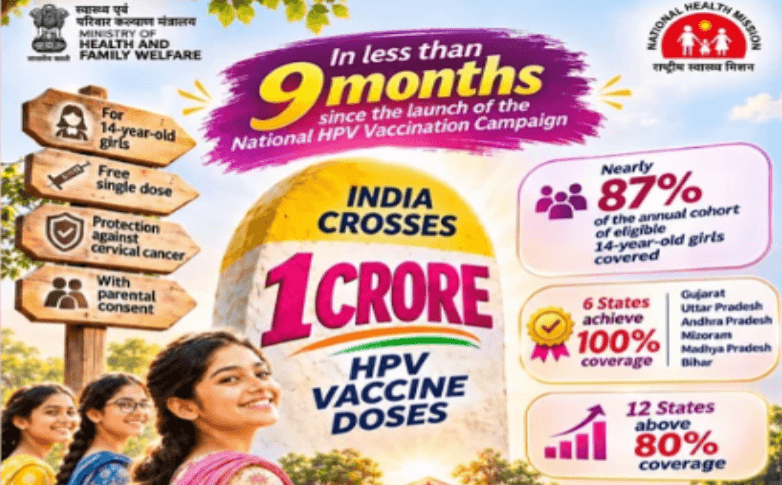
Context: India surpassed 1 crore HPV vaccine doses under the National HPV Vaccination Campaign, achieving nearly 87% coverage of its annual target of 1.20 crore 14-year-old girls.

About National HPV Vaccination Campaign:
What it is?
- A preventive, non-infectious recombinant vaccine formulated using virus-like particles (VLPs) that protects against persistent infection by high-risk Human Papillomavirus (HPV) strains—primarily HPV types 16 and 18, which cause over 80% of cervical cancer cases in India (alongside types 6 and 11 in the quadrivalent Gardasil-4 vaccine used in the national drive).
Scheme Under: Launched on February 28, 2026, in Ajmer, under the Ministry of Health and Family Welfare, with vaccination records tracked through the U-WIN platform.
Aim: To protect 14-year-old girls against HPV infection before exposure, prevent cervical cancer and support the WHO’s cervical cancer elimination strategy.
Key Features of HPV Vaccine & National Campaign:
- Free, Single-Dose Vaccination: Provides a free, voluntary single dose of HPV vaccine to eligible girls, with informed parental consent and evidence supporting strong protection.
- Targeted Age Group: Covers approximately 1.20 crore 14-year-old girls annually, ensuring vaccination before potential HPV exposure and maximising preventive benefits.
- Multi-Strain Protection: Uses WHO-prequalified Gardasil-4, protecting against HPV types 6, 11, 16 and 18, alongside India’s indigenous quadrivalent vaccine, Cervavac.
- Public Healthcare Delivery: Vaccines are administered at designated government health facilities, including PHCs, CHCs and district hospitals, with digital registration and certification through U-WIN.
- Vaccination Safety Monitoring: Vaccination centres are linked to 24×7 healthcare facilities for monitoring and managing rare Adverse Events Following Immunization (AEFI).
Significance:
- With over 1.20 lakh annual cases and nearly 80,000 deaths in India, HPV vaccination strengthens primary prevention and reduces future cancer risks.
- Free vaccination improves access for rural and underserved adolescent girls, reducing financial barriers and advancing Universal Health Coverage (UHC).