Proposed 25% U.S. Tariffs on India
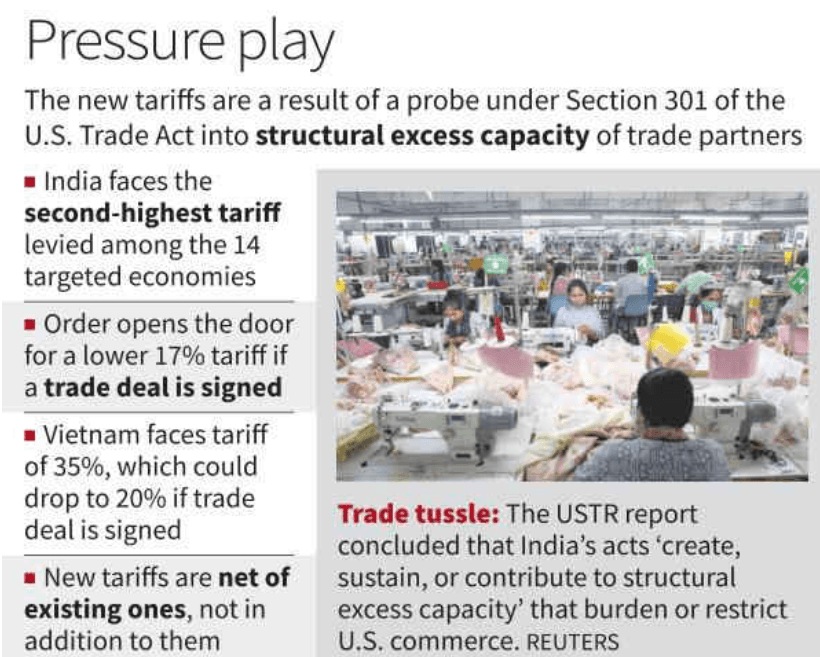
Context: The Office of the United States Trade Representative (USTR) proposed a 25% tariff on Indian goods, following a Section 301 investigation into “structural excess manufacturing capacity” across 14 major economies.

About Proposed 25% U.S. Tariffs on India:
What it is?
- A proposed unilateral trade measure under Section 301 of the U.S. Trade Act, 1974, imposing a 25% tariff on Indian goods over alleged structural excess manufacturing capacity, with a conditional reduction to 17% upon concluding a reciprocal trade agreement.
Overview of the New U.S. Tariff Measures:
- Proposed 25% Duty on India: Following 14 affirmative findings out of 16 investigations launched in March 2026, the USTR proposed tariffs up to 25% on Indian imports—the second-highest rate globally after Vietnam (35%).
- Comparative Tariff Structure: India’s 25% baseline rate exceeds proposed duties for China, Bangladesh, Cambodia, and Singapore (up to 20%); Indonesia, Malaysia, and Thailand (18%); and the EU, Japan, South Korea, Taiwan, and Switzerland (15%).
- Conditional Reduction to 17%: Concluding a reciprocal trade pact would lower India’s tariff to 17%, giving it a 1–3 percentage point edge over Asian rivals.
- Non-Stacking & Consultation Timeline: The 25% duty will not stack onto the existing 10% Section 301 forced-labour duty or 50% Section 232 steel/aluminium tariffs; written comments close January 5, 2027, ahead of public hearings starting January 25, 2027.
Reasons Behind the U.S. Tariffs on India
- Alleged Structural Excess Capacity: The USTR claimed Indian industrial policies and subsidies fuel excess capacity—especially in pharmaceuticals, medical devices, steel, solar energy, and ICT—harming U.S. producers and jobs.
- Five Core USTR Allegations: Washington cited state-backed industrial expansion plans, inadequate labour protections, financial repression, sustained market access barriers, and failure to curb global overcapacity.
- Reliance on Non-Market Economies: U.S. officials flagged economic security risks from Indian sectors using upstream inputs and FDI from non-market economies.
- Dual-Rate Bargaining Leverage: Analysts (such as GTRI) note the 25% penalty vs. 17% deal rate serves as a geopolitical lever to pressure partners into bilateral trade deals on U.S. terms.
Legal Framework Governing U.S. Tariffs
- Section 301 (Trade Act of 1974): Authorizes the USTR to investigate “unreasonable or discriminatory” foreign trade practices burdening U.S. commerce and impose unilateral retaliatory tariffs.
- Section 232 (Trade Expansion Act of 1962): Allows the U.S. President to impose tariffs or quotas on national security grounds—currently enforcing a global 50% tariff on steel and aluminium.
- Lindsey O. Graham Sanctioning Russia and Iran Act of 2026: Permits secondary tariffs up to 100% on nations importing large volumes of Russian oil (currently paused).
- WTO Dispute Settlement Friction: Unilateral Section 301 duties bypass multilateral WTO adjudication, reviving bilateral managed trade.
Implications for the Indian Economy
- Export Competitiveness & Margin Pressure: A 25% tariff threatens price competitiveness in India’s largest export market, squeezing margins across pharmaceuticals, engineering goods, textiles, solar modules, and electronics.
- Pressure to Accelerate the BTA: Locking in the 17% rate provides a slight tariff edge over Vietnam (20% deal rate) and Bangladesh/Indonesia (18% deal rate), pressuring New Delhi to finalize the Bilateral Trade Agreement.
- Risks to Domestic Industrial Policy (PLI): U.S. scrutiny of industrial expansion and input sourcing directly challenges India’s PLI and import-substitution strategies in solar, pharma, and ICT.
- Supply-Chain Diversification Costs: Addressing U.S. concerns over non-market economy inputs could force Indian exporters to reconfigure upstream supply chains, raising short-term costs.
Way Forward for India–U.S. Trade Relations
- Conclude a Balanced BTA: Leverage negotiations under the February 2026 framework and Joint Statement to secure the 17% tariff tier while safeguarding sensitive agricultural and MSME sectors.
- Present Evidence-Based Rebuttals at USTR Hearings: Submit sectoral data before January 5, 2027, and at the January 25 hearings showing Indian capacity serves domestic infrastructure and supply-chain diversification rather than predatory dumping.
- Resolve Non-Tariff Bottlenecks: Address mutual regulatory, standards, and customs friction via bilateral working groups to reduce unilateral U.S. trade actions.
- Diversify Export Markets: Fast-track trade pact implementation with the EU, UK, EFTA, ASEAN, and Middle Eastern partners to insulate exporters from single-market tariff shocks.
Conclusion:
The USTR’s proposed 25% Section 301 tariff highlights the growing weaponization of trade policy to extract bilateral concessions. While rejecting the overcapacity charge, India must use the January 2027 USTR consultation window and BTA negotiations to secure tariff relief while diversifying export destinations and strengthening domestic value chains against protectionist headwinds.
Why has the India–Iran–USA relationship emerged as a major diplomatic challenge for India? Analyse how India can manoeuvre through these competing strategic interests.