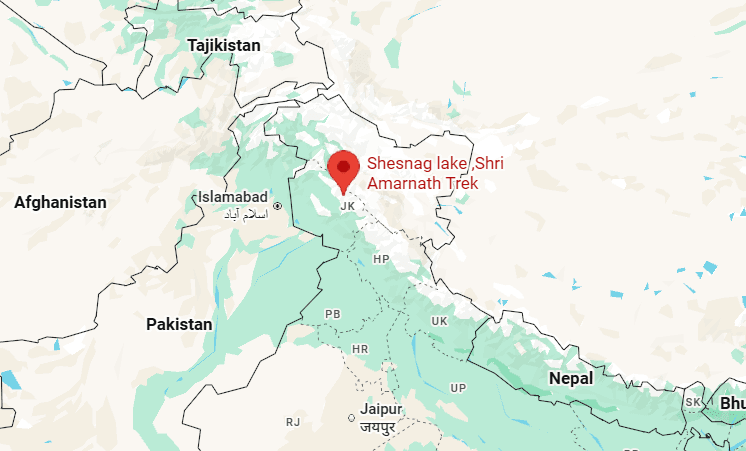
Mapping
Sheshnag Lake
Context: A viral video showing excavation along Sheshnag Lake in Jammu and Kashmir has sparked concerns over damage to the fragile Himalayan ecosystem.

About Sheshnag Lake:
What it is?
- A sacred, high-altitude oligotrophic alpine glacial lake (naturally low in nutrients and algae, giving it crystal-clear greenish-blue waters) serving as a vital base camp along the traditional Pahalgam–Amarnath Yatra route.
Located in: Situated in the Great Himalayan range in Anantnag district, Jammu and Kashmir.
Origin:
- Formed by glacial action and fed continuously by melting snowfields and mountain streams from surrounding peaks; in Hindu tradition and the 12th-century chronicle Rajatarangini, it is revered as the abode of the serpent king Sheshnag (where Lord Shiva left his serpents before revealing the Amar Katha to Goddess Parvati).
Key Features of Sheshnag Lake:
- High-Altitude Elevation: Sits at an elevation of 3,590 metres (11,780 feet) above sea level, stretching roughly 1.1 km in length and 0.7 km in width.
- Seasonal Winter Freezing: Remains completely frozen and inaccessible under heavy snow from December to March/May, thawing into shimmering turquoise waters during summer.
- Source of the Lidder River: Drains via the Sheshnag stream into the East Lidder River, a major perennial tributary of the Jhelum River.
- Cold-Water Aquatic Habitat: Supports cold-water alpine fauna, notably serving as a natural habitat for brown trout.
- High-Risk Glacial Lake Classification: Identified among 14 high-risk glacial lakes in Jammu and Kashmir monitored closely for Glacial Lake Outburst Flood (GLOF) and ecological vulnerabilities.
Implications:
- Debris dumping risks slope instability, pollution of the Lidder–Jhelum basin, landslides and glacial lake outburst floods (GLOFs).
- Raises concerns over compliance with the Supreme Court’s 2012 directive permitting 12-foot-wide walking tracks but prohibiting motorable metalled roads.