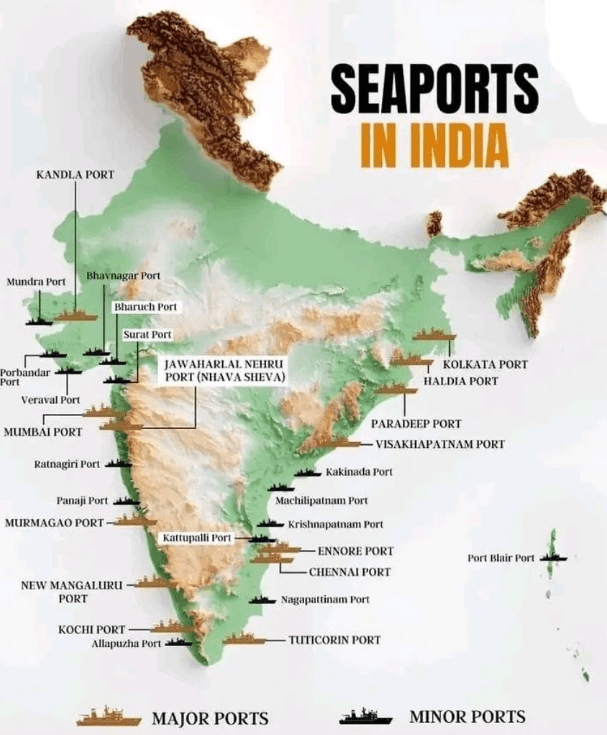
Mapping
Deendayal Port
Context: Deendayal Port Authority (DPA), Kandla, was conferred the prestigious ‘Major Port of the Year’ award at the 13th edition of the Samudra Manthan Awards, organised by Bhandarkar Publications in Mumbai.

About Deendayal Port:
What it is?
- One of India’s 12 Major Ports under the administrative control of the Ministry of Ports, Shipping and Waterways, operating as an all-weather, natural tidal port and serving as India’s largest state-owned major port by cargo volume handled.
Located in: Situated on the Kandla Creek along the northern shore of the Gulf of Kutch in Kutch district, Gujarat (with an offshore oil terminal at Vadinar).
History:
- Origins (1930s): Originated with a single RCC jetty built at Old Kandla in 1930 by Maharao Khengarji III of Kutch.
- Post-Partition Development (1950s): Following Partition (1947), India developed Kandla Port to replace Karachi Port. Jawaharlal Nehru laid its foundation in January 1952, and it became a Major Port on April 8, 1955.
- Renaming & Corporatisation: Renamed from Kandla Port to Deendayal Port in 2017 in honour of Pandit Deendayal Upadhyaya, and transitioned into Deendayal Port Authority (DPA) under the Major Port Authorities Act, 2021.
Aim: To provide cost-effective, high-efficiency, and smart maritime logistics infrastructure for export-import (EXIM) and coastal trade while driving industrial and green-energy growth across western and northern India.
Key Features of Deendayal Port:
- All-Weather Tidal Harbour: Located within the sheltered Kandla Creek, the port remains protected from strong monsoon waves, enabling 24×7 maritime operations throughout the year.
- Multi-Cargo & Liquid Storage Hub: Handles containers, dry cargo, crude oil and chemicals through 16 cargo berths, 6–7 oil jetties and Vadinar facilities, with over 23 lakh kilolitres of liquid storage.
- Record Cargo Handling: One of India’s leading major ports in cargo handling, Kandla crossed 150 Million Metric Tonnes (MMT) of annual cargo throughput in FY 2025–26.
- PPP Expansion at Tuna Tekra: Expanding cargo capacity through Public-Private Partnerships, including a mega container terminal with DP World and a ₹2,276.06 crore multipurpose terminal with Essar Ports.
- Proximity to India’s First SEZ: Located just 9 km from Kandla Special Economic Zone (KASEZ), established in 1965 as India’s and Asia’s first Export Processing Zone.
Significance:
- Connects states including Gujarat, Rajasthan, Punjab and Haryana to international markets, providing shorter maritime access to the Middle East, Europe and Africa.
- Supports Maritime India Vision 2030 and the National Green Hydrogen Mission through green hydrogen and ammonia export infrastructure, alongside smart port modernisation.