Prelims
The Malabar Tree Toad
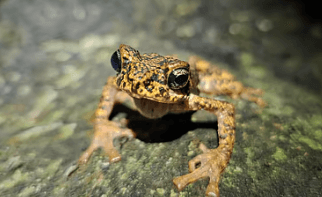
Context: Karnataka became the first state in India to officially declare a state amphibian, designating the endemic Malabar Tree Toad (Malenadina Mara Gantikappe) under an order issued by the Department of Forest, Ecology and Environment.

About The Malabar Tree Toad:
What it is?
- A tiny, endangered arboreal amphibian belonging to the family Bufonidae. It is the sole surviving species in the monotypic genus Pedostibes (Asian tree toads) and is distinguished as the only toad species in India adapted to living in tree canopies.
Habitat:
- Western Ghats Endemic Species: Found only in the Western Ghats, mainly in wet evergreen and semi-evergreen forests at elevations ranging from 250 to over 1,000 metres.
- Tree-Dwelling Habitat: Spends most of its life in tree canopies, moist tree hollows and water-filled leaf bases, moving towards streams and forest floors during breeding.
Key Characteristics:
- Adaptations for Tree Climbing: Measures around 3.5–3.8 cm and has broad, sticky finger and toe pads that help it climb trees, branches and vertical surfaces.
- Rough and Warty Skin: Has rough, gland-covered skin with a brownish-grey body, dark sides and a distinct creamy-white stripe extending from below the eye to the shoulder.
- Pre-Monsoon Breeding: Breeds mainly between March and June, during pre-monsoon and early monsoon showers, unlike many Indian frogs that reproduce during peak monsoon rains.
- Specialised Tadpoles: Its tadpoles have sucker-like mouthparts that help them attach to slippery rocks in fast-flowing streams and feed on algae without being washed away.
- Distinctive Breeding Call: Male frogs produce a sharp, repeated call lasting around 3–7 seconds, at approximately 3,780 Hz, to attract females during the breeding season.
Significance:
- Its dependence on clean streams, healthy tree cover and moist forests makes it a useful indicator of environmental quality in Western Ghats ecosystems.
- Its recognition as a state amphibian highlights lesser-known species and encourages protection of forest canopies, freshwater streams and breeding habitats.