Prelims
The Martyrs’ Memorial of the First War of Independence of 1857
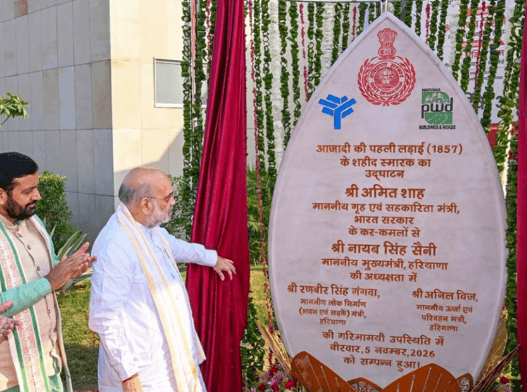
Context: Union Home Minister and Minister of Cooperation inaugurated the grand Martyrs’ Memorial of the First War of Independence of 1857 in Ambala, Haryana, constructed at a cost of ₹594 crore across 22 acres.

About The Martyrs’ Memorial of the First War of Independence of 1857:
What it is?
- A sprawling, modern war and heritage memorial complex featuring 22 interactive exhibition galleries, an open-air theatre for 2,500 people, and a light-and-sound show.
- It integrates traditional regional crafts (such as Phulkari and Sarkanda) with advanced digital technologies—including virtual reality, holography, and projection mapping—to depict the unsung revolutionaries and timeline of the 1857 freedom struggle.
Located in: Situated along the Grand Trunk Road in Ambala Cantonment, Haryana, a historic military centre that witnessed sepoy unrest during the Revolt of 1857.
About the First War of Independence (1857):
- Causes and Immediate Trigger: The revolt was triggered by greased Enfield rifle cartridges, while agrarian distress, heavy taxation, military discrimination and declining handicrafts fuelled widespread resentment.
- Political Discontent and Annexations: Lord Dalhousie’s Doctrine of Lapse and the annexation of Awadh in 1856 alienated Indian rulers, landlords and soldiers, intensifying opposition to British rule.
- Outbreak at Meerut and Unrest at Ambala: Following Mangal Pandey’s resistance at Barrackpore, the major uprising began at Meerut on May 10, 1857, while Ambala also witnessed sepoy unrest.
- Widespread Popular Participation: The revolt spread across north and central India, involving sepoys, peasants, artisans, zamindars and sections of Hindu and Muslim communities against British colonial rule.
- Constitutional Transformation: The Government of India Act, 1858 ended East India Company rule, transferred administration to the British Crown and led to major military and administrative reforms.
Major Leaders and Centres of the 1857 Struggle:
| Centre / Region | Major Leaders | Role & Significance |
| Delhi | Bahadur Shah II (Zafar) & General Bakht Khan | Nominal head and symbolic rallying center of Indian unity; General Bakht Khan of the Bareilly troops led the military defense. |
| Kanpur | Nana Saheb (Dhondu Pant), Tatya Tope, & Azimullah Khan | Adopted son of Peshwa Baji Rao II who expelled the British garrison; supported by military tactician Tatya Tope and political strategist Azimullah Khan. |
| Jhansi | Rani Lakshmibai | Valorous leader who rebelled against the Doctrine of Lapse; famously died in combat defending Gwalior alongside Tatya Tope. |
| Lucknow (Awadh) | Begum Hazrat Mahal & Birjis Qadr | Declared her young son ruler and led talukdars and sepoys in prolonged resistance, laying siege to the British Residency in Lucknow. |
| Jagdishpur / Arrah (Bihar) | Kunwar Singh & Amar Singh | 80-year-old Rajput zamindar who waged mobile guerrilla warfare against British forces across western Bihar and eastern Uttar Pradesh. |
| Faizabad | Maulvi Ahmadullah Shah | Religious scholar and military leader (Lighthouse of Rebellion) who led troops in battle against British columns in Awadh. |
| Bareilly (Rohilkhand) | Khan Bahadur Khan | Descendant of Rohilla rulers who organized a parallel government and led large rebel forces in Rohilkhand. |
| Haryana (Rewari/ Ballabhgarh) | Rao Tula Ram & Raja Nahar Singh | Rao Tula Ram liberated Rewari and defended the southwestern frontier (Battle of Nasibpur); Raja Nahar Singh fortified the approaches to southern Delhi. |
| Allahabad (Prayagraj) | Maulvi Liaquat Ali | Led revolutionary forces and set up headquarters at Khusro Bagh, governing the region until captured by Colonel Neill. |