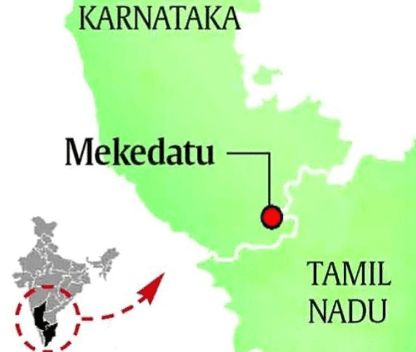
The Mekedatu Project
Context: Karnataka reaffirmed its commitment to the Mekedatu reservoir project, asserting its legal right while assuring Tamil Nadu its 177.25 TMC Cauvery water share.

About The Mekedatu Project:
What it is?
- A proposed multi-purpose balancing reservoir and drinking water infrastructure project (formally the Mekedatu Balancing Reservoir and Drinking Water Project) planned by the Government of Karnataka (through Cauvery Neeravari Nigam Limited) at Mekedatu (“Goat’s Leap”), a deep rocky gorge near Kanakapura.
Background:
- Conceived in 2013, the Mekedatu Project’s Detailed Project Report (DPR) was submitted to the Central Water Commission (CWC) in 2019, with an estimated cost of ₹9,000 crore.
- In November 2025, the Supreme Court dismissed Tamil Nadu’s challenge to DPR scrutiny as premature, while emphasising mandatory environmental, forest and wildlife clearances before construction.
Aim: To supply 4.75 TMC of drinking water to Bengaluru and surrounding areas, generate 400 MW of hydropower, and regulate Cauvery flows to meet Tamil Nadu’s water entitlements.
River Associated: Proposed across the Cauvery River, downstream of Sangama, where the Arkavathi joins the Cauvery, approximately 4 km upstream of the Karnataka–Tamil Nadu border.
Key Features of the Mekedatu Project
- Substantial Reservoir Storage Capacity: Proposes a concrete gravity dam with 16 TMC gross storage and 59.46 TMC live storage to conserve surplus monsoon flows for regulated utilisation.
- Urban Drinking Water Security: Allocates 75 TMC of Cauvery water to Bengaluru and adjoining areas, addressing growing urban water demand and reducing dependence on groundwater resources.
- 400 MW Hydroelectric Generation: Includes a 400 MW hydropower facility to generate renewable electricity, support peak-hour power requirements and strengthen Karnataka’s energy security.
- Inter-State Flow Regulation: Functions as a balancing reservoir to regulate seasonal Cauvery flows and facilitate Karnataka’s compliance with mandated water releases to Tamil Nadu.
- Ecological and Forest Footprint: Involves submergence of over 5,000 hectares of forest and wildlife habitat, necessitating statutory environmental clearances, wildlife approvals and compensatory afforestation.
Implications:
- Intensifies Karnataka–Tamil Nadu water-sharing disputes, as Tamil Nadu fears upstream storage could affect timely irrigation releases to Cauvery delta farmers, triggering political and legal opposition.
- Threatens Cauvery Wildlife Sanctuary’s forests, elephant corridors and aquatic biodiversity, including the endangered hump-backed mahseer, raising significant environmental and regulatory challenges.
Tags: Mekedatu Project, Mekedatu Balancing Reservoir and Drinking Water Project, Karnataka Tamil Nadu Cauvery Water Dispute, Mekedatu Dam Project on Cauvery River, Cauvery Water Sharing Supreme Court Verdict, Mekedatu Project Storage.