CME
The National Clean Air Programme (NCAP)
Context: A Centre for Research on Energy and Clean Air (CREA) analysis found that 31 of 38 Indian cities exceeding the national PM2.5 standard in October 2026 were outside the National Clean Air Programme (NCAP), highlighting gaps in pollution-control coverage.

About The National Clean Air Programme (NCAP):
What it is?
- A national-level air pollution control initiative launched by the Ministry of Environment, Forest and Climate Change (MoEFCC) in January 2019, targeting particulate pollution through city-specific clean air action plans.
Aim: To achieve up to 40% reduction in PM10 concentrations by 2025–26, compared with 2017–18 levels, or attain national ambient air quality standards.
Key Findings of the CREA Analysis:
- Pollution Beyond NCAP Coverage: Of 38 cities exceeding the PM2.5 standard, 31 were non-NCAP cities, revealing significant gaps in the programme’s geographical coverage.
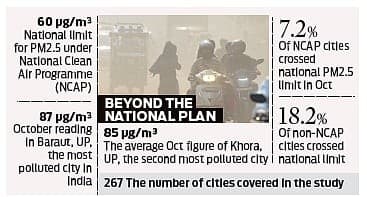
- Higher Pollution Incidence Outside NCAP:2% of non-NCAP cities breached the PM2.5 limit, compared with 7.2% of NCAP cities, indicating approximately 2.5 times higher incidence.
- Regional Concentration of Pollution: Uttar Pradesh recorded 13 polluted cities, followed by Haryana (11), with six of the ten most polluted cities located in Uttar Pradesh.
- Severe Pollution in Smaller Cities: Baraut (87 µg/m³) and Khora (85 µg/m³) recorded the highest October PM2.5 averages, highlighting pollution risks beyond major metropolitan centres.
Significance:
- Highlights the need to expand clean air interventions beyond NCAP cities, particularly in smaller urban centres facing persistent pollution.
- Demonstrates the importance of coordinated interstate pollution-control strategies, as particulate pollution crosses administrative boundaries.
- Underscores the need for wider air-quality monitoring, targeted emission controls and evidence-based policies to reduce population exposure.
Relevance to UPSC Examination Syllabus:
| Paper | Relevant syllabus themes |
| GS Paper II – Governance | Government policies and interventions, implementation gaps, institutional coordination and public health |
| GS Paper III – Environment | Air pollution, environmental degradation, National Clean Air Programme, pollution-control measures and sustainable urban development |
| Essay | Environmental governance, development versus sustainability, urbanisation and public health |