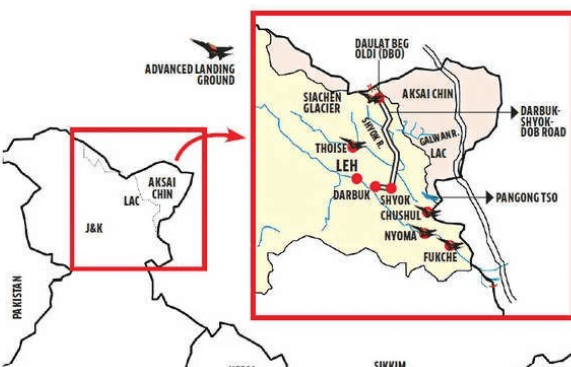
Mapping
The Nyoma Airbase
Context: An Indian Air Force (IAF) IL-76MD heavy-lift strategic transport aircraft made the world’s highest-altitude landing of its kind at eastern Ladakh’s Mudh-Nyoma airbase.

About The Nyoma Airbase:
What it is?
- A high-altitude, strategic forward military airbase of the Indian Air Force (Mudh-Nyoma Air Force Station), developed from an Advanced Landing Ground (ALG) into a full-fledged, all-weather airfield capable of operating frontline fighter jets and strategic heavy-lift transport aircraft.
Location: Situated at 13,700 feet in eastern Ladakh’s Leh district, south of the Indus River, approximately 46 km from the Line of Actual Control (LAC).
History:
- Initial Construction: Originally developed as an Advanced Landing Ground (ALG) during the 1962 Sino-Indian War, it subsequently remained unused for several decades.
- Reactivation (2009): The Indian Air Force (IAF) reactivated Nyoma on September 18, 2009, with the successful landing of an An-32 transport aircraft.
- Modernisation (2025): Upgraded by BRO under Project HIMANK at ₹214 crore, the airbase was inaugurated on November 12, 2025, with a C-130J landing.
Key Features of Nyoma Airbase:
- Heavy-Lift and Fighter-Capable Runway: Features a 3-km blacktopped runway designed to accommodate heavy transport aircraft and frontline fighters, including C-17, IL-76, Su-30MKI and Rafale.
- High-Altitude Combat Airfield: Among the world’s highest fighter-capable airfields at 13,700 feet, complementing Leh, Daulat Beg Oldi and Fukche in Ladakh’s air defence network.
- Extreme-Cold Infrastructure: Equipped with hardened aircraft shelters, crash barriers, fuel-storage facilities and technical hangars, supporting military aviation operations during harsh Himalayan winters.
- Rapid Deployment Hub: Enables faster deployment of troops, armoured vehicles, artillery and essential supplies to forward areas, strengthening operational readiness along the LAC.
- Fourth Major IAF Base in Ladakh: Complements Leh, Thoise and Kargil airbases, expanding India’s forward air operations and strategic reach across the Ladakh frontier.
Significance:
- Strengthens India’s ability to respond to Chinese PLAAF bases across Tibet, including Ngari Gunsa and Lhasa Gonggar, reducing operational distance disadvantages.
- Enhances rapid troop deployment, heavy equipment transport, casualty evacuation and aerial surveillance and military preparedness in eastern Ladakh.