Prelims
The Saffron Cultivation
Context: A pilot saffron cultivation experiment on barren land rejuvenated under Project Him Sarovar in Ladakh recorded its first flowering in just 30 days—half the conventional two-month cycle.
About The Saffron Cultivation:
What it is?
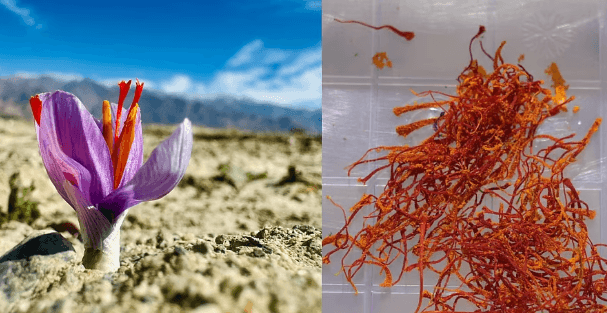
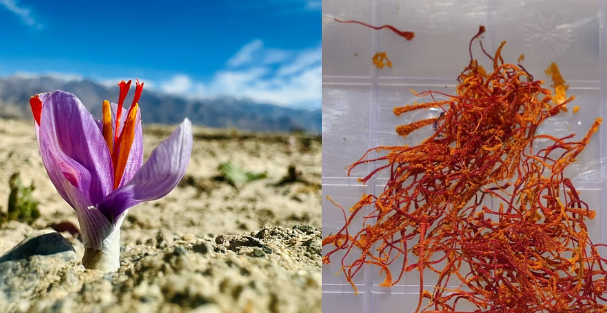
- The agricultural production of saffron (Crocus sativus), a perennial herbaceous autumn-flowering geophyte in the Iridaceae family. It yields the world’s most expensive spice, derived exclusively from the three delicate, vivid crimson-red stigmas plucked and dried from each purple flower.
Habitat & Growing Conditions:
- Thrives in temperate, sub-Mediterranean, and high-altitude cold-arid agro-climatic zones situated between 1,500 and 2,800 metres above mean sea level.
- Requires well-drained, loose, friable, neutral-to-slightly-alkaline sandy-loam or clay-loam soils with low water retention to avoid corm rot.
- Needs warm, dry summers for corm dormancy followed by crisp, cool autumns with abundant sunlight during the flowering phase.
Key Characteristics of Saffron Cultivation
- Vegetative Corm Propagation: Crocus sativus is a sterile triploid that cannot produce viable seeds; reproduction relies entirely on underground corms (bulbs) planted in late summer, which divide annually into daughter corms.
- Short, Concentrated Autumn Bloom Window: Flowering occurs in a narrow period of 2 to 3 weeks during autumn (late October to mid-November), requiring early morning hand-harvesting before flowers wilt under strong sunlight.
- Labour-Intensive Floral Processing: Extremely delicate and manual harvesting; it takes approximately 150,000 to 175,000 flowers to produce just one kilogram of dried saffron spice, as stigmas must be plucked by hand immediately after picking.
- High-Potency Active Phytochemicals: Distinguished by three core bioactive chemical constituents: crocin (responsible for the bright golden-yellow water-soluble colour), picrocrocin, and safranal (delivering the volatile aroma).
- Low Water Requirement with High Frost Tolerance: Drought-hardy crop well-suited to dry plateau microclimates, capable of withstanding winter snow and sub-zero temperatures during its dormant winter phase.
Significance:
- Saffron cultivation offers high returns to marginal farmers, transforming cold, arid mountain regions into profitable agricultural zones.
- Extends saffron cultivation beyond Kashmir into Ladakh, Himachal Pradesh and Sikkim, diversifying production and reducing dependence on traditional growing regions.