Prelims
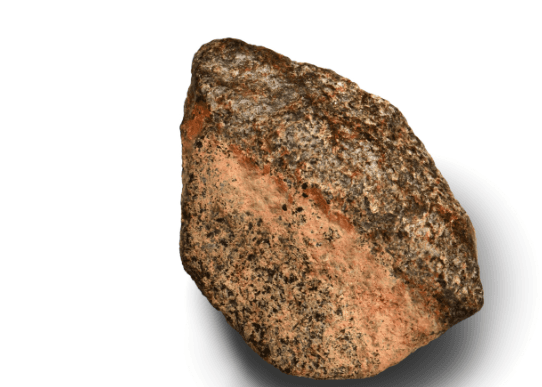
The Teghaza 001 Meteorite
Context: A NASA-funded study published in the journal Science confirmed that an 800-gram rose-colored meteorite named Teghaza 001, found in the Sahara Desert in 2022, originated from Mars over 4.1 billion years ago.

About The Teghaza 001 Meteorite:
What it is?
- A rare, rose-colored Martian meteorite weighing roughly 800 grams (nearly 2 pounds), representing an ancient, pristine fragment of the Red Planet’s primordial crust. It is one of approximately 435 confirmed Martian meteorites on Earth and is described by researchers as a geological “Rosetta Stone” for early Mars.
Origin:
- Crystallized from cooling magma in the Martian crust more than 4.1 billion years ago during the planet’s Noachian era.
- Spectroscopic and mineralogical data matched against NASA’s Mars Reconnaissance Orbiter (MRO) observations point to 13 potential source areas, predominantly matching the heavily cratered southern highlands of Mars.
- Ejected into interplanetary space following a massive asteroid or comet impact on the Martian surface before eventually intersecting Earth’s orbit.
Discovery: Found in 2022 in Teghaza, Mali, in the Sahara Desert. Oxygen isotope analysis at the University of New Mexico confirmed its Martian origin.
Key Characteristics:
- Distinctive Pink Colour: Displays a pinkish hue and diverse volcanic minerals, offering insights into the formation and evolution of Mars’ early crust.
- Ancient Zircon Crystals: Contains microscopic zircon crystals that preserve isotopic records, helping scientists determine the rock’s age and geological history.
- Advanced Dating Technique: Scientists used in-situ rubidium-strontium dating to analyse tiny mineral grains without destroying the meteorite sample.
- Evidence of Ancient Water: Geological and isotopic signatures indicate liquid water circulated through Mars’ crust around 4.1 billion years ago, suggesting early hydrothermal activity.
- Atmospheric Evolution: Preserves geochemical evidence of interactions between rocks, water and the Martian atmosphere, helping scientists investigate Mars’ early environmental changes.
Significance:
- Provides evidence of ancient water and geological activity on Mars, helping assess whether conditions could have supported microbial life.
- Offers a physical Martian sample for laboratory analysis, improving understanding of Mars’ geological evolution without requiring a spacecraft sample-return mission.