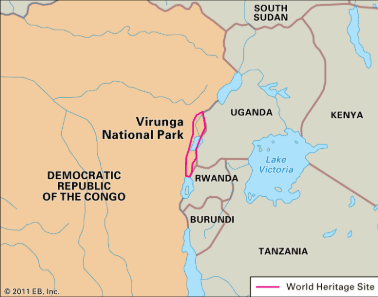
Mapping
Virunga National Park Anthrax Outbreak
Context: An anthrax outbreak in Virunga National Park, DR Congo, has killed at least 30 hippos since September, prompting stricter surveillance and preventive measures against animal-to-human transmission.

About The Virunga National Park:
What it is?
- Africa’s oldest national park and one of the continent’s most biodiverse protected conservation areas, designated as a UNESCO World Heritage Site in 1979.
Located in: Situated in the Albertine Rift Valley, eastern DR Congo, bordering Uganda and Rwanda, covering approximately 7,800 sq. km.
History:
- Establishment: Founded in 1925 as Albert National Park by Belgium’s King Albert I, primarily to protect endangered mountain gorillas.
- Expansion: Later expanded to include Lake Edward, Rwindi plains and Rwenzori Mountains, protecting diverse habitats and wildlife across eastern Congo.
- Renaming and Management: Renamed Virunga National Park in 1969, it is managed through a partnership between ICCN and the Virunga Foundation.
Key Features of Virunga National Park:
- Ecological Diversity: Features savannas, wetlands, tropical forests and alpine vegetation, extending from lowland plains to the glacier-covered Rwenzori Mountains.
- Active Volcanoes: Contains two of Africa’s most active volcanoes, Mount Nyiragongo and Mount Nyamuragira, located within the Virunga volcanic range.
- Great Ape Conservation: Protects Mountain gorillas, eastern lowland gorillas and eastern chimpanzees, making it an important sanctuary for endangered great apes.
- Rich Biodiversity: Supports over 218 mammal, 706 bird, 109 reptile and 78 amphibian species, including forest elephants, okapis and hippopotamuses.
About Anthrax:
What it is?
- A severe, non-contagious zoonotic infectious disease caused by Bacillus anthracis, a Gram-positive, rod-shaped bacterium capable of forming highly resistant, dormant spores that survive in soil for decades.
Key Features of Anthrax:
- Long-Lived Spores: Bacillus anthracis spores can survive in soil for decades, with droughts and heavy rainfall increasing their exposure to grazing animals.
- Three Main Transmission Routes:
- Cutaneous Anthrax: Enters through skin cuts after contact with infected animals, causing a painless sore with a characteristic black centre (eschar).
- Gastrointestinal Anthrax: Spreads through raw or undercooked infected meat, causing severe abdominal pain, vomiting and gastrointestinal bleeding.
- Inhalation Anthrax: Occurs when airborne spores are inhaled, potentially causing severe respiratory illness, bloodstream infection and life-threatening complications.
- Non-Contagious Nature: Anthrax rarely spreads between humans. Infection primarily occurs through exposure to contaminated soil, infected animals or animal products.
Treatment:
- Antibiotic Therapy: Early treatment with ciprofloxacin or doxycycline is essential. Severe cases require intravenous antibiotics, often in combination, to control infection.
- Antitoxin Therapy: Severe anthrax may require anthrax immunoglobulin or monoclonal antibodies, such as raxibacumab, alongside antibiotics to neutralise bacterial toxins.